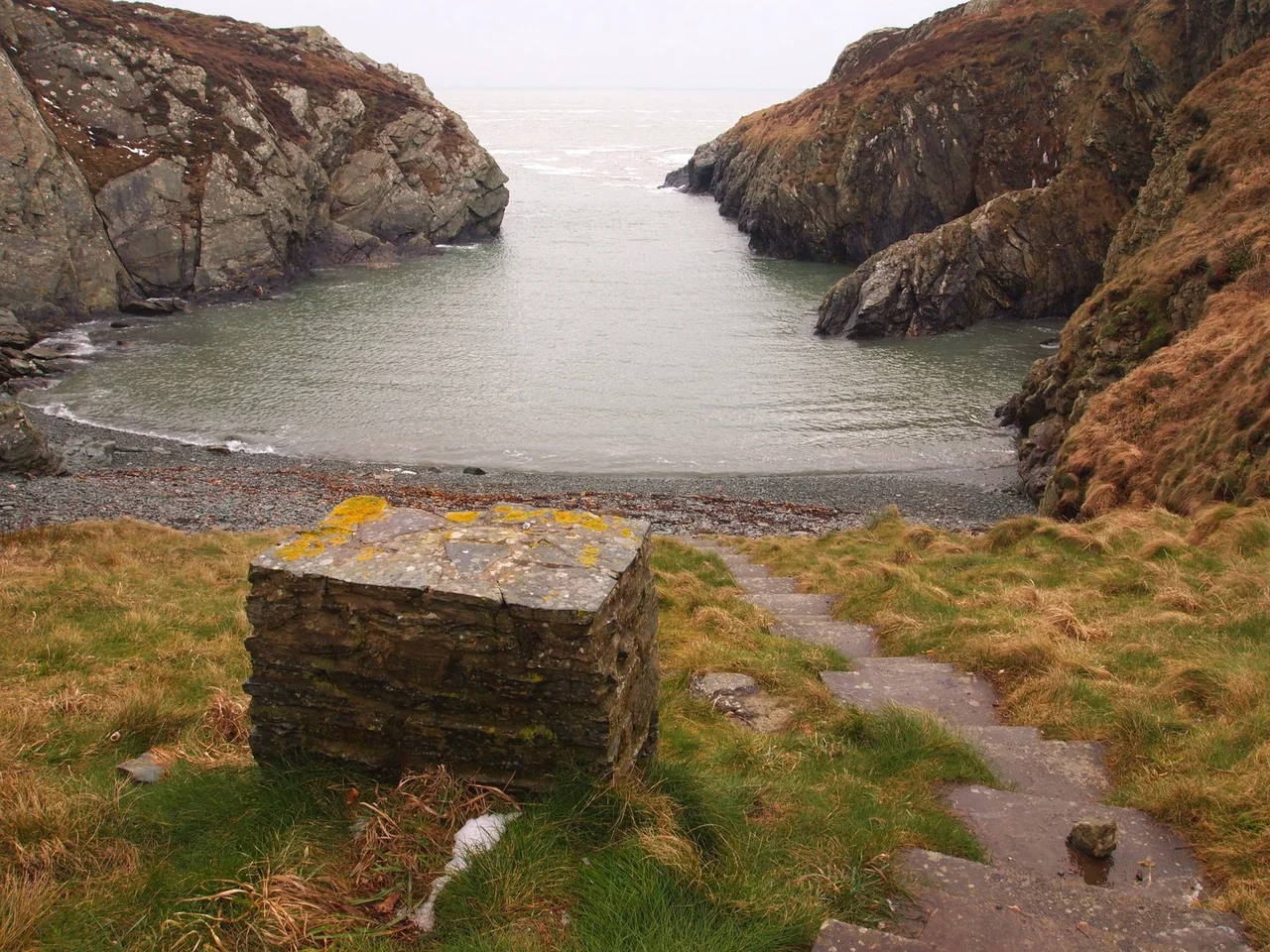

Porth Ruffydd Lifeboat Station
On 17 December 1889, the barque Tenby Castle came apart on the rocks at Penrhos Point in the kind of weather that turned the western cliffs of Holy Island into a graveyard. Eleven of her fourteen crew drowned within sight of land. The Holyhead lifeboat, summoned from the far side of the island, arrived too late; the Holyhead Volunteer Life Brigade, hauling their gear three miles overland from town, could only ferry three men back in a small boat through breaking surf, one trip at a time. Five members of that brigade would eventually receive the RNLI Silver Medal. Three weeks later, the Royal National Lifeboat Institution made a decision in London: never again should rescuers have to travel that far. A new station would be built at the head of the next cove south, at Porth Ruffydd.
A Cove Chosen in Anger
The cost was £1,320 for a boathouse described in the records as the finest on that coast. The lifeboat itself came from a different sort of fund altogether. Mr and Mrs Norbury of Bowdon, near Altrincham, ran a small charitable engine of their own, the Norbury Lifeboat Fund, raising money through collections, sales of work, and amateur theatricals in the parish halls of Cheshire. For Porth Ruffydd they had also received an anonymous gift of £700, which covered most of the bill. Watkins & Co. built the boat to a standard 34-foot pulling-and-sailing self-righting pattern: ten oars, two masts, room for the crew that would mostly be carried down from Holyhead when the rocket went up. On 6 August 1891, Mrs Norbury named her Norbury (ON 297) at a Holyhead ceremony, watched her capsized twice in the inner harbour to prove she would right herself, and the boat sailed for her new station.
Fourteen Launches, No Lives
The first call came on 19 November 1893, to the steamship SS Theresa. The lifeboat was not required. The second, on 12 October 1894, was to a Norwegian vessel called Eugenie, aground on Ramon Rocks; she was helped clear and refloated. So it went, for thirteen years. The Norbury launched fourteen times. She rescued the dignity of one or two refloated cargoes. She never saved a single life. The geography that had made the new station necessary made it almost useless in the same breath. By the time the alarm reached Holyhead and the off-station crew could be brought down to Porth Ruffydd, most casualties in those waters were already past saving. In 1904, after a quiet review of service figures, the RNLI committee closed the station. The Norbury was broken up. Her crew, never permanent residents of the cove, dispersed back to Holyhead.
What the Steps Remember
The boathouse stood empty above the small beach for another ninety-three years. Photographs from the 1920s show it intact, slate-roofed, the slipway still leading down into the kelp. By the 1990s the slates were gone and the walls were going. In 1997 it was demolished. What remains today is the flight of stone steps that once ran from the cliff path down to the boathouse door, ending now at nothing. Walkers on the Anglesey Coastal Path pass them without always knowing what they were for. The cove faces southwest into the prevailing weather; on a winter day the swell still hammers against Penrhos Point exactly as it did in 1889. The station was a monument as much as a rescue post: built in grief, paid for by strangers in Cheshire, manned with the best equipment of the age, and quietly defeated by distance and tide.
From the Air
Porth Ruffydd sits at 53.286N, 4.676W on the southwest coast of Holy Island, about 3 miles southwest of Holyhead Port. Approaching from the Irish Sea, the small cove is just south of Penrhos Point, with South Stack Lighthouse a clearly visible landmark 2.5 nm to the northwest. Nearest airfield is RAF Valley (EGOV) 6 nm to the southeast; Caernarfon (EGCK) lies 18 nm south across the Menai Strait. Best viewed at 1,500–2,500 ft AGL in light winds; the cliffs here generate significant turbulence in any southwesterly above 15 knots.
Nearby Stories
- Snowdon Mountain Railway 8 km away
- German submarine U-1051 8.3 km away
- German submarine U-246 11 km away
- Trwyn Du Lighthouse 13 km away
- Irish Sea Bridge 20 km away
- HMS Manners (K568) 34 km away
- HMS Tyler 47 km away
- Birkdale Palace Hotel 79 km away