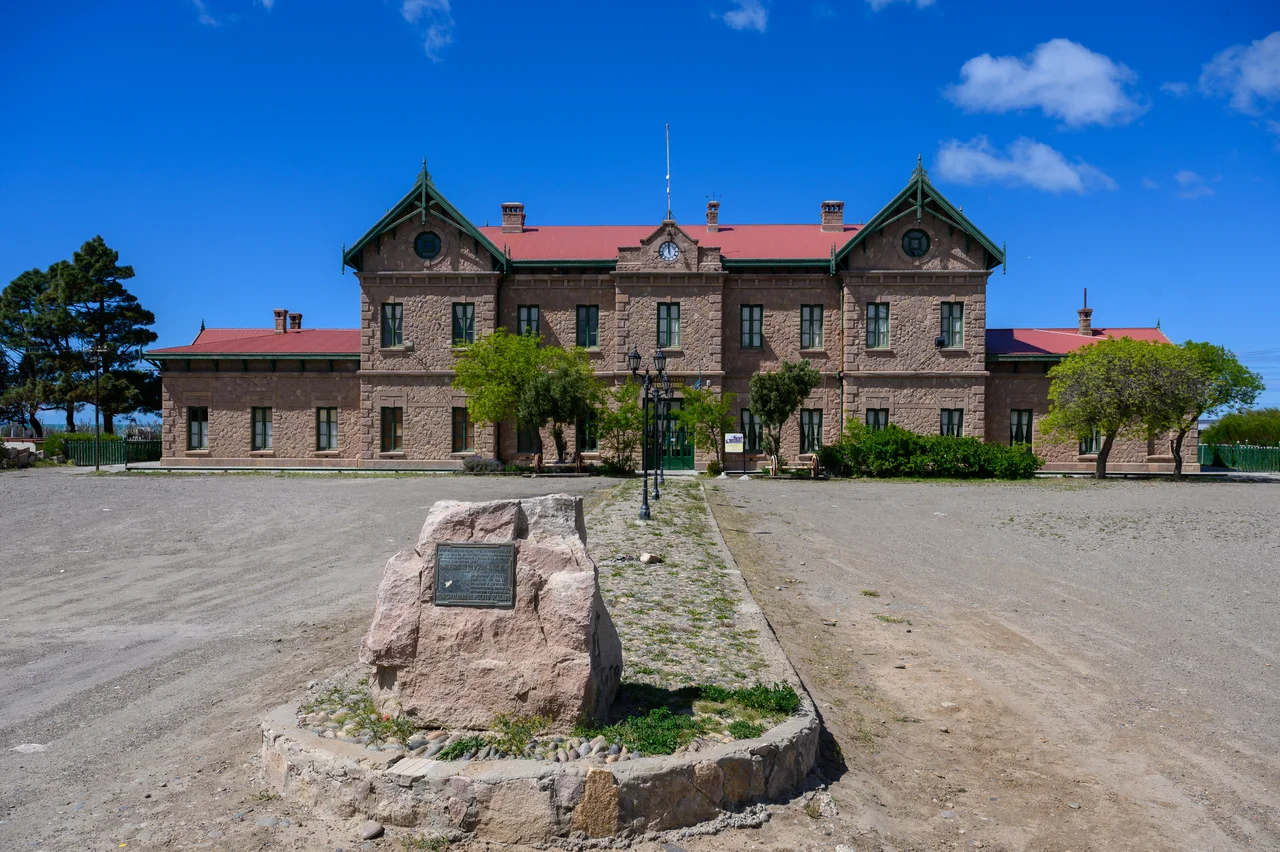

Puerto Deseado
An English pirate gave this town its name, after his own ship. In December 1586, Thomas Cavendish sailed his vessel Desire into the long blue estuary on the Patagonian coast, bound for the Pacific to raid Spanish ports, and called the anchorage Port Desire. The Spanish later turned it into Puerto Deseado, the Desired Port, but the headland at the harbour mouth still carries the privateer's name: Punta Cavendish. Few towns wear their history so plainly in the things they are called.
A River That Is Really the Sea
Puerto Deseado is built along a ria, a river valley drowned by the ocean. The Deseado River no longer reaches the sea as freshwater; instead the Atlantic pushes nearly thirty kilometres inland up its old course, a fjord-like blue channel hemmed by rust-coloured cliffs. The result is one of the strangest meeting points of land and water in Argentina, where marine wildlife crowds close to a working town. Commerson's dolphins, small and boldly patterned in black and white, ride the currents in the estuary's mouth. On islets just offshore, Magellanic and southern rockhopper penguins nest within sight of the fishing fleet, and cormorants wheel above water the colour of slate.
Every Flag in the South Atlantic
Long before the privateers, the estuary had been charted in 1520 by Magellan's circumnavigating expedition, and for three centuries it served as a contested doorway to the southern ocean. The Tehuelche people met the newcomers on these shores; when Cavendish landed, their arrows wounded several of his crew. Spain tried to hold the coast with forts and a doomed fishing colony run by the Real Compañía Marítima, abandoned in 1807 when the soldiers finally marched away. Then, at the time of the Argentine Confederation in 1833, HMS Beagle dropped anchor here, and a young naturalist named Charles Darwin went ashore to walk the Patagonian scrub and puzzle over its fossils. The permanent town came late, founded for good only in 1882.
The Sloop Beneath the Tide
The estuary keeps its dead. In 1770, the British sloop-of-war HMS Swift, based at Port Egmont in the Falklands, ran for shelter from a storm and slipped into the Río Deseado to dry out. Working up the channel, she struck a submerged rock; the crew lightened her and freed her, only for a second uncharted rock to finish the job. She went down on 13 March 1770, and three of her ninety-one men, the cook and two soldiers, drowned. For more than two centuries the Swift lay forgotten in the murky water until 1982, when local divers found the wreck, a discovery that effectively founded underwater archaeology in Argentina. Today her recovered relics fill a seafront museum, raised from the very water that swallowed them.
A Town That Works the Water
Modern Puerto Deseado earns its living from the sea, as it always has. Some 16,747 people live here, and the rhythm of the place is set by the fishing industry: processing plants line the Avenida Costanera, and much of the town works as stevedores, crane operators and fish cleaners, hauling and packing the cold Atlantic's catch. The climate keeps the streets grey and breezy, a cold semi-desert so persistently cloudy and mild that travellers have compared its skies to the British Isles, though a continental edge brings sudden summer heat and hard winter frost. It is a straggly, hardworking port, but it sits in front of one of Patagonia's great wildlife theatres, where the boat tours that thread the ria are as much a part of life as the fishing fleet.
From the Air
Puerto Deseado lies at 47.75°S, 65.92°W on the Atlantic coast of Santa Cruz Province, Argentina, at the mouth of the Deseado estuary. From the air the defining feature is the ria itself: a long, narrow blue inlet driving roughly 30 km inland between reddish cliffs, with the town clustered on its north bank near the harbour mouth. The local airport is Puerto Deseado Airport (ICAO SAWD), just outside town. Comodoro Rivadavia (ICAO SAVC), the nearest major airport, lies about 290 km to the north. Recommended viewing altitude 2,000-4,000 ft AGL to trace the estuary, the offshore penguin islets, and the urban grid. Skies are commonly overcast with strong, steady winds off the South Atlantic.
Nearby Stories
- Bosques Petrificados de Jaramillo National Park 129 km away
- Comodoro Rivadavia Rail Disaster (1953) 153 km away
- Puerto San Julián 174 km away
- Floridablanca (Patagonia) 202 km away
- Comodoro Rivadavia 215 km away
- Disappearance of ARA San Juan 406 km away
- Jason Islands 469 km away
- Pepys Island 488 km away