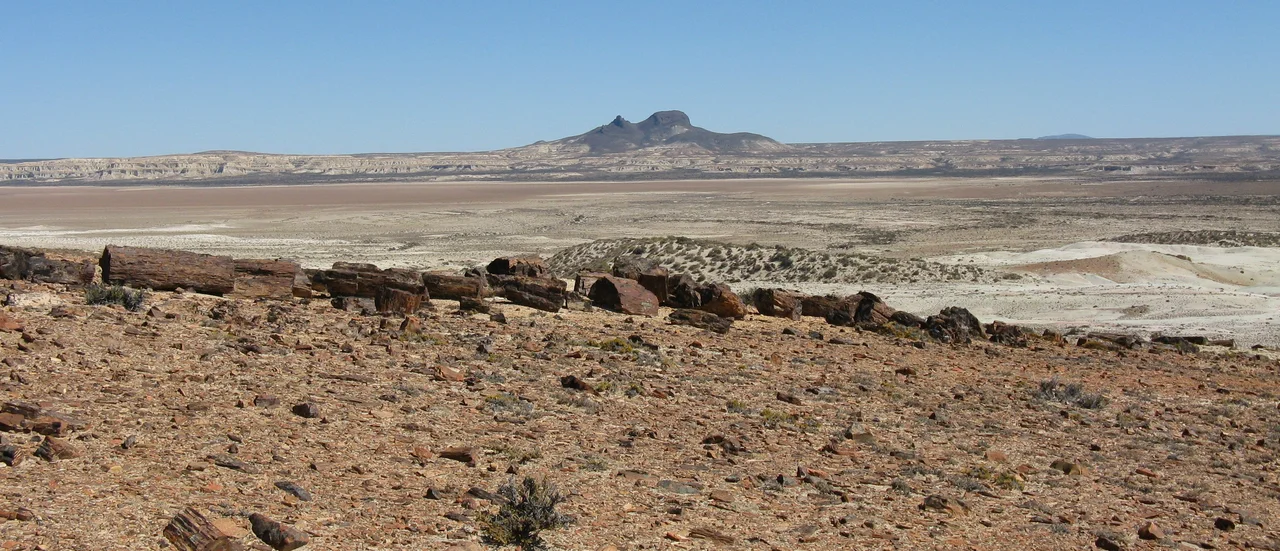

Bosques Petrificados de Jaramillo National Park
Run your hand along one of the fallen trunks and you expect bark. Instead you feel cold stone, polished hard, the growth rings preserved in agate and jasper as cleanly as the day the tree died. There are no living trees for miles here, only low spiny scrub bending in the wind of the Santa Cruz steppe. Yet these trunks are unmistakably trees, some two meters across, some thirty meters long, lying where they fell roughly 150 million years ago. The Jaramillo Petrified Forest holds the remains of one of the planet's great lost woodlands, frozen mid-collapse and waiting on the open plain for anyone willing to make the drive.
A Forest Before the Mountains
To understand this place, subtract the Andes. In the late Jurassic, the mountain wall that now blocks Patagonia's rain had not yet risen. Moist air rolled in freely from the Pacific, and Santa Cruz was warm, wet, and dense with forest. Towering conifers grew here, chief among them Araucaria mirabilis, an ancient cousin of the monkey-puzzle trees that still survive in Chile and Argentina today. Some of these giants reached 100 meters tall and 3.5 meters thick. Then the Andes began to lift, the volcanoes woke, and ash buried the forest where it stood. The same uprising that killed these trees created the rain shadow that keeps their graveyard a desert. The park exists as direct evidence that this corner of Patagonia was once a far greener world.
How Wood Becomes Stone
Petrifaction is a slow act of substitution. Volcanic ash sealed the trunks away from the oxygen that would have rotted them. Mineral-rich groundwater seeped in, and molecule by molecule, silica replaced the woody tissue while keeping its structure intact. What remains is not wood and not quite ordinary rock, but a faithful stone copy of a tree, growth rings and all. The fossilized cones scattered nearby came from the same Araucaria forest, which is part of why this site has drawn researchers since the trunks were first documented in 1925. The trees did not have to be dug out of a cliff or quarried from bedrock; many lie loose on the surface, exposed by a hundred million years of wind stripping the soft steppe soil away from the stone. Among the best reserves of petrified trees anywhere on Earth, Jaramillo lets you read deep time at eye level, no excavation required.
Life on the Steppe Today
The living landscape could hardly contrast more sharply with the one entombed beneath it. This is Patagonian steppe: cold, arid, and relentlessly windy, with barely 200 millimeters of rain a year and temperature swings from summer highs near 40 degrees Celsius to hard winter frosts. Vegetation hugs the ground as low, thorny shrub, built to survive drought and gale. Yet the plain is far from empty. Guanacos pick their way across the scrub, the flightless lesser rhea darts between bushes, and the rust-colored culpeo fox hunts the open ground alongside the smaller South American gray fox and the burrowing dwarf armadillo. Watching a guanaco step among petrified trunks older than the dinosaurs' last act, you feel the strange double exposure of this place: two worlds, 150 million years apart, sharing the same patch of earth.
Protecting the Deep Past
Argentina first guarded the trunks in 1954, designating roughly 13,700 hectares as the Petrified Forest Natural Monument. That status held for decades until the National Parks Administration acquired adjacent land and, in December 2012, reclassified the expanded area as a full national park covering 78,543 hectares. The upgrade matters because petrified wood is endlessly tempting to pocket, and a fossil forest can be carried off one fragment at a time. Protection keeps the trunks where they belong, lying in the open as they have for ages, so visitors can stand among them and grasp something almost impossible to hold in the mind: a forest that lived, died, and turned to stone an unfathomable span before any human walked the steppe.
From the Air
Bosques Petrificados de Jaramillo sits in northeastern Santa Cruz Province at roughly 47.67 degrees south, 68.17 degrees west, deep in the Patagonian steppe well inland from the Atlantic coast. From the air the park reads as flat, tawny scrubland broken by low mesas and dry watercourses, with no forest to mark it. The nearest sizable airport is General Enrique Mosconi International Airport (SAVC) at Comodoro Rivadavia, about 220 kilometers north; Perito Moreno Airport (SAWP) lies to the west. Best viewed from 3,000 to 6,000 feet AGL in the typically clear, dry air, though watch for strong, gusty westerly winds and sparse surface landmarks for navigation.
Nearby Stories
- Comodoro Rivadavia Rail Disaster (1953) 112 km away
- Puerto Deseado 118 km away
- Floridablanca (Patagonia) 144 km away
- Cueva de las Manos 163 km away
- Lake Colhué Huapi 248 km away
- Monte León National Park 255 km away
- Potosi (barque) 264 km away
- Jason Islands 583 km away