.jpg)
Jason Islands
On the morning of 24 January 1600, a Flemish sea captain named Sebald de Weert, beaten back toward the Strait of Magellan by storms on his way home to the Netherlands, sighted three small islets that appeared on none of his charts. He tried to land and could not; the sea would not let him. He marked them down anyway, and for nearly two centuries the whole Falkland archipelago was known to Europe as the Sebald Islands. Those three specks were the Jason Islands, flung out to the far north-west of West Falkland, and they remain among the wildest places in the South Atlantic.
Sharply Rising Peaks
The Jasons are a string of islands and islets with names like Steeple, Grand, Elephant and Flat, most of them ringed by cliffs and carpeted in dense tussac grass that grows head-high. Steeple Jason is cinched in the middle by a narrow neck of land that splits it into two steep-sided halves. Grand Jason, the largest, rises to high plateaux cut by gullies; Elephant Jason runs along a ridge more than 200 metres tall. The conservationist Ian Strange, who knew this archipelago as well as anyone, wrote that the Jasons' "sharply rising peaks give them a grandeur found in few other areas" of the Falklands. Standing offshore in a swell, it is easy to see what he meant.
The Greatest Albatross City on Earth
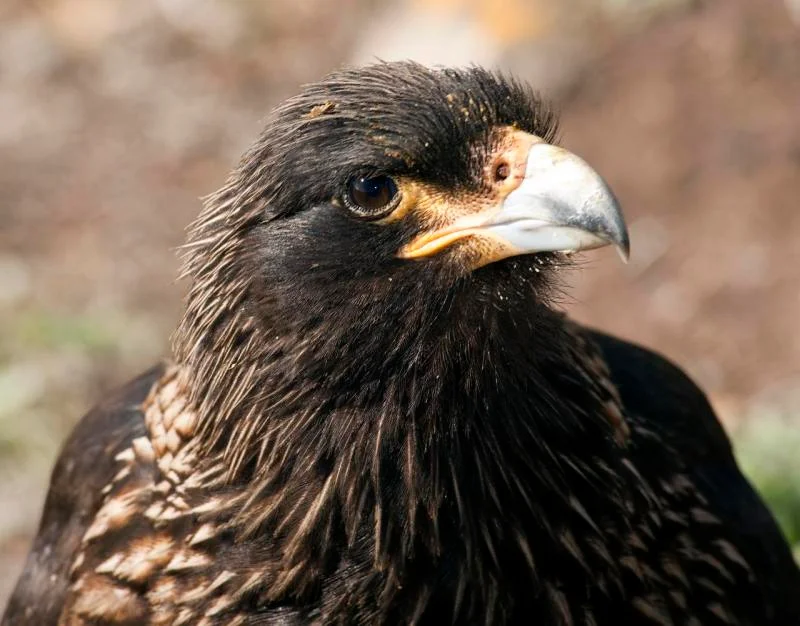
Steeple Jason holds a record that staggers anyone who witnesses it: the largest colony of black-browed albatrosses in the world, a living city of birds packed into a band that runs for miles along the shore. Surveys have counted well over a hundred thousand breeding pairs, the nests so close together that the slope looks frosted with white. The wider Jason group is a globally recognised Important Bird Area, home as well to roughly 140,000 pairs of southern rockhopper penguins, thousands of gentoos, southern giant petrels, and the striated caracara, a bold and inquisitive bird of prey that the islanders nicknamed the "Johnny rook." Striated caracaras are among the rarest raptors on the planet, and here they thrive.
A Kingdom of One Man's Making
The slaughter came first. Between 1864 and 1866, roughly two million rockhopper and gentoo penguins were killed on the Jasons and boiled down for their oil. A century later the islands found an unlikely champion. In March 1970 they were bought by Len Hill, an Englishman who ran a bird sanctuary called Birdland in the Cotswold village of Bourton-on-the-Water. Offered the islands for ten thousand pounds, Hill talked the price down to five and a half thousand on the condition that the sheep be removed. To fund the conservation work, he printed his own Jason Islands stamps and, later, his own banknotes, signed "Len Hill, Administrator" and valid until the end of 1979. Collectors prize them still.
Given Back to the Wild
In the 1990s the New York philanthropist Michael Steinhardt bought Steeple Jason and Grand Jason and gave them to the Wildlife Conservation Society, the body that runs the Bronx Zoo, along with the money to build a research station named for himself and his wife Judy. The Steinhardt field station, completed in 2003, lets scientists live on Steeple Jason for stretches at a time, monitoring the seabirds. No one lives here permanently. In the 1920s a single Falkland Islands policeman was stationed on the group to deter foreign seal poachers, and shepherds once grazed sheep until overgrazing scarred the land. Today the sheep are gone, the islands are run as nature reserves, and apart from mice on Steeple Jason, they remain free of the introduced predators that have devastated wildlife elsewhere.
From the Air
The Jason Islands lie at roughly 51.08 degrees south, 60.97 degrees west, strung out to the far north-west of West Falkland and surrounded by open ocean. They make a striking visual waypoint: a chain of cliff-edged islands with the distinctive saddle-backed profile of Steeple Jason at the western end and the high ridge of Elephant Jason nearby. There is no airstrip and no harbour; the islands are reached only by boat or, for researchers, by chartered light aircraft and small craft. The nearest fixed-wing airfields are on West and East Falkland: Port Stanley Airport (ICAO SFAL) and RAF Mount Pleasant (ICAO EGYP), both well to the south-east. Seas here are exposed and frequently rough, and the wind rarely rests. Best viewing is in the austral summer, October through March, when seabird colonies are at their peak; fly low and slow along Steeple Jason's shoreline to see the albatross colony stretch into the distance.
Nearby Stories
- Saunders Island 20 km away
- Capture of Port Egmont 43 km away
- New Island 49 km away
- Isla de los Estados 425 km away
- Pepys Island 436 km away
- Disappearance of ARA San Juan 457 km away
- Puerto Deseado 465 km away
- Sinking of ARA General Belgrano 482 km away