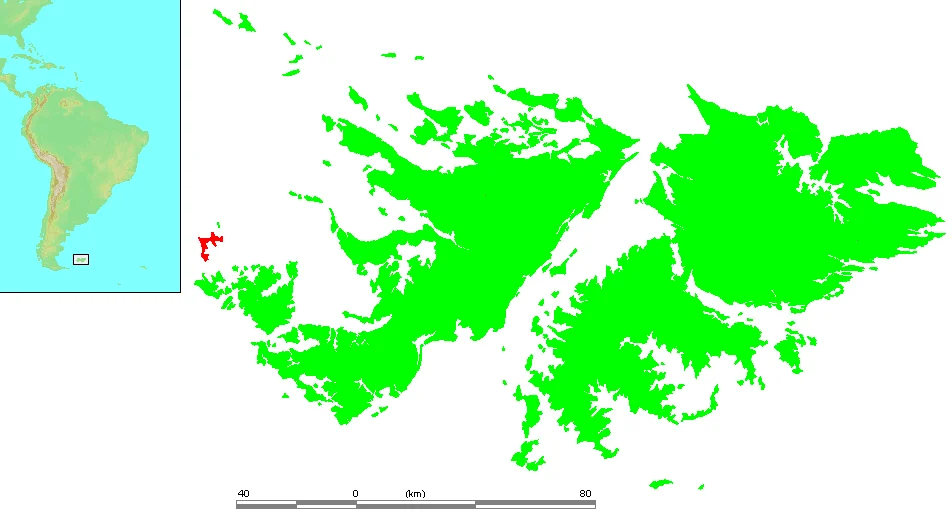

New Island
In 1813 the American sealing captain Charles Barnard sailed in to help survivors of a British shipwreck, and the people he rescued repaid him by stealing his ship and abandoning him here. For over a year Barnard lived on New Island with a few companions, a dog, and an open boat, hunting birds and seals to stay alive until British whalers finally carried him off in 1814. The rough stone shelter his party built still stands, folded into the oldest surviving building in the Falklands. That is the kind of place New Island is: small, remote, and bound up with people who came a very long way and then could not leave.
The Cliff and the Settlement
New Island lies in the far west of the Falkland archipelago, nearly 150 miles from the capital at Stanley. Most who come arrive by cruise ship, but only the smaller vessels are allowed in, and only for a few hours. From the tiny settlement on the eastern shore, an easy half-mile trail leads to the island's signature spectacle: a colony of southern rockhopper penguins and black-browed albatrosses crowded onto the cliffs of the western coast. The two species nest almost shoulder to shoulder, the penguins bouncing up rock faces on stubby legs while the albatrosses, wings spanning more than two metres, ride the updraughts off the sea. King cormorants pack the ledges between them.
A Reserve, Whole at Last
For decades New Island was split in two. New Island South was run as a nature reserve; New Island North was held separately by the writer and photographer Tony Chater. In July 2006 the reserve's trust acquired the northern half as well, and for the first time the entire island was managed as a single sanctuary. The Falklands conservationist Ian Strange, an artist and author who had spent a lifetime studying these waters, helped shape the reserve and has long been associated with its care. The protection shows. New Island carries colonies counted in the tens of thousands of pairs, and its scientists track how albatross, rockhopper and prion populations rise and fall year to year.
Where the Wildlife Is Tame
On the gentler eastern slopes, Magellanic and gentoo penguins share white-sand beaches that run down into clear turquoise water. Peale's porpoises sometimes follow boats right into the shallows, nosing up to knee-deep water to inspect visitors. Falkland fur seals and southern sea lions haul out along the shore. In the summer months whales pass on migration, minke and sei and fin, and the great southern right whales among them. Because so few people ever set foot here, the animals have never learned that humans are something to flee, and a walker can sit within arm's reach of a nesting bird without disturbing it.
After Dark
The real show begins once the light fails. Thousands of thin-billed prions, small grey seabirds that spend their days far out at sea, come streaming back to their burrows under cover of darkness, filling the air with a babble of calls as each one searches for its mate among the tussac. Overhead, the sky does something most of the world has forgotten how to see. With no light pollution for hundreds of miles and air scrubbed clean by the South Atlantic, New Island offers some of the clearest stargazing anywhere, the Milky Way arched bright from horizon to horizon over an island that holds barely a handful of people.
From the Air
New Island sits at roughly 51.72 degrees south, 61.30 degrees west, at the far western edge of the Falklands archipelago, surrounded by open South Atlantic water. The defining visual landmark is its western coastline, where sea cliffs plunge a sheer 600 feet to the ocean; the low-lying eastern shore shows pale sand beaches by contrast. There is no commercial airport on the island itself; access is by the inter-island air service from Stanley, flown in eight-seat Britten-Norman Islander aircraft to a grass strip. The nearest hard-runway airfields are Port Stanley Airport (ICAO SFAL) about 150 miles east and RAF Mount Pleasant (ICAO EGYP) to the south-east on East Falkland. Weather is changeable and wind near-constant; clear, calm windows are best in the austral summer, October through March. Recommended viewing altitude is low and slow over the western cliffs to take in the seabird colonies and the contrast between the two coasts.
Nearby Stories
- Saunders Island 48 km away
- Jason Islands 54 km away
- Wildlife of the Falkland Islands 55 km away
- Sea Lion Island 127 km away
- HMS Sheffield (D80) 320 km away
- Isla de los Estados 344 km away
- Río Grande (Argentina) 451 km away
- Puerto San Julián 481 km away