.jpg)
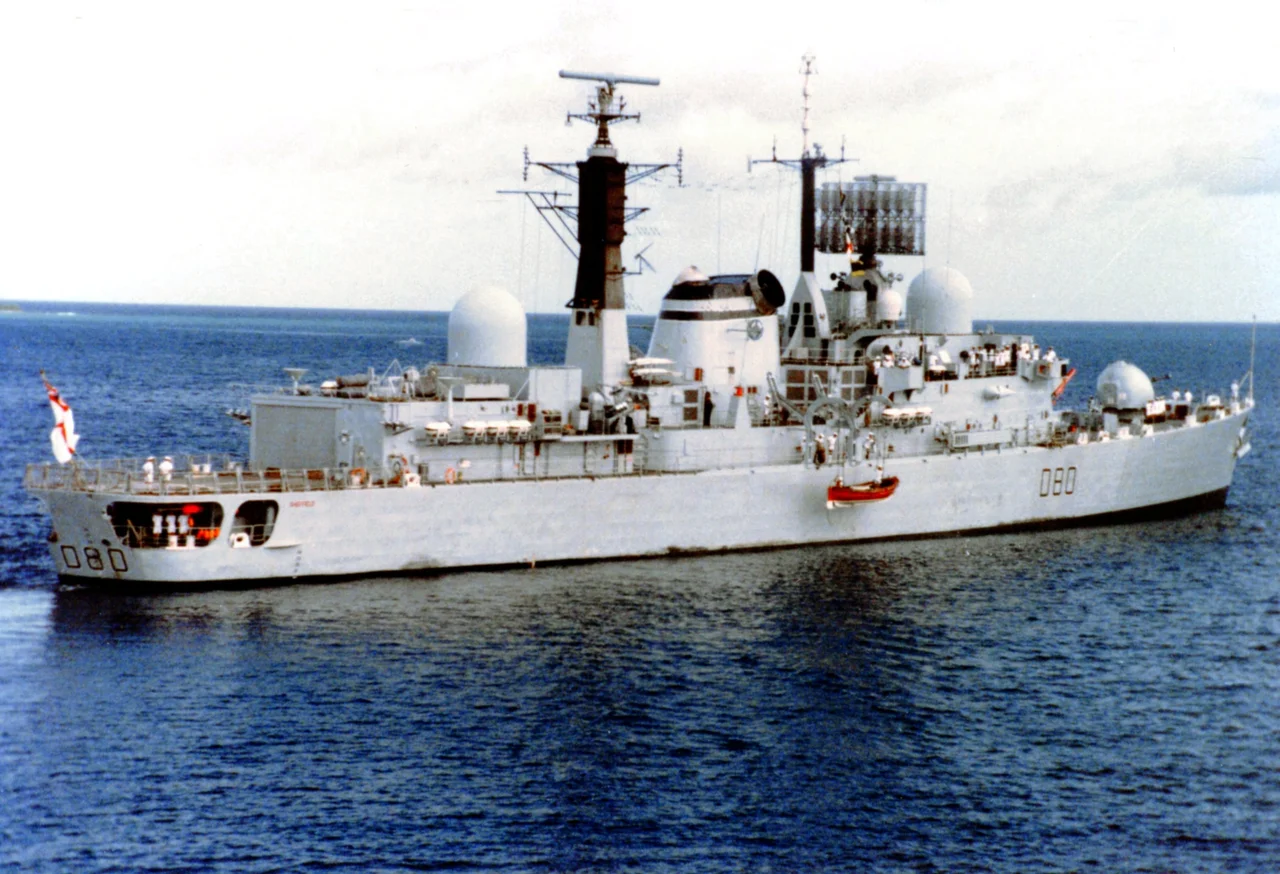
HMS Sheffield (D80)
The watchword that morning was Handbrake. It was the codeword the British task force used for an inbound Exocet, and at 11:04 on 4 May 1982, two of those missiles were already in the air, skimming the grey Atlantic at the speed of a rifle bullet. HMS Sheffield never saw them coming. Her long-range radar could not pick out aircraft hugging the wave tops, and in the seconds that mattered her operations room hesitated, half-convinced the threat was overrated. One missile missed. The other struck her starboard side and tore a hole the size of a doorway in her hull. Twenty men died, and within days the destroyer that had cost the Crown over twenty-three million pounds lay on the seabed. She was the first Royal Navy ship sunk in combat since 1945.
First of a New Breed
Sheffield was the prototype of the Type 42 destroyer, a sleek and modern warship built to throw a protective umbrella of Sea Dart missiles over the fleet. Commissioned in February 1975, she carried the odd silhouette of her class: paired exhaust deflectors on her funnel, nicknamed Mickey Mouse ears, fitted only to her and two near-sisters that were sold to Argentina. That detail would carry a bitter irony. The same Argentine Navy that bought ships of Sheffield's bloodline now studied her radar signature, her detection ranges, her reaction times. When war came in the South Atlantic, Argentine pilots had effectively been rehearsing against Sheffield's twin all along.
Pecking the Lobes
The men who killed Sheffield were not reckless. Two Argentine Navy Super Etendards, flown by Lieutenant Commander Augusto Bedacarratz and Lieutenant Armando Mayora, lifted off from Rio Grande and refuelled in the air before sliding down to thirty metres above the sea. They used a patient technique the crews called pecking the lobes, probing the fringes of British radar while staying out of its main beam. A Neptune patrol plane fed them the targets. The pilots climbed for a few seconds, locked their coordinates, dropped low again, and launched. It was a cold, methodical piece of flying, and these airmen flew home knowing they had done what no one had managed in nearly four decades: sink a modern warship of a major navy.
A Ship Consumed
The Exocet punched through the junior ratings' galley area and breached an engine-room bulkhead just above the waterline. Many accounts hold that the warhead did not even explode, yet it hardly needed to. The impact knocked out the ship's electrical power and ruptured the pressurised fire main, so that when flames took hold there was no water to fight them. The twenty who died were mostly working in the galley and the computer room, in the part of the ship the missile gutted. For six days Sheffield drifted while crews tried to save her, then she foundered under tow on 10 May. Only one body was ever recovered. The fires taught the Royal Navy a grim lesson about the nylon clothing its sailors wore, which melted onto burned skin, and the service changed its uniforms because of what happened here.
The Reckoning
A Board of Inquiry convened within weeks and did not flinch. It found that Sheffield had failed to react to Glasgow's clear warning, never went to action stations, never fired her Sea Dart, never launched chaff. The anti-air warfare officer, it emerged, was not even in the operations room when the missiles came, and did not believe his ship lay within Argentine range. When a fuller version of the report surfaced in 2017, it revealed findings of negligence that two officers had quietly escaped, the disciplinary case apparently set aside so as not to dampen the national mood at the war's victorious end. The honesty of that later document is its own kind of memorial: a refusal to let twenty deaths be smoothed over for the sake of a triumphant story.
From the Air
The wreck lies in the South Atlantic at roughly 53.07 degrees south, 56.93 degrees west, more than 200 kilometres east-southeast of the Falkland Islands and well out into open ocean, far from any landmass. The site is a protected war grave under the Protection of Military Remains Act, and there is nothing to see on the surface. The nearest aviation facilities are on the Falklands themselves: RAF Mount Pleasant (ICAO: EGYP / SFAL) and the older Port Stanley Airport (ICAO: SFAL / EGYP region). Expect the classic South Atlantic picture at altitude, frequent low cloud, strong westerly winds, and rapidly shifting visibility over a cold, empty sea.
Nearby Stories
- Lady Elizabeth (1879) 121 km away
- Sea Lion Island 135 km away
- Yorke Bay 137 km away
- Sinking of ARA General Belgrano 363 km away
- Isla de los Estados 516 km away
- South Georgia Island 1289 km away
- Grytviken 1305 km away
- Isla de Lobos 1972 km away