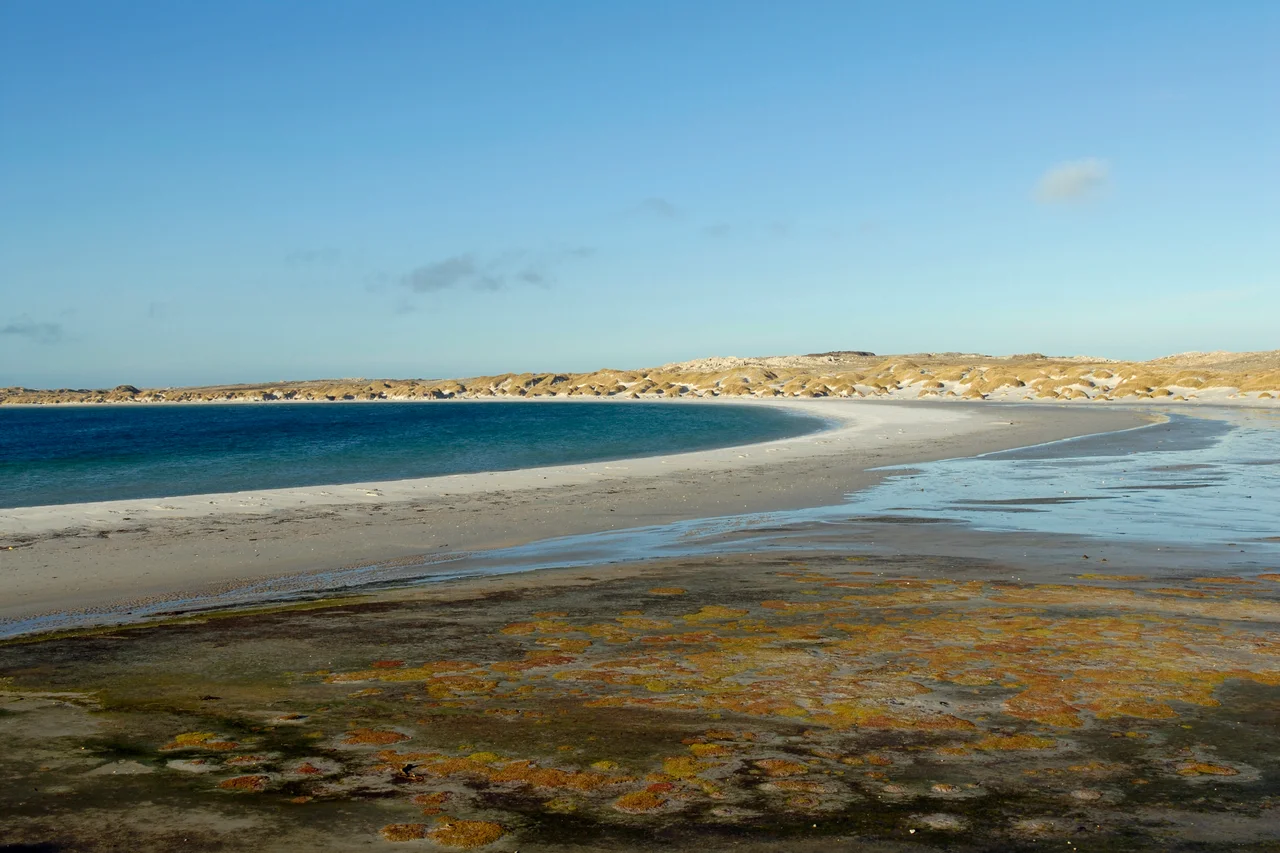

Yorke Bay
For nearly four decades, the safest creatures on this windblown crescent of sand weighed less than a bag of sugar. Yorke Bay had been sown with hundreds of landmines during the 1982 war, and the fences went up, and the people stayed away. But the Magellanic penguins kept coming ashore, waddling over buried anti-tank charges built to stop a tank, far too light to trip them. The mines meant to keep an army out had instead fenced a wildlife refuge in.
A Beach Built for an Invasion That Never Came
Geography made Yorke Bay dangerous. It sits just 800 meters north of Stanley's airport and a few kilometers from the Falklands capital, one of only three nearby beaches gentle enough to land troops on. So in 1982, occupying Argentine forces packed the sand with anti-personnel and anti-tank mines, most of them minimum-metal designs that detectors struggle to find. The expected amphibious assault never came here; British forces took Stanley overland from the west instead. The mines stayed. Before the war this had been the town's swimming beach, a place for summer picnics within sight of home. Afterward it became forbidden ground, marked off and left to the wind. In 1986 a tractor and bulldozer laying a pipeline were destroyed by an anti-tank mine, and the fences became permanent.
The Penguins That Would Not Explode
Nature is rarely sentimental, but it is opportunistic. Shut out of the dunes, people stopped trampling the grass, stopped disturbing the burrows, stopped harvesting the eggs. The Magellanic penguins, which nest in tunnels dug into the soft ground, found themselves with a private beach guarded by the deadliest fence imaginable. They thrived. Gentoo penguins joined them. A BBC headline summed up the absurd grace of it: "The Falklands penguins that would not explode." The birds, a few kilograms at most, simply never weighed enough to detonate the charges. For tourists arriving by cruise ship, it produced an extraordinary spectacle: penguins safe on a beach no human could set foot on, viewed only from a careful distance across the wire.
The Argument for Leaving Well Enough Alone
For years, the experts argued the bay should stay sealed forever. A Cranfield University assessment found the sand dunes had crept and grown since 1982, in places swallowing the mines under as much as fifteen meters of sand, scrambling the neat rows in which they were laid and burying them beyond the reach of detection gear. Worse, a single big storm could heave them back to the surface without warning. Clearing them all would mean excavating the entire beach with armored machinery, a job that was expensive, perilous, and certain to wreck the internationally important penguin rookeries. Even Falklands Governor Howard Pearce warned against it, arguing that recovering "only 95 percent" of the mines would breed a false confidence more dangerous than the fences themselves.
Reclaiming the Beach
In the end, an international promise won out. Under the Anti-Personnel Mine Ban Convention, the United Kingdom committed to clearing every mine from the islands, and from 2009 the slow, methodical work crept toward Yorke Bay, the hardest field of all. Deminers stripped away the towering dunes and sifted the sand through screens fine enough that no mine could pass undetected, scheduling the heaviest work for winter so the breeding penguins would be undisturbed. On 14 November 2020, the Falkland Islands were declared free of landmines, and islanders were invited at last to "reclaim the beach" their grandparents had swum from. The wire came down. The penguins, of course, never left.
From the Air
Yorke Bay lies at 51.68°S, 57.80°W on the north coast of East Falkland, facing into Port William. From the air it reads as a pale sand crescent immediately north of Mount Pleasant's smaller neighbor, Port Stanley Airport (ICAO SFAL), roughly 800 meters to the south. Stanley, the capital, sits about 6 km southwest. The principal regional gateway is RAF Mount Pleasant (ICAO EGYP), some 50 km to the west-southwest. Recommended viewing altitude 1,500-3,000 ft AGL for the bay, dunes, and Gypsy Cove on the western side. Expect strong, persistent westerly winds and rapidly shifting maritime visibility; clear-weather windows reveal the dune fields and the penguin beaches below.
Nearby Stories
- Argentine Military Cemetery 46 km away
- Sea Lion Island 81 km away
- Pebble Island raid 87 km away
- HMS Coventry (D118) 134 km away
- HMS Sheffield (D80) 137 km away
- Sinking of ARA General Belgrano 463 km away
- South Georgia Island 1411 km away
- Villa Gesell 1565 km away