
Pebble Island raid
The plan was as old as the regiment itself: slip in by night, blow up the enemy's aircraft where they sat, and vanish before sunrise. Forty years earlier the newly formed SAS had perfected exactly this trick against German planes in the North African desert, and on the night of 14 May 1982 their successors revived it on a windswept scrap of the Falklands. Pebble Island is a small place, barely four miles across at its widest and forty square miles in all, lying off the north coast of West Falkland. The Argentines had turned its grass airstrip into a forward base, and the reconnaissance aircraft flying from it threatened to expose the British landings being planned just to the east. Forty-five men of D Squadron, 22 SAS, were sent to make the problem disappear.
A Shrinking Window
It almost did not happen on the scale intended. Eight men of the Boat Troop had paddled ashore by folding canoe on 10 May to scout the airfield, and they brought back unwelcome news: fierce headwinds would stretch the helicopter flight from HMS Hermes and shrink the time on target from a planned ninety minutes to perhaps thirty. With the clock that tight, the raiders made a hard choice. The aircraft came first. The radar, the ground crews, the garrison, all of it became secondary to the single objective of destroying the planes before the night ran out. Each man would carry at least two mortar bombs ashore on top of his own weapons, more than a hundred bombs hauled in by hand for the diversion.
Charges in the Cockpits
Three Sea King helicopters set the squadron down six kilometres from the strip, and the Mountain Troop crept in toward the parked aircraft. They passed within sight of an Argentine sentry without being spotted and went methodically to work. The method was brutally simple: smash the cockpit glass, drop in a thermite grenade wrapped in plastic explosive with a short fuse, and move to the next aircraft. Where charges were not used, rifles and rockets did the job, shooting away undercarriages and raking fuselages. As the planes began to burn, the County-class destroyer HMS Glamorgan opened up from offshore with her 4.5-inch guns, walking high-explosive shells across the Argentine positions and setting the ammunition dump and fuel stores alight.
The Mine in the Dark
The defenders barely fought back. By the Argentine account, the marines stayed in their shelters through Glamorgan's bombardment, unable to tell a commando raid from a full invasion and reluctant to come out into the shellfire. Only as the SAS regrouped to leave did the single serious casualty occur, and it came not from a firefight but from the ground itself. The Argentine garrison had buried charges under the airstrip to deny it to any attacker, and when they triggered one, the blast flung shrapnel that wounded a British soldier. He was hauled back to the pickup point by his comrades, and the raiders reached the helicopters with time to spare, lifting away before the sky began to lighten.
Eleven Aircraft and a Lost Friend
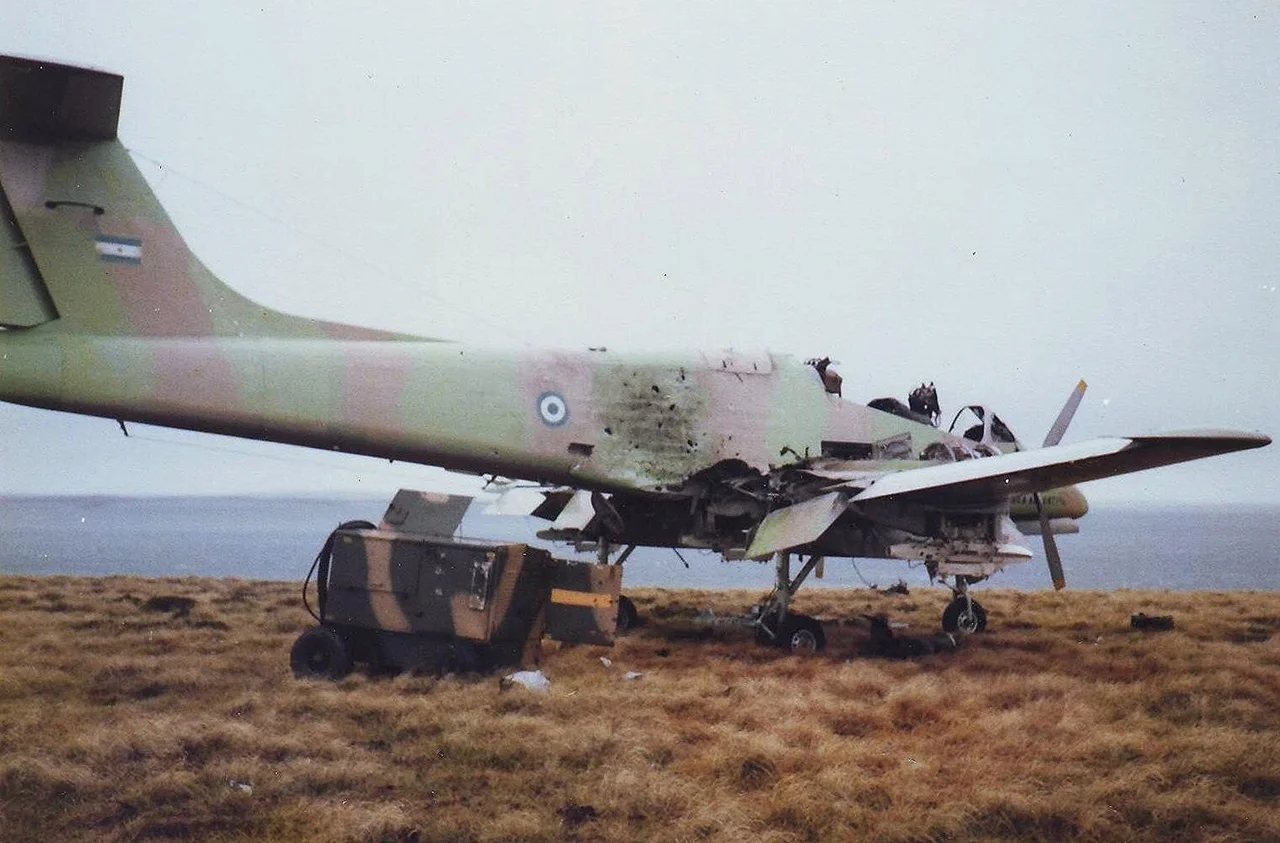
By dawn, eleven Argentine aircraft lay wrecked on Pebble Island: six Pucara ground-attack planes, four Turbo Mentor trainers pressed into the light-attack role, and a single Skyvan transport, along with the shattered ammunition and fuel dumps. Not one British life had been lost in the action, and the raid entered SAS legend as a near-perfect echo of its wartime ancestry. Yet the war was not finished with the men who carried it out. Captain Gavin Hamilton, who led the assault on the stores that night, was killed less than a month later, on 10 June, fighting near Port Howard while directing fire over a far larger Argentine garrison. The Argentine troops on Pebble Island held their ruined base until the war's later stages, the last of them lifted off by Navy Sea Kings on 1 June.
From the Air
Pebble Island sits at roughly 51.31 degrees south, 59.61 degrees west, a long, narrow island hugging the north coast of West Falkland and separated from it by a shallow sound. From the air it makes a clear coastal waypoint, low and elongated, with the old wartime airstrip on its eastern half. The nearest major airfield is RAF Mount Pleasant (ICAO: SFAL) on East Falkland to the southeast; the island retains a small grass strip of its own. Expect the persistent strong winds that nearly cancelled the 1982 raid, frequent low cloud, and quick swings in visibility over open, treeless terrain.
Nearby Stories
- Wildlife of the Falkland Islands 2.1 km away
- Saunders Island 12 km away
- Falkland Islands sovereignty dispute 19 km away
- Falklands War 28 km away
- Argentine Military Cemetery 62 km away
- Pepys Island 442 km away
- Disappearance of ARA San Juan 472 km away
- Puerto Deseado 582 km away