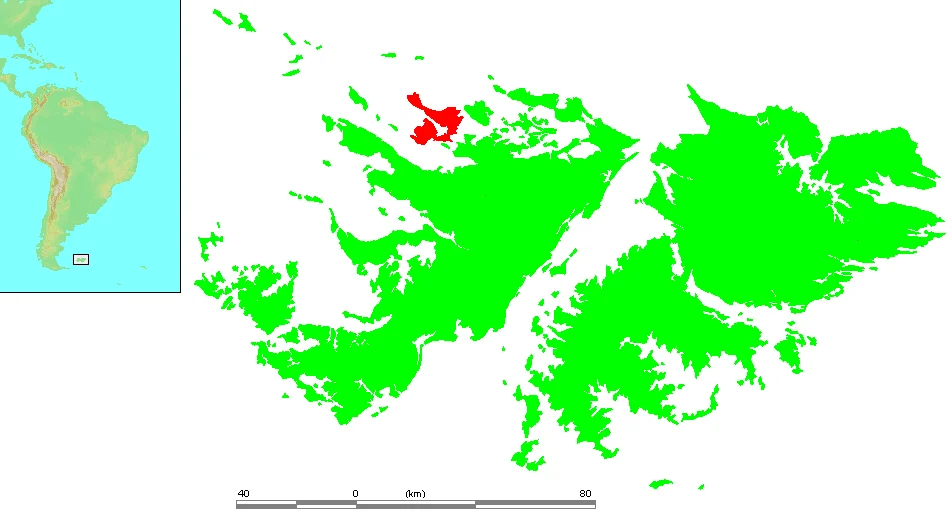

Saunders Island
Four people live on Saunders Island in winter. In summer the number rises to five. That is the entire human population of an island that holds tens of thousands of seabirds and once held the first British settlement anywhere in the Falklands. The arithmetic of the place tells you almost everything: a vast, wind-raked landscape, a single family running sheep across it, and a wildlife spectacle at the western end so concentrated that cruise ships now reroute themselves to spend an afternoon there.
The Neck
The wildlife gathers at a place simply called "The Neck," a low isthmus of sand and grass at the western end of the island where the wind funnels and the animals throng. Here a huge colony of black-browed albatrosses nests within sight of rockhopper and gentoo penguins, with Magellanic penguins burrowed into the slopes and the occasional regal king penguin standing among them. Imperial cormorants line the rocks, elephant seals sprawl on the beaches, and black-necked swans drift in the shallows. A Land Rover trip across the farm carries visitors out to it. For a half day at The Neck, an island of five people becomes one of the densest concentrations of life in the South Atlantic.
Where Britain Began Here
In January 1765 Commodore John Byron, grandfather of the poet, sailed his squadron into a bay on the coast of Saunders Island and named it Port Egmont, after the First Lord of the Admiralty. He claimed the harbour, and indeed all the surrounding islands, for King George III, unaware that France had quietly planted a colony elsewhere in the archipelago the year before. The next year Captain John MacBride built a permanent garrison at Port Egmont. It was the first British settlement in the Falklands, and the foothold from which two and a half centuries of disputed, deeply held British presence would grow. The remains of that settlement still lie on Saunders today.
The Flag That Would Not Stay Down
Port Egmont did not stay British for long the first time. In June 1770 a Spanish fleet of five ships and 1,400 soldiers forced the small garrison here to surrender, a bloodless humiliation that nearly pitched Britain, Spain and France into open war before Spain backed down and handed the settlement back. The British abandoned it again in 1774 to save money, leaving only a flag and a plaque insisting the islands were still theirs. That stubborn claim never quite died. It was reasserted, disputed and fought over for generations, and the ruins of those first stone buildings on Saunders remain the physical root of one of the most enduring sovereignty quarrels in the modern world.
A Farm at the End of the World
Today Saunders is, first and last, a working sheep farm, run by the Pole-Evans family from the single settlement on the eastern shore. Everything here is self-catering; visitors buy eggs and bread at the settlement and cook for themselves in simple lodgings, some of them set out near the wildlife so guests can wake among the penguins. There is Wi-Fi in the settlement and a well-kept grass airstrip a short drive away, served by the islands' small Islander aircraft. Tourists are welcomed only between mid-September and the end of April, the austral spring and summer, when the colonies are full and the weather, by Falklands standards, is at its kindest.
From the Air
Saunders Island lies at roughly 51.34 degrees south, 60.18 degrees west, off the north coast of West Falkland and surrounded by water. Its most distinctive landmark from the air is The Neck, the narrow sand isthmus at the western end where the seabird and penguin colonies cluster; the lone settlement sits on the eastern shore. The island is reached by the inter-island air service flying eight-seat Britten-Norman Islander aircraft into a maintained grass strip, or by ship. The nearest hard-runway airfields are Port Stanley Airport (ICAO SFAL) and RAF Mount Pleasant (ICAO EGYP), both to the south-east on East Falkland. Wind is near-constant and weather changeable; the visiting season runs mid-September through April. For wildlife, fly low and slow over The Neck rather than the grazed interior.
Nearby Stories
- HMS Coventry (D118) 11 km away
- Jason Islands 13 km away
- Pebble Island raid 16 km away
- New Island 33 km away
- Falklands War 89 km away
- Isla de los Estados 439 km away
- Pepys Island 471 km away