
Falklands War
It began with scrap metal. In March 1982, a party of Argentine workers landed on remote South Georgia under contract to dismantle an old whaling station, and raised their national flag over the abandoned sheds. Within weeks that small provocation had escalated into the largest naval and air campaign the world had seen since 1945. By 14 June, more than 900 people were dead, a military dictatorship had been mortally wounded, and a cluster of treeless islands 8,000 miles from London had become, briefly, the center of the world.
Two Flags, One Archipelago
Argentina calls them the Malvinas. Britain calls them the Falklands. The dispute reaches back to 1833, when Britain established control over the islands, and Argentina never stopped insisting they were stolen territory. By 1982 the roughly 1,800 islanders were almost all descendants of British settlers, and they wanted nothing to do with Buenos Aires. None of that mattered to General Leopoldo Galtieri's ruling junta, which was drowning in economic collapse and the bloody legacy of its Dirty War. Seizing the islands promised a wave of patriotic unity. On 2 April 1982, Argentine forces stormed ashore in Operation Rosario. The tiny Royal Marine garrison fought briefly, then surrendered on the governor's order. The junta had its triumph. It would not last.
The Task Force Sails
Margaret Thatcher's government made a decision that stunned military planners: it would retake the islands by force, across the breadth of the Atlantic, with winter closing in. The US Navy privately judged the operation a near-impossibility. On 5 April, a hastily assembled naval task force steamed out of Portsmouth, cheered by crowds lining the harbor. The British were heavily outnumbered in the air, with around 42 Harriers against well over a hundred Argentine jets. They would fight at the very end of a supply line that stretched halfway around the planet, with Ascension Island the only stepping-stone in between. What they had was resolve, professional troops, and nuclear-powered submarines that would soon change everything.
War at Sea
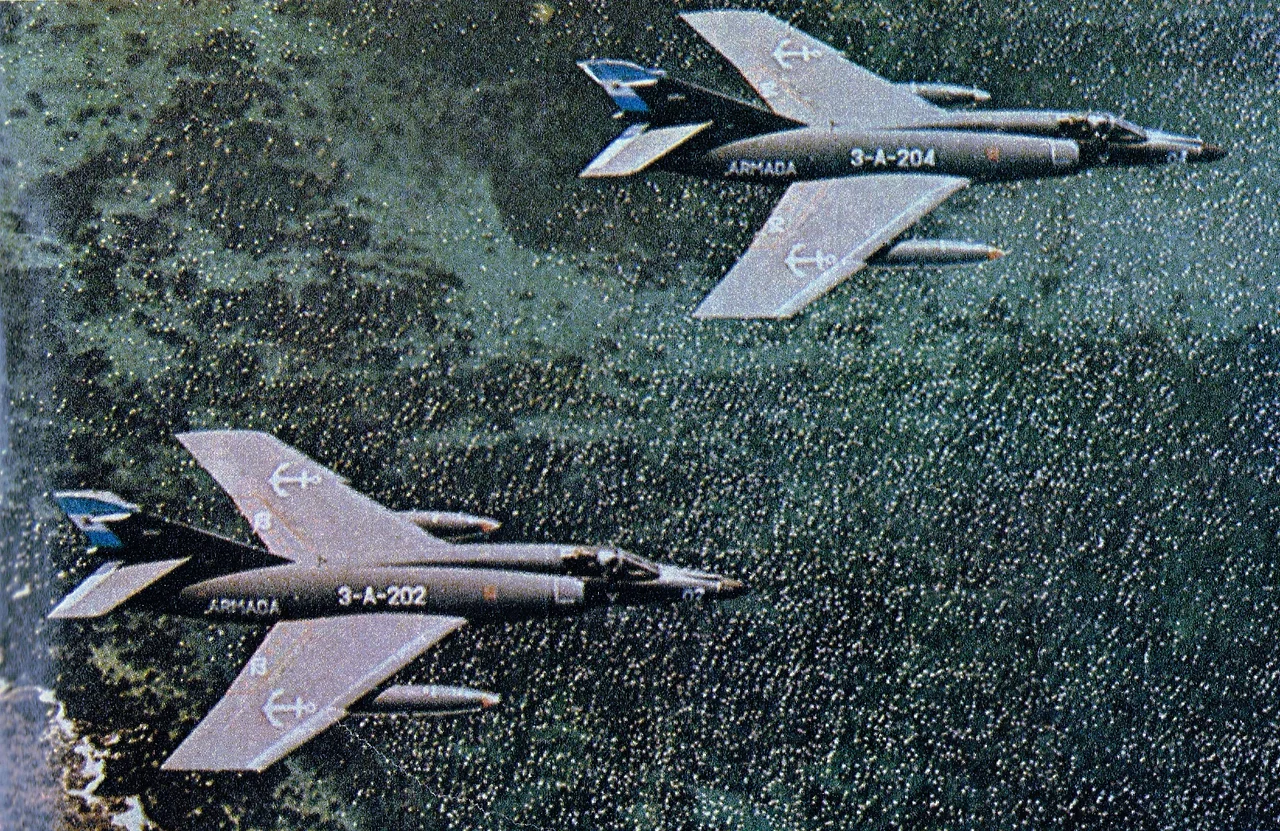
The sea war turned brutal fast. On 2 May, the submarine HMS Conqueror torpedoed the Argentine cruiser ARA General Belgrano; she sank within the hour, and 323 sailors died, nearly half of all Argentina's losses in the entire war. After Belgrano, the Argentine fleet retreated to port and never seriously threatened British ships again. But the Argentine air force did. Two days later, an Exocet missile struck the destroyer HMS Sheffield, the first Royal Navy warship lost in action since the Second World War. Over the weeks that followed, Argentine pilots flew low and hard against the landing fleet in San Carlos Water, the bay the sailors nicknamed Bomb Alley. Ship after ship was hit. Many British vessels survived only because Argentine bombs, released from too low an altitude, failed to arm before impact.
The Land Campaign
British troops came ashore at San Carlos on 21 May and began the grinding work of taking the islands back, settlement by settlement, ridge by ridge. At Goose Green, 2 PARA broke the first major Argentine position and lost their commanding officer, Lieutenant Colonel H. Jones, killed leading a charge and awarded a posthumous Victoria Cross. Then came the long march east toward the capital, Stanley, and the ring of dark, rocky peaks that guarded it. On the night of 11 June, in three simultaneous attacks, the British stormed Mount Harriet, Two Sisters, and Mount Longdon. Two nights later they took Tumbledown and Wireless Ridge. With the high ground gone, the defense of Stanley collapsed. On 14 June, the Argentine commander surrendered.
What the War Left Behind
The reckoning was heavy on both sides. In all, 649 Argentine servicemen, 255 British servicemen, and three Falkland Islanders were killed. Many of the Argentine dead were young conscripts, far from home in a cold they were never equipped for. Many of the British dead were professional soldiers and sailors barely older. The war's political aftershocks ran deep: in Argentina, defeat shattered the junta's authority and hastened the return of democracy the following year. In Britain, victory carried Thatcher to a landslide re-election. The islanders remained British and, in a 2013 referendum, voted overwhelmingly to stay that way. Decades on, the peaks above Stanley still bear the names of the battles fought across them, and the dead of both nations still rest beneath this hard southern ground.
From the Air
The Falkland Islands lie in the South Atlantic at roughly 51.75 degrees south, 59 degrees west, around 300 nautical miles east of the southern tip of Argentina. East Falkland holds most of the war's key sites: the capital, Stanley, on the eastern coast; the ring of peaks immediately west of it (Mount Harriet, Two Sisters, Mount Longdon, Tumbledown); and the Darwin-Goose Green isthmus to the southwest. The main airfield is RAF Mount Pleasant (ICAO: EGYP), about 33 miles southwest of Stanley, opened in 1985 as part of the postwar 'Fortress Falklands' garrison; the older Port Stanley Airport (ICAO: SFAL) sits two miles from the capital. Best appreciated at medium altitude in clear conditions, the islands present a treeless, boggy landscape of rolling moorland, peat, and stone runs, ringed by deeply indented coastline and frequently shrouded in fast-moving fog, rain, and snow even outside the southern winter.
Nearby Stories
- Bluff Cove Air Attacks 10 km away
- Falkland Islands sovereignty dispute 13 km away
- Pebble Island raid 26 km away
- Volunteer Point 36 km away
- Sea Lion Island 47 km away
- HMS Coventry (D118) 75 km away
- HMS Sheffield (D80) 150 km away
- Sinking of ARA General Belgrano 400 km away