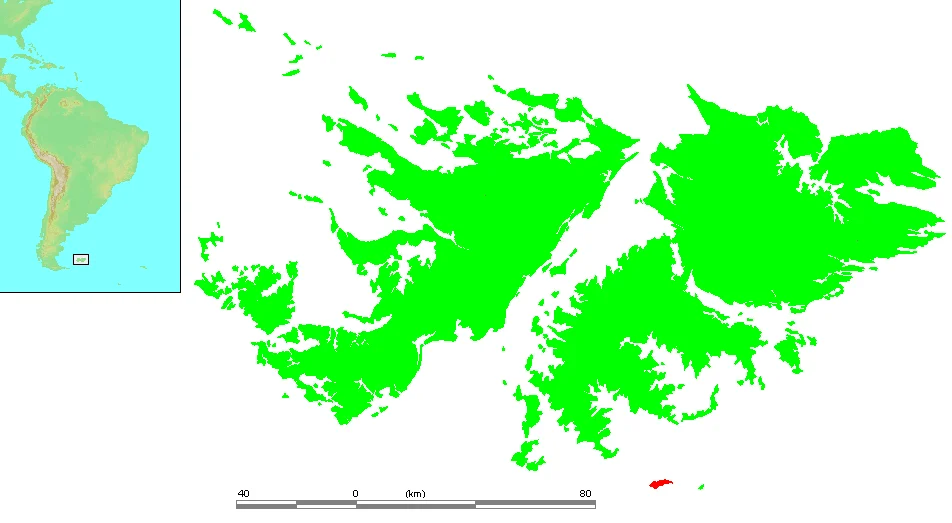

Sea Lion Island
Step off the small plane onto a dirt strip, and within minutes the wildlife is closer than you would believe possible. Sea Lion Island is barely nine square kilometres of tussock grass and pale beaches, the southernmost inhabited point in the entire Falkland archipelago. There are no predators to teach the animals fear. Gentoo penguins waddle past your boots. Elephant seals the size of small cars sprawl across the sand. And the local caracaras, bold to the point of larceny, have a documented habit of stealing golf balls off the lodge's improvised course.
The Battle of the Beaches
The island's headline event is the elephant seal rut. This is the most important breeding site for southern elephant seals in the Falklands, and from September through November the beaches become an arena. In the 2003 to 2004 season alone, 540 breeding females hauled ashore. The bulls are colossal and uncompromising, rearing up to slam against rivals in contests that leave the sand churned and the air full of guttural roaring. Hundreds of pups are born each spring. Later in the year the sea lions that give the island its name come ashore to breed in their turn, and the whole calendar of the place is set not by people but by the animals' relentless seasonal rhythm.
A Coast Full of Wings
Beyond the seals, the island is a seabird metropolis. East of the lodge, more than five thousand gentoo penguins crowd a single breeding ground. A three-mile walk west leads to Rockhopper Point, where close to 500 pairs of rockhopper penguins nest alongside a colony of king cormorants, and rock cormorants build into a natural stone arch. Magellanic penguins burrow through the grassy western reaches near Beaver Pond, named not for any rodent but for the Beaver bush planes that once landed there. At the island's far end, giant petrels nest in such skittish company that visitors must watch from a purpose-built hide. Orcas patrol the surrounding water, and king penguins occasionally wander ashore to rest among their smaller cousins.
A Memorial Out at Sea
Among the penguins at Rockhopper Point stands something more solemn: a memorial to HMS Sheffield. On 4 May 1982, during the Falklands War, the Royal Navy destroyer was struck by an Argentine Exocet missile. Twenty of her crew were killed. The badly damaged ship sank six days later while under tow, going down roughly a hundred miles to the southeast, in deep water on the edge of the Total Exclusion Zone. The memorial sits quietly among nesting birds, an unexpected reminder that these calm and abundant waters were, within living memory, the setting of a war. Twenty young sailors did not come home from the sea beyond this shore, and the island remembers them.
Life at the End of the Map
For all its drama, Sea Lion Island runs on a gentle, old-fashioned rhythm. A single lodge offers full board, packed lunches for those out walking, and an honour bar where guests pour their own drinks and settle up on trust. You can tour the island by Landrover, hike the trails cross-country, or hit a few golf shots at the lodge's makeshift course, provided the larcenous caracaras leave your ball alone. Getting here is its own small adventure: the government air service is the reliable route, since rough seas make boat landings a genuinely hit-and-miss affair, and even a phone call out once required a particular calling card. There is no crowd, no rush, and very little between you and the Southern Ocean. You come for the wildlife, stay for the silence, and leave understanding why a place this small, this far south, holds onto people the way it does.
From the Air
Sea Lion Island lies at roughly 52.43°S, 59.08°W, south of mainland East Falkland and the southernmost inhabited island in the archipelago. Access is by the Falkland Islands Government Air Service (FIGAS) from Stanley Airport (SFAL); Mount Pleasant (EGYP/MPN) is the main runway on East Falkland. The island has a well-maintained dirt landing strip, with an older grass strip kept for unfavourable winds. From the air it appears as a low, flat green island fringed by white-sand beaches and tussock, with Bull Hill (about 46 m) the only real high point. Recommended viewing altitude is 1,000–2,500 ft. Expect strong, gusty winds and quickly changing maritime conditions; calm clear spells are best for spotting wildlife and the offshore waters where HMS Sheffield was lost.
Nearby Stories
- Bodie Creek Suspension Bridge 42 km away
- Bluff Cove Air Attacks 57 km away
- Wildlife of the Falkland Islands 82 km away
- Battle of Mount Harriet 97 km away
- HMS Sheffield (D80) 125 km away
- Capture of Port Egmont 126 km away
- Sinking of ARA General Belgrano 318 km away
- Isla de los Estados 400 km away