
Capture of Port Egmont
On 10 June 1770, a tiny British garrison at the western edge of the Falkland Islands looked out at five Spanish warships and 1,400 soldiers, and did the only sensible thing. They fired their guns once, for honour, and then they surrendered. Not a single man died. Yet this bloodless little capitulation on a windswept, almost worthless shore brought Britain, Spain and France to the very brink of war, set the philosopher Samuel Johnson to writing, and planted a grievance that still echoes through the South Atlantic two and a half centuries later.
A Quarrel Over Empty Ground
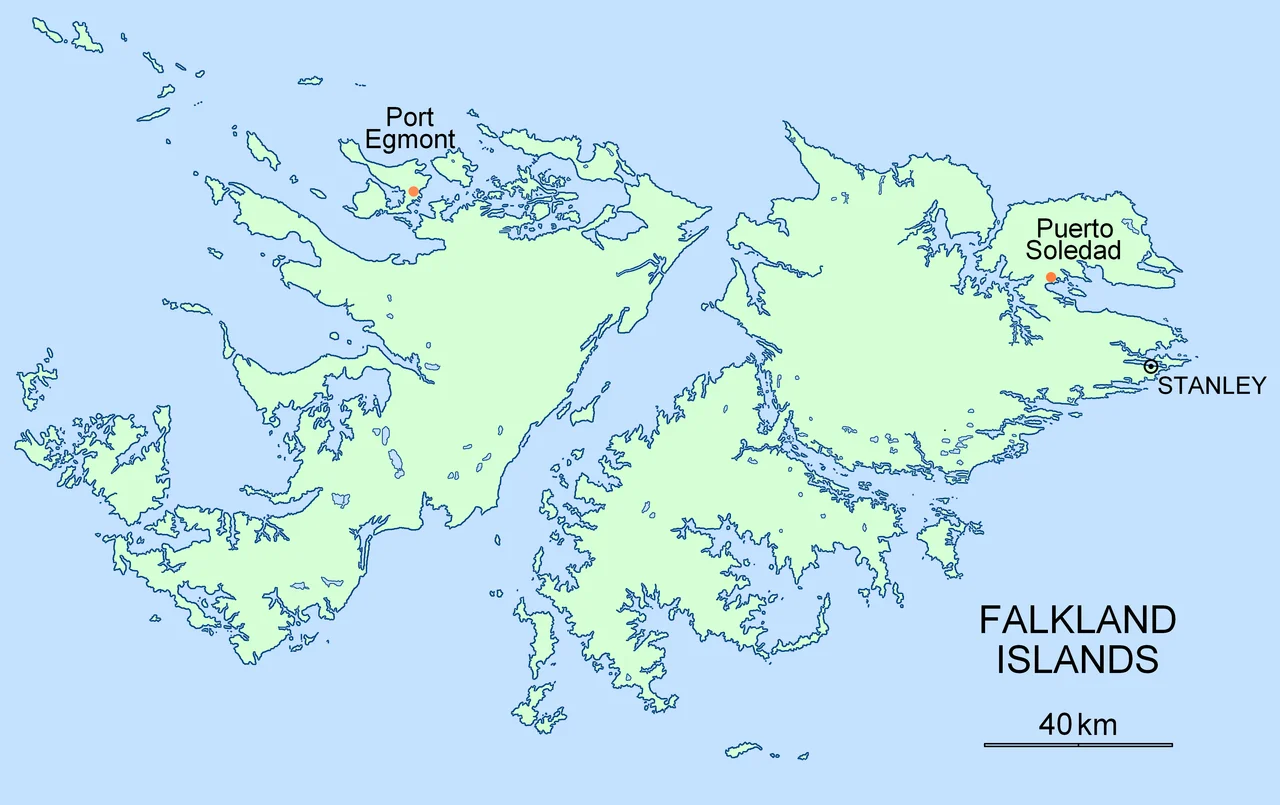
Britain had built its settlement at Port Egmont, on Saunders Island, in 1765. Spain, which claimed the whole region, regarded the British as squatters on Spanish soil; the British returned the compliment, insisting the islands were theirs. For years the two sides traded sharply worded letters across the water. In November 1769 the British commander, Captain Anthony Hunt, spotted a Spanish schooner quietly surveying his island and ordered it to leave. The Spanish ordered him to leave. Each invoked his king. Neither budged. It was the kind of standoff that, on so remote and barren a coast, might have simmered indefinitely, had Spain not decided to settle it with force.
Five Ships and a Token Shot
Francisco Bucareli, the Spanish governor in Buenos Aires, dispatched a squadron under General Juan Ignacio de Madariaga. Four frigates and a xebec carried 1,400 soldiers and a siege train across the South Atlantic to Port Egmont. The British defenders had a wooden blockhouse and an eight-gun battery, and no chance whatsoever. When the Spanish soldiers waded ashore, the commanders William Maltby and George Farmer exchanged a few rounds for the sake of the record and then asked for terms. They were granted them. After being detained for twenty days, the British were allowed to sail home aboard their one remaining ship, the sixteen-gun Favourite; their other vessel, the Swift, had already foundered down the coast at Port Desire. The Spanish renamed the place and raised their own flag.
The World Holds Its Breath
When word reached London, the insult, more than the ground, set off a public outcry. The British demanded that Spain restore Port Egmont and make amends. Spain stalled, trying to turn the argument toward the deeper question of who actually owned the islands; the secretary of state, Lord Weymouth, refused to discuss anything until satisfaction was given, and the machinery of war began to turn. France, bound to Spain by treaty, was expected to join in, and for a few tense months three navies stood ready over a cluster of islands almost nobody had seen. Then the French king declined to fight. Stripped of that support and facing the Royal Navy alone, Spain backed down, disavowed the expedition, and agreed to give Port Egmont back.
The Long Shadow
Samuel Johnson, asked to defend the government's restraint, wrote a famous pamphlet questioning whether such far-flung rocks were worth any blood at all, calling Port Egmont "a colony that could never become independent, for it could never be able to maintain itself." The peace held, but Britain's commitment did not. In 1774, in a wider tightening of imperial spending, the British quietly withdrew, leaving behind only a flag and a plaque asserting that the islands remained theirs. That plaque mattered. The claim it represented never died, and the sovereignty dispute it preserved would flare again and again, most terribly in 1982. A crisis that killed no one in 1770 set the terms for one that would kill many, generations later.
From the Air
The site of Port Egmont lies on the north-east coast of Saunders Island at roughly 51.35 degrees south, 60.06 degrees west, on a sheltered bay off West Falkland, surrounded by water. From the air the setting is a deeply indented coastline of low grassy ground and pale beaches; the historic settlement site sits near the present-day Saunders Island farm. There is no airport at the site itself; Saunders is reached by the inter-island Islander air service to a grass strip, or by ship. The nearest hard-runway airfields are Port Stanley Airport (ICAO SFAL) and RAF Mount Pleasant (ICAO EGYP), both to the south-east on East Falkland. Wind is persistent and weather changeable; clearest conditions come in the austral summer, October through March. Fly low and slow over the bay to take in the natural harbour that made this exposed shore worth fighting over.
Nearby Stories
- HMS Coventry (D118) 20 km away
- Battle of San Carlos (1982) 25 km away
- Falklands War 30 km away
- Jason Islands 36 km away
- New Island 58 km away
- Sinking of ARA General Belgrano 449 km away
- Pepys Island 463 km away