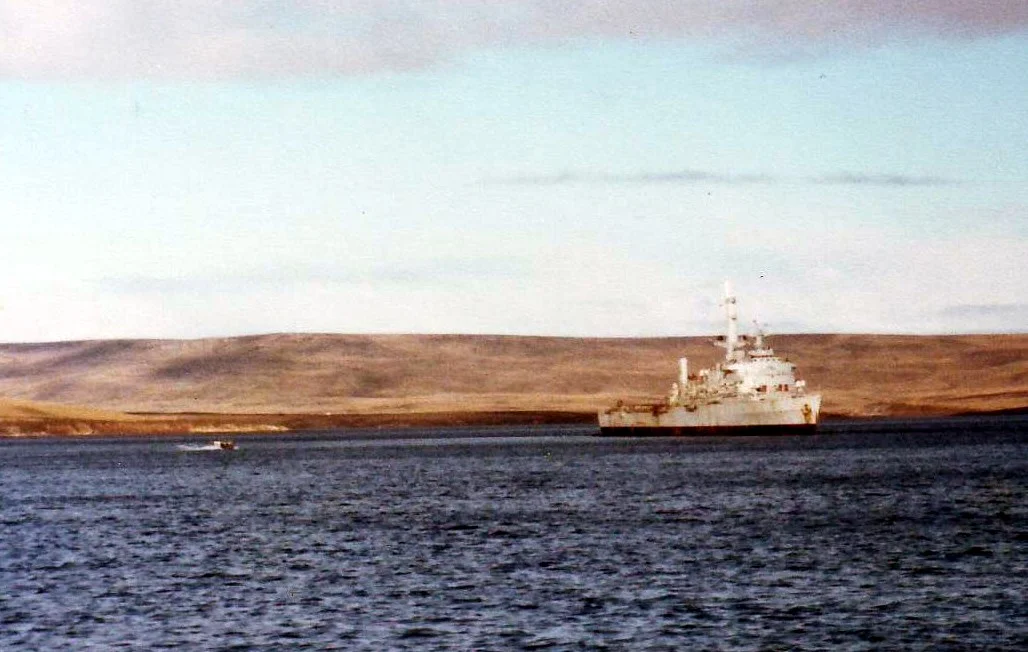

Battle of San Carlos (1982)
The men who fought in San Carlos Water gave it a darker name. They called it Bomb Alley, and for five days in May 1982 the title was earned again and again. Tucked behind the hills off Falkland Sound, this narrow anchorage was chosen for a British amphibious landing precisely because its terrain shielded the ships from sea-skimming missiles and submarines. What the hills could not stop were Argentine jets coming over the ridgelines at masthead height, so low that British radars lost them against the land. From 21 to 25 May, wave after wave of Skyhawks and Daggers screamed down on the warships guarding the beachhead. It was the first time in history that a modern fleet armed with guided missiles and carrier aircraft had to defend itself against full-scale air assault, and the cost was paid in ships and in lives on both sides.
Two Minutes Over the Target
The Argentine pilots flew at the very edge of possibility. Their A-4 Skyhawks and Israeli-built Daggers launched from mainland bases 380 to 580 nautical miles away, far enough that the Skyhawks needed two mid-air refuellings just to reach the islands and home again. By the time they roared into San Carlos, fuel left perhaps two minutes over the ships before they had to turn for the long flight back across the South Atlantic. There was no loitering, no second pass, no margin for error. These were not faceless raiders but young airmen attempting something close to suicidal, pressing attacks through a thicket of missiles and gunfire with their tanks nearly dry, and many of them did not return.
The First Night
It began before dawn on 21 May, when a small Argentine army outpost on Fanning Head spotted the British fleet slipping into the Sound and opened fire. In the confused fighting that followed, two British Gazelle helicopters were brought down by ground fire. The death of Sergeant Andrew Evans was especially cruel: his stricken aircraft ditched, and as he and his crewman struggled in the water, Argentine soldiers kept firing on them for some fifteen minutes, against the orders of their own commander. The second Gazelle was shot down moments later, killing Lieutenant Ken Francis and Lance Corporal Pat Giffin. By full daylight the air attacks had begun in earnest, and the frigates Ardent and Argonaut were hit. Ardent, mortally wounded, sank the next morning.
Three Ships Lost
Over the days that followed the anchorage became a furnace. HMS Ardent went down with 22 of her crew dead, more than a quarter of her company. On 23 May, HMS Antelope was struck by a bomb that did not explode on impact; the device detonated later as a brave disposal team tried to defuse it, and two men were lost before she broke apart and sank. On 25 May, Argentina's national day, the destroyer HMS Coventry was sunk farther out while acting as a decoy, taking nineteen of her people with her. Three Royal Navy ships destroyed in five days, and yet the pattern of the fighting held a strange mercy and a strange tragedy together: thirteen Argentine bombs slammed into British ships and failed to go off, their fuses set wrong for such low-level attacks.
Six Better
That flaw in the bomb fuses may have decided the campaign. Lord Craig, a retired Marshal of the Royal Air Force, summed it up in a single chilling line: "Six better fuses and we would have lost." Had those thirteen unexploded bombs detonated, the landing force might have been shattered before it could establish itself. Instead, for all the losses among the escorting warships, the British succeeded in keeping the strike aircraft away from the packed transports deeper in the bay. The troops got ashore. From the beachhead at San Carlos a land campaign rolled east across the moors until, on 14 June, Argentine forces in Stanley surrendered. The lesson of Bomb Alley rippled through navies worldwide, which spent the 1980s bolting on close-in guns to fend off exactly the kind of low, fast attack these pilots had pressed home.
From the Air
San Carlos Water lies at about 51.51 degrees south, 59.08 degrees west, an inlet on the western side of East Falkland opening onto Falkland Sound, the strait that separates East and West Falkland. From the air it reads as a sheltered, hill-ringed anchorage, the very feature that made it both a safe landing site and a deadly funnel for attacking aircraft. The nearest major airfield is RAF Mount Pleasant (ICAO: SFAL) to the southeast, with Port Stanley Airport beyond it on the east coast. Expect strong, gusty winds, frequent low cloud over the surrounding ridges, and the fast-changing visibility typical of the South Atlantic.
Nearby Stories
- Pebble Island raid 26 km away
- Wildlife of the Falkland Islands 28 km away
- Port Louis, Falkland Islands 41 km away
- Sea Lion Island 65 km away
- Jason Islands 88 km away
- HMS Sheffield (D80) 181 km away
- Sinking of ARA General Belgrano 411 km away
- Casa del Puente 1484 km away