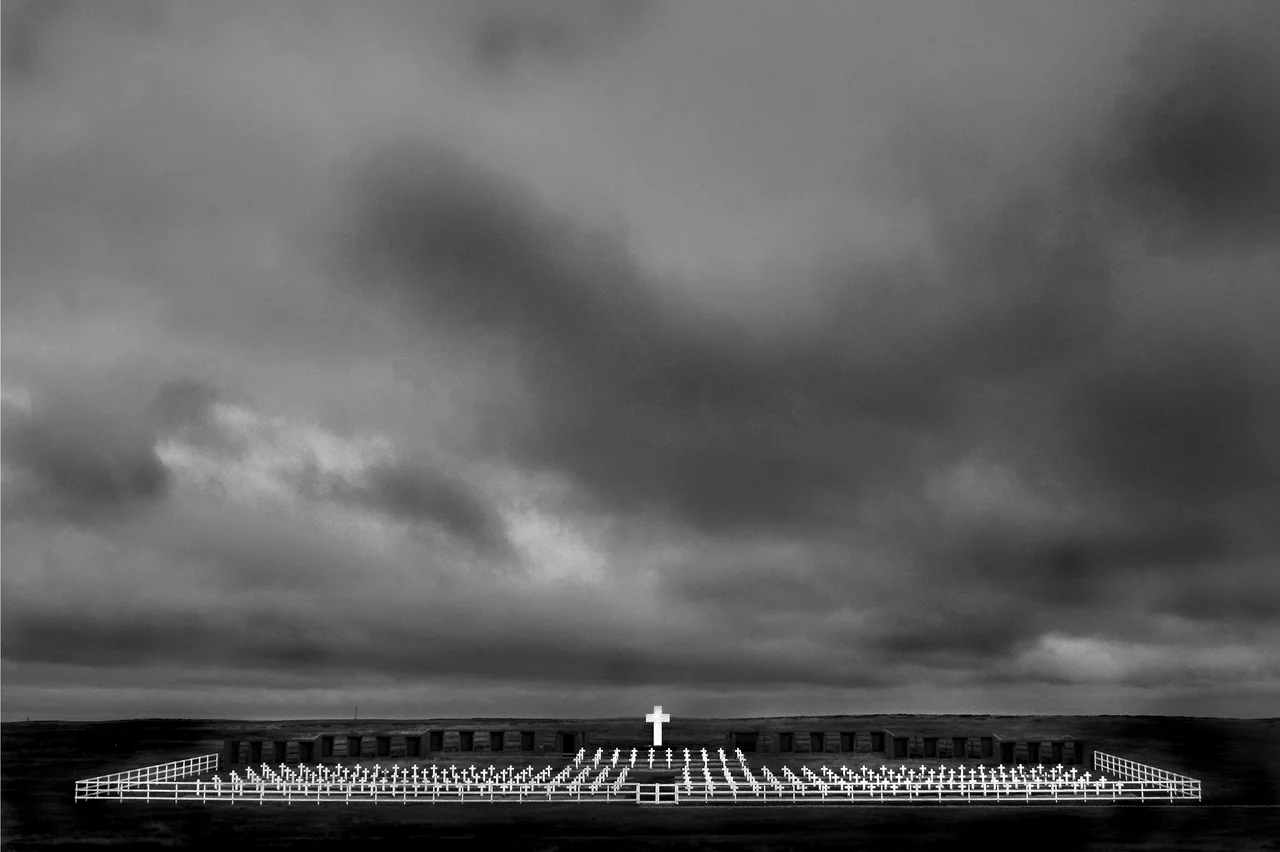

Argentine Military Cemetery
Soldado argentino solo conocido por Dios. An Argentine soldier known only to God. For more than three decades, that single line was carved on grave after grave at the cemetery near Darwin, white crosses in neat rows on the open ground of East Falkland. The men beneath them had names. They had mothers and fathers, towns they came from, faces remembered at kitchen tables across Argentina. The war had simply taken their names away, and it would take a quiet, patient act of mercy by both former enemies to give many of them back.
Left Where They Fell
When the fighting stopped on 14 June 1982, most of the Argentine dead lay in hasty graves close to where they had died, scattered across the battlefields of a cold and distant island. Britain offered to send the bodies home to Buenos Aires. The ruling junta refused, declaring that the men were already in their homeland. So the dead stayed. Late that year the British government gave the task of gathering them to a firm of civilian undertakers, working under a British Army officer, Colonel Geoffrey Cardozo. Assisted by the armed forces, they found and documented each grave and brought the bodies to Darwin, already the largest single resting place, where dozens killed at nearby Goose Green had been buried soon after that battle.
Best Efforts in the Dark
Many of the dead had no identification tags. Cardozo's people did what they could, identifying each man from the personal effects found with him, never trusting a single object but weighing them together: a letter, a photograph, a rosary, a name stitched into a collar. Every soldier was given a Christian burial with full military honors, whether or not anyone could say who he was. Each grave received a white wooden cross bearing a name if one was known, and if not, the inscription that would stand for thirty-five years: an Argentine soldier known only to God. It was the most honest thing the living could offer the dead. It was also, for the families back home, an open wound that would not close.
The Long Wait of the Mothers
Imagine waiting decades to learn which of those identical white crosses belongs to your son. That was the reality for hundreds of Argentine families. The cemetery sits inside a low walled enclosure, watched over by a statue of the Virgen de Lujan, Argentina's patron saint. Around the graves, glass plaques carry the names of all 649 Argentine servicemen who died in the war, listed without rank or service branch, exactly as the families asked. The families themselves became the keepers of the place. In 2007 an Argentine man married to a Falkland Islander took on its upkeep, tending the graves of his countrymen on the islands his country had fought to claim. Even in mourning, the war's hard lines blurred into something more human.
Giving Back the Names
In 2016 the United Kingdom and Argentina did something rare for two nations divided by a war: they agreed, together, to identify the unknown. Under the International Committee of the Red Cross, a forensic team came to Darwin in 2017, working through the southern winter to exhume, study, and document the remains in each anonymous grave. DNA from the dead was matched against samples that grieving relatives gave freely, with analysis led by the Argentine Forensic Anthropology Team and verified in laboratories abroad. The results came one family at a time. By 2018, more than eighty soldiers had been named, and the work continued in the years that followed, returning name after name to the crosses. For the first time, hundreds of relatives could stand before an actual grave and know, at last, that their son or brother lay there.
What Remains
Not every story closed cleanly. A handful of graves still bear the old inscription, their occupants unmatched to any sample offered. In at least one case a soldier was identified, but his family chose to leave his name off the headstone, keeping him among the unknown by their own wish. There have been ugly moments too: the shrine to the Virgin was vandalized more than once, drawing apologies from British officials and grief from the families. Yet the deeper truth of this place runs the other way. In 2002 Prince Andrew, himself a Falklands veteran, laid a wreath here and spoke of the friends he had lost, saying he understood what the Argentine families had endured. Two nations that sent their young men to kill one another on this island have spent the years since helping each other carry the dead home, if only in name. The crosses still stand in their quiet rows, and now, for most of them, someone knows exactly whom to mourn.
From the Air
The Argentine Military Cemetery lies at Fish Creek, just east of the Darwin settlement on East Falkland, at roughly 51.80 degrees south, 58.94 degrees west, near the Darwin-Goose Green isthmus where much of the land war was fought. From the air it appears as a small, distinct walled enclosure of pale crosses on open, treeless moorland, set apart from the scattered farm buildings nearby. The nearest major airport is RAF Mount Pleasant (ICAO: EGYP), roughly 30 nautical miles to the east; Port Stanley Airport (ICAO: SFAL) sits further east near the capital. Best viewed at low altitude in clear, calm conditions; the surrounding terrain is rolling grass, gorse, and peat, frequently swept by wind and obscured by fast-moving fog and rain. This is a place of mourning and reflection, deserving of quiet respect from any visitor, by land or air.
Nearby Stories
- Bluff Cove Air Attacks 10 km away
- Falkland Islands sovereignty dispute 13 km away
- Pebble Island raid 26 km away
- Volunteer Point 36 km away
- Sea Lion Island 47 km away
- HMS Coventry (D118) 75 km away
- HMS Sheffield (D80) 150 km away
- Sinking of ARA General Belgrano 400 km away