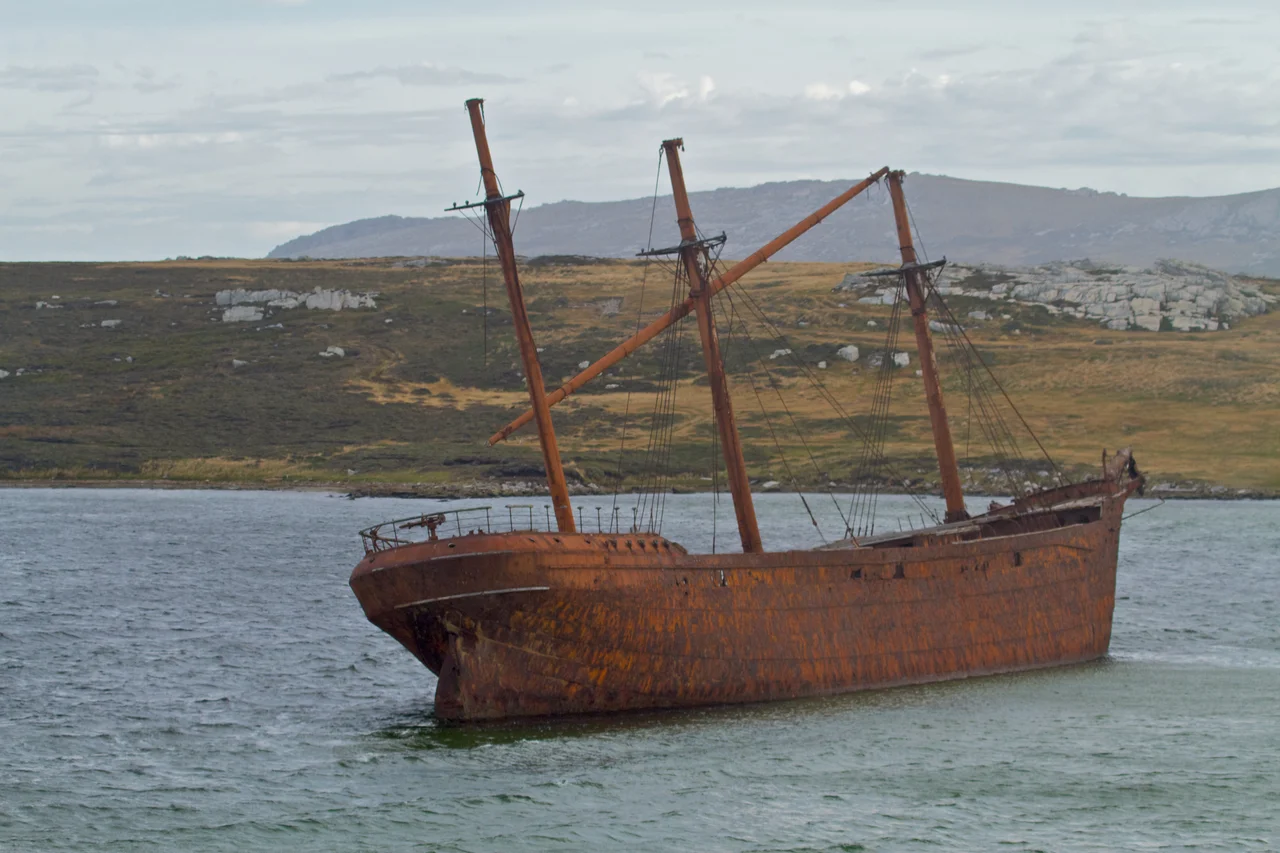

Lady Elizabeth (1879)
She still rocks with the tide. More than a century after her last voyage, the iron barque Lady Elizabeth lies half-beached in Whalebone Cove at the edge of Stanley Harbour, three masts still standing, her hull bleeding rust into the cold water. Launched on the River Wear in 1879 to carry cargo around the world, she ended as a casualty of Cape Horn and an accident of a snapped mooring line. Today she is the most recognisable shipwreck in the Falklands - a 1,155-ton ghost of the age of sail, frozen mid-decay against the treeless hills, beautiful and doomed in equal measure.
From the River Wear
The Lady Elizabeth was a Sunderland ship through and through. Robert Thompson Jr. built her at Southwick on the River Wear and launched her on 4 June 1879 - an iron barque of 1,155 tons, three-masted, the seventh-largest vessel his firm ever produced. She was ordered to replace an earlier ship of the same name, lost off the coast of Western Australia the year before. For her first decades she did exactly what she was built to do, hauling cargo across the world's oceans under a succession of owners: a bankrupt British shipowner, a Manxman from a seafaring family, and finally, in 1906, a Norwegian company that paid a little over three thousand pounds for her. She was, by then, an ageing windjammer in a world turning to steam.
The Mystery of the Lost Finns
One voyage left a mark that the years have not erased. Sailing from Callao in Peru, the Lady Elizabeth carried a crew that included several Finnish sailors. Soon after leaving port, a man named Granquiss fell ill with what the captain diagnosed as malarial fever; days later a second Finn, Haparanta, came down with the same. The captain dosed them with remedies and let them walk the deck for air. Then Granquiss vanished. A search of the ship found nothing. That evening Haparanta was gone too. The captain concluded that fever had driven both men into delirium and over the side into the sea - two sailors lost not to storm or shipwreck but to sickness, their bodies never recovered, their names surviving only in an inquiry filed at the far end of the world. It is a small, sad reminder that the romance of sail rode always alongside real human suffering.
Broken at the Horn
Her end as a working ship came in the winter of 1912 and 1913. Loaded with lumber and bound from Vancouver for Mozambique, she met savage weather rounding Cape Horn - the graveyard of so many sailing ships. Four crew members were swept overboard, both her boats were lost, and part of her cargo and deck were torn away. The captain turned for the nearest port. Limping toward Stanley, she struck Uranie Rock off Volunteer Point, north of the harbour, tearing a long break in her hull and keel. She was sinking as she reached Port Stanley, and when surveyors examined the damage they condemned her: unseaworthy, beyond economical repair, with no dry dock within thousands of miles to save her. In 1913 she was sold off and put to work as a floating coal hulk, stripped of her purpose but still afloat.
Adrift Into Legend
For twenty-three years she sat in the harbour as a storage hulk. Then, on 17 February 1936, a storm parted her mooring lines and the old barque drifted free, grounding at last in Whalebone Cove where she remains today. Time has not been gentle. The keel is rusting through, the bottom floods at high tide, rivets have failed and sprung the starboard plating outward, and in a 2008 gale her bowsprit finally broke away. Yet much of her endures - the anchor crank, the davits that once held her lifeboats, fragments of the spiral staircase, patches of original paint still clinging inside the hull. Plans to turn her into a floating museum were drawn up and abandoned for lack of funds. So she stays as she is, neither salvaged nor sunk: a relic of the windjammer era left to the wind and the tide, photographed by every visitor who comes to Stanley and watched over by the Falkland Islands Museum that cannot quite bring itself to let her go.
From the Air
The Lady Elizabeth lies in Whalebone Cove at the eastern end of Stanley Harbour, at approximately 51.69 degrees south, 57.80 degrees west, partially beached and clearly visible against the shoreline. From the air her three standing masts and dark hull stand out at the harbour's edge, just east of the town of Stanley. Recommended viewing altitude is 1,000 to 2,500 feet for a clear view of the wreck and the surrounding cove. Stanley Airport (ICAO SFAL, IATA PSY) on the Cape Pembroke peninsula is the closest field, only a couple of nautical miles to the east; RAF Mount Pleasant (ICAO EGYP, IATA MPN) lies about 25 nautical miles to the southwest. Expect strong, gusty winds and fast-changing cloud, with the sheltered harbour often offering good low-level visibility over the wreck.
Nearby Stories
- Volunteer Point 3.8 km away
- Argentine Military Cemetery 40 km away
- Sea Lion Island 67 km away
- Pebble Island raid 89 km away
- HMS Sheffield (D80) 118 km away
- Sinking of ARA General Belgrano 447 km away
- South Georgia Island 1404 km away
- Villa Gesell 1585 km away