.jpg)
Isla de Lobos
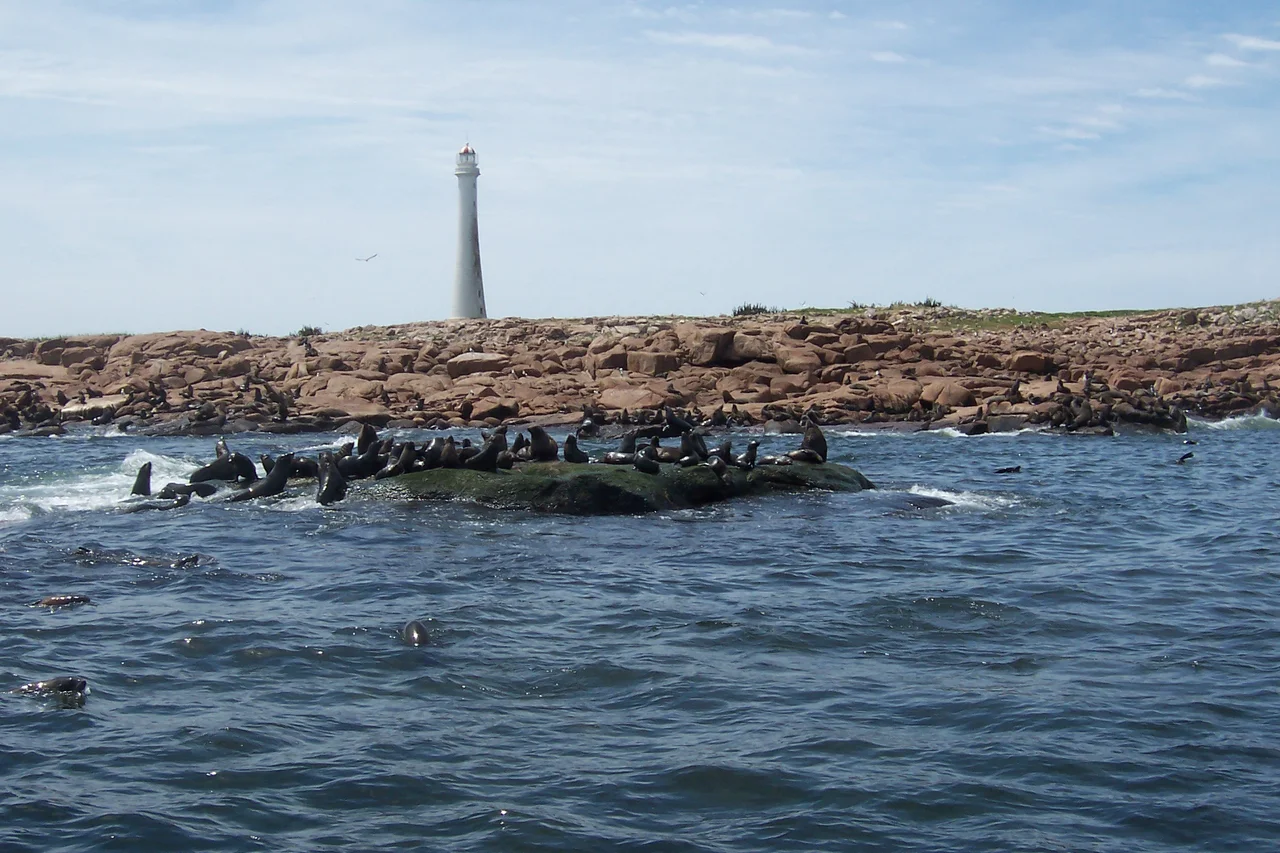
You hear Isla de Lobos before you see it clearly. Across the water off Punta del Este, the island sends up a sound like a vast, restless crowd, a roaring, barking chorus that carries on the wind from a colony of sea lions so dense the rocks themselves seem to move. At the 2005 count, roughly 250,000 South American sea lions hauled out here, alongside some 1,500 South American fur seals, making this one of the largest sea lion colonies on the continent. Rising above the din stands a slim white tower, the tallest lighthouse in South America, keeping watch where the Río de la Plata finally surrenders to the open Atlantic.
Where the River Ends
Isla de Lobos lies about eight kilometers southeast of Punta del Este, a small outcropping of rock that geologists read as the last visible link in the Cuchilla Grande, the range of hills that runs out beneath the sea. It marks a meaningful threshold: the outer edge of the estuary of the Río de la Plata, where the muddy river water that drains half a continent meets the cold blue of the South Atlantic. Spanish navigator Juan Díaz de Solís documented the island in 1516 and named it San Sebastián de Cádiz. The Venetian explorer Sebastian Cabot stopped here in 1527, and the following year Diego García de Moguer sailed past and called it the Island of the Snapper. Names came and went; the sea lions stayed.
The Tallest Light
In 1858 the Uruguayan government raised a lighthouse on the island, rebuilding it in 1906. At 59 meters above sea level, it is the tallest lighthouse in South America. Climb the 240 steps to the outside balcony and the whole world rearranges itself: the heaving carpet of animals below, the surf breaking white on black rock, and the distant skyline of Punta del Este shimmering across the channel. In July 2001, the tower became the first automated lighthouse in Uruguay, drawing its power from the sun. On days when fog swallows the coast, a compressed-air siren takes over from the light, sending its warning out into the murk where the beam cannot reach.
A Refuge in the Storm
A little over a kilometer from the main island, a bare rock holds a small votive chapel and a story of desperation. Surveys in the 1990s found inscriptions inside: some in German referring to July 1945, others in Italian reading Grazie per la Finita Burrasca, thanks for the ended storm. The evidence suggests a mixed crew of German and Italian sailors, fleeing the wreckage of the Second World War from a harbor in Spain, ran out of fuel and food on a long voyage, scuttled their submarine, and scrambled onto this rock alive. They named it Finita Burrasca and built the chapel to Our Lady of Storms in gratitude. Sailors have used the name as shorthand for safe shelter ever since.
Protected at Last
For most of its recorded history, Isla de Lobos was a place of harvest. Its marine life was hunted and exploited economically until the early 1990s, when the killing was finally outlawed in 1991 and economic exploitation ceased by 1992. Protection deepened over time. The island became part of a coastal-islands nature reserve, and in 2024 it was folded into a new marine protected area, the Island and Islet of Lobos and their Submerged Environment National Park. The waters around it now draw life rather than hunters. Southern right whales pass through on their winter migration, southern elephant seals appear from time to time, and pods of orcas hunt these channels, among the few places in Uruguay where the great predators reliably show themselves.
From the Air
Isla de Lobos sits at approximately 35.024 degrees south, 54.883 degrees west, about 8 km southeast of the Punta del Este peninsula. From the air it reads as a distinct dark landmass ringed by white surf, with a slim lighthouse tower at its high point and a smaller islet to the east. It makes an excellent coastal waypoint where the Río de la Plata estuary opens into the Atlantic. The nearest airport is Capitán de Corbeta Carlos A. Curbelo International (ICAO: SULS) at Laguna del Sauce, roughly 25 km west-northwest. Approach from offshore on a clear day; the surrounding waters are a protected marine park, so maintain a respectful altitude over the wildlife.
Nearby Stories
- Laguna de Rocha 27 km away
- 2012 Air Class Líneas Aéreas Fairchild Swearingen Metroliner crash 38 km away
- Laguna Garzón Bridge 41 km away
- La Paloma 54 km away
- Tronador (rocket) 150 km away
- Battle of Sarandí 158 km away
- Mundo Marino 192 km away
- South Georgia Island 2521 km away