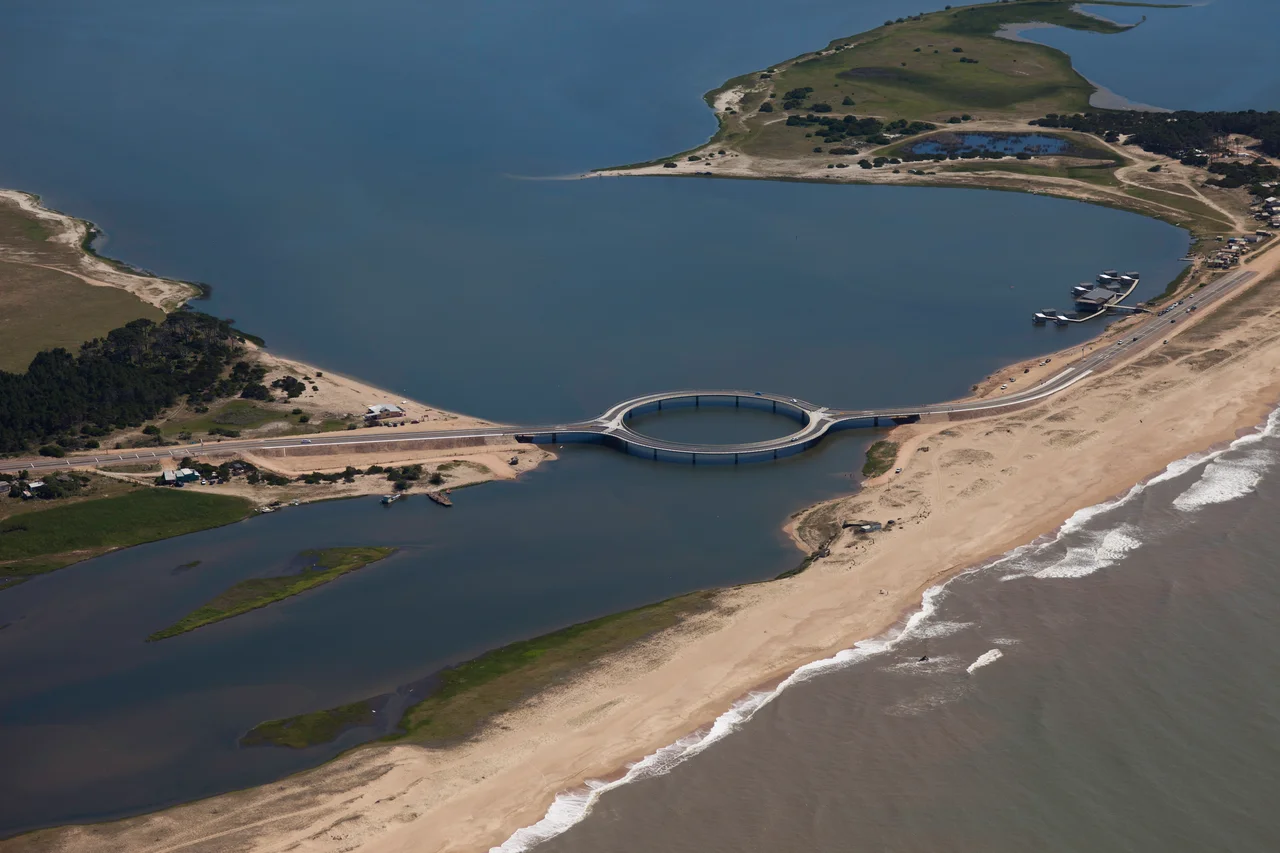

Laguna Garzón Bridge
From above, it looks like a mistake, or a doodle: a complete circle of roadway floating in the middle of a coastal lagoon, traffic peeling apart on one side and rejoining on the other, with open water in the hole at its center. There is nothing wrong with it. The ring is the entire point. When the architect Rafael Viñoly was asked to span the Laguna Garzón, where the Maldonado and Rocha departments meet, he refused to give the coast a fast, forgettable straight line. He gave it a curve that makes you brake, steer, and notice where you are. Since December 2015 the circular bridge has carried cars across a lagoon that, until then, you could only reach by a two-car ferry that ran only in daylight and only in good weather.
The Argument Against a Straight Line
A conventional bridge would have been cheaper and faster to drive. That was exactly the worry. The Laguna Garzón sits in one of the most pristine coastal stretches of Uruguay, a fragile screen between the developed beaches near Punta del Este and the wilder, emptier coast of Rocha beyond. A straight span would have invited speed, and speed invites traffic, sprawl, and the slow erasure of the very quiet that draws people east. Viñoly's solution was psychological as much as structural. The circle splits oppositely-bound traffic into two separate curving lanes near the entrance and reunites them at the far side. You cannot take it at pace. You ease around the arc, and in the seconds that costs you, the panorama of water, sky, and dune does its work.
Steel, Concrete, and a Ring of Water
The numbers behind the ring are substantial. Construction ran from September 2014 to December 2015 and consumed roughly 450 tons of steel, 500 cubic metres of concrete, and 40,000 metres of cable. The bridge cost about eleven million dollars, ten million of it underwritten by the Argentine real estate developer Eduardo Costantini, whose interests in the area gave him reason to want the crossing built well. The result handles around a thousand vehicles a day and, crucially, lets pedestrians and cyclists cross too. Walkways line both the outer rim and the inner edge, so you can stop midway, lean on the railing, and stare straight down into the lagoon held inside the circle.
A Gateway to the Quiet Coast
What the bridge really opened was access to a coastline that had been deliberately hard to reach. For decades the ferry was a bottleneck, and that inconvenience kept the Rocha side sleepy. The ring changed the math without throwing the doors wide: it connects the two shores while still asking every driver to slow down and behave. East of here the road runs toward José Ignacio's lighthouse and on into the lagoons and surf villages of Rocha. The bridge is the threshold between two moods of the Uruguayan coast, the polished resort world and the windswept one, and it is designed so that the moment you cross, you have already taken your foot off the accelerator.
An Architect Who Crossed Oceans
The man who drew the ring was a long way from home, in a sense, and very close to it in another. Rafael Viñoly was born in Montevideo and grew up in Argentina before building a career in the United States, where his name went on towers and concert halls and convention centers around the world. The Laguna Garzón crossing brought him back to the Uruguayan coast for a project utterly unlike his glass high-rises, a low, quiet, deliberately humble structure whose whole ambition was to interrupt the act of driving for a few seconds. It is the kind of idea that sounds like a gimmick until you cross it, and then it simply works: the curve slows the car, the car slows the eye, and the lagoon, the dunes, and the sky get the attention the architect insisted they deserved. Viñoly died in 2023, and the ring on the water remains one of the most quietly beloved things he ever made.
From the Air
The Laguna Garzón Bridge lies at 34.80°S, 54.57°W, spanning the narrow neck of the Laguna Garzón where it nearly meets the Atlantic, on the Maldonado–Rocha departmental border. From the air the perfect ring is one of the most distinctive man-made shapes on the entire South American coast, set against the blue-green lagoon and a thread of barrier dune separating it from the ocean surf. It photographs best from directly overhead at low altitude. José Ignacio and its lighthouse sit a few kilometers west. The nearest airport is Capitán de Corbeta Carlos A. Curbelo International (SULS / PDP) at Laguna del Sauce, about 50 km west near Punta del Este; Montevideo's Carrasco International (SUMU / MVD) is roughly 160 km southwest. Clear skies and calm wind make the lagoon's surface mirror-flat, sharpening the circle from above.
Nearby Stories
- Cerro Catedral (Uruguay) 8.1 km away
- Minas 9.3 km away
- Argentino Hotel 18 km away
- Isla de Lobos 20 km away
- Cabo Polonio 33 km away
- Punta del Diablo 93 km away
- Tronador (rocket) 191 km away
- South Georgia Island 2542 km away