.jpg)
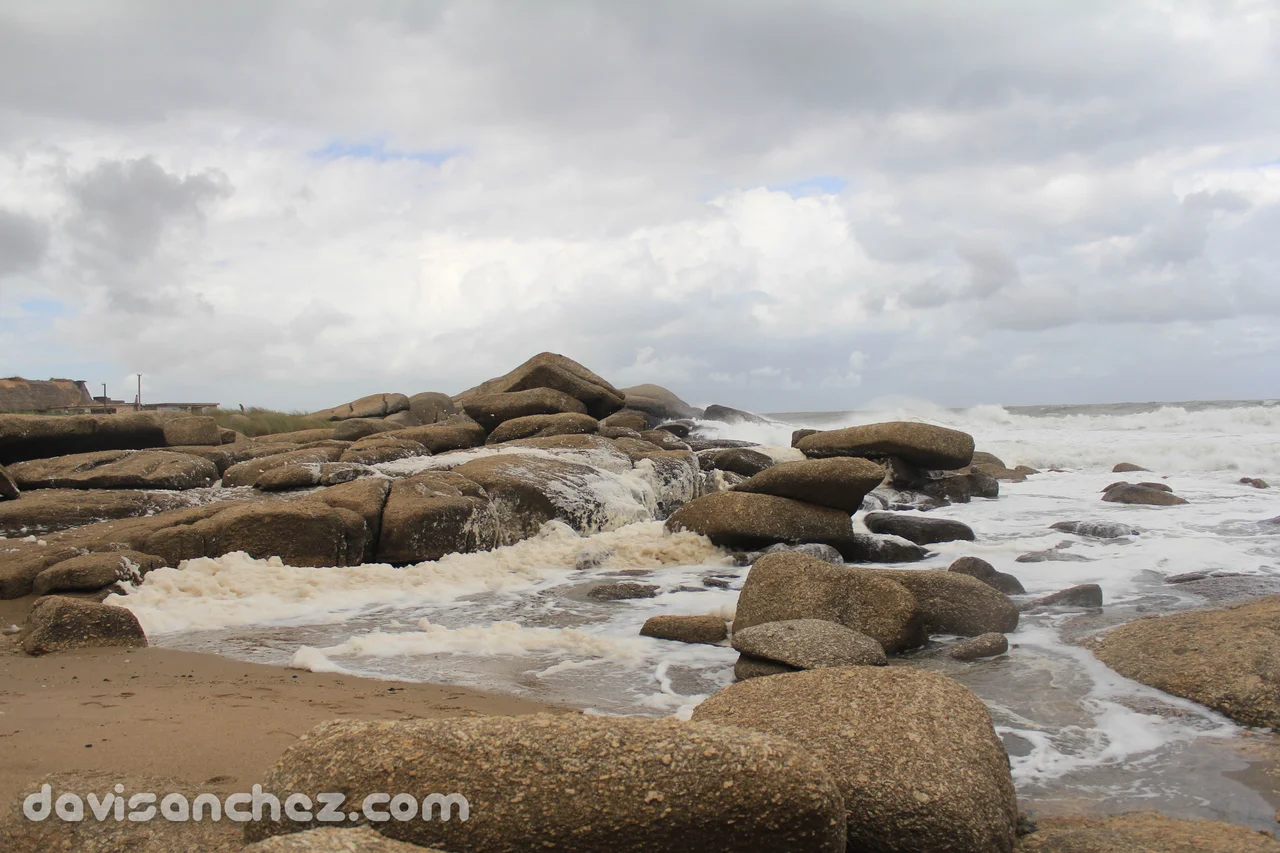
Punta del Diablo
The shark fishermen made this town. In the early 1940s, men came down from the village of Valizas to a windswept point on the Rocha coast, chasing tiburon, because shark liver oil was worth real money then. They built shacks, hauled their boats onto the sand, and stayed. Eight decades later their beach is still lined with fishing boats, but it now shares the cove with bohemian cafes, brightly painted cabins, and a summer crowd that outnumbers the year-round residents many times over. Punta del Diablo is two places wearing the same name, and which one you find depends entirely on the season you arrive.
Founded on Sea Air and Shark Oil
The story starts with a family looking for health. The Rocha family settled here around 1935, drawn by the clean sea air, one of their children suffering from asthma. The fishermen followed about 1942, working the lucrative shark trade, and a community took root around the boats. The 2011 census counted just 823 permanent residents, mostly fishermen and artisans. The artisans matter to the town's character: the wives and partners of fishermen began crafting objects from shells, starfish, driftwood, and pebbles, and that handmade tradition grew into the summer crafts fair that still appears each year. The town's rustic charm is not a marketing pose. It is the residue of a working fishing village that never fully paved itself over.
From a Few Hundred to Twenty Thousand
Then summer arrives, and the math goes haywire. Between mid-December and mid-February, the population balloons from a few hundred to upwards of twenty thousand, swollen with Argentines, Brazilians, Uruguayans, and a growing share of Europeans. Nearly every house in town gets rented; during the first two weeks of January, even a bed in a shared hostel room requires a reservation. The dirt roads fill, the night clubs throb until dawn, and the price of a cabin can climb from ten dollars in the off-season to three hundred a night at the peak. It is a town built to be quiet that agrees, for two months a year, to be anything but. Easter week, which Uruguayans call Tourism Week, adds a second surge to the calendar.
The Other Eleven Months
Come outside high season and you meet the town the fishermen would recognize. The crowds vanish, most restaurants and cabin rentals shut their doors, and the beaches go gloriously empty. This is when surfers have the place to themselves, working the breaks at beaches like La Viuda and Del Rivero, with autumn and winter offering the most consistent waves. The rhythm slows to fireside conversations and long walks on deserted sand. You can rent a house for a month in the low season for what a single January night would cost. The lone ATM closes for the winter, the supermarkets thin their shelves, and what remains is the elemental version of the place: wind, water, and the boats waiting on the beach for the next catch.
A Discovery That Stuck
Punta del Diablo did not stay a secret. In 2008, Lonely Planet named it one of the top places in the world to visit, and the attention accelerated a transformation already underway, drawing travelers from far beyond the regional crowd that had long defined its summers. Yet the town has held a surprising amount of its old self. You still buy fish straight from the fishermen at stands along the beach. You still get around on foot, or by moto, four-wheeler, or horse, the way locals always have. The bohemian cafes and the working harbor coexist on the same shore, and the village somehow remains both a destination and a place where people quietly mend nets. The name, fittingly, means Devil's Point, a touch of the dramatic on a coast that mostly just wants to be left alone.
From the Air
Punta del Diablo lies at roughly 34.05 degrees south, 53.54 degrees west, on the Atlantic coast of Rocha Department, about 298 km east of Montevideo and just south of Santa Teresa National Park. From the air it appears as a small coastal settlement clustered around a sheltered point, with a fishing-boat beach, sandy shoreline, and long open beaches stretching north and south; the dark forested mass of the national park lies immediately to the north. Best viewed at low altitude in clear conditions. The nearest airfield is at Chuy near the Brazilian border to the northeast; Laguna del Sauce International (SULS) near Punta del Este sits roughly 175 km to the southwest, and Montevideo's Carrasco International (SUMU) about 290 km west-southwest.
Nearby Stories
- Fuerte San Miguel (Uruguay) 9.6 km away
- Cabo Polonio 21 km away
- Laguna de Rocha 41 km away
- Treinta y Tres 62 km away
- Cerro Catedral (Uruguay) 64 km away
- Taim Ecological Station 144 km away
- Praia do Cassino 220 km away
- South Georgia Island 2570 km away