
Praia do Cassino
Nobody can tell you exactly how long Praia do Cassino is, and that is part of its strangeness. Ask different sources and you will hear anywhere from 212 to 254 kilometers, a margin of error wider than most countries' entire coastlines. The reason is a genuine mathematical puzzle called the coastline paradox: the more precisely you measure a shore, tracing every bend and inlet, the longer it grows, with no final answer. So Cassino simply runs. It begins at the stone breakwaters guarding the port of Rio Grande and does not stop, in any meaningful sense, until it reaches the mouth of the Chuí Stream on the border with Uruguay. For a stretch of that distance, it is plausibly the longest uninterrupted sand beach on Earth.
The Casino in the Name
The name is a relic of a more glamorous era. Cassino means casino, and the beach earned it honestly. When the resort opened in 1890, developed by a company that built a tourist complex on the dunes and debuted it on the 26th of January that year, it drew well-off Brazilians, many of European descent, to gamble in luxury hotels overlooking the Atlantic. They played poker, craps, and blackjack while the surf rolled in below. The good times did not last. The persecution of Italian and German communities during the Second World War, followed by Brazil's nationwide ban on gambling in 1946, gutted the resort's economy and shuttered its gaming tables. The casinos vanished. Only the name, and the faded grandeur, remained.
A Rocket, a Shipwreck, and a Statue
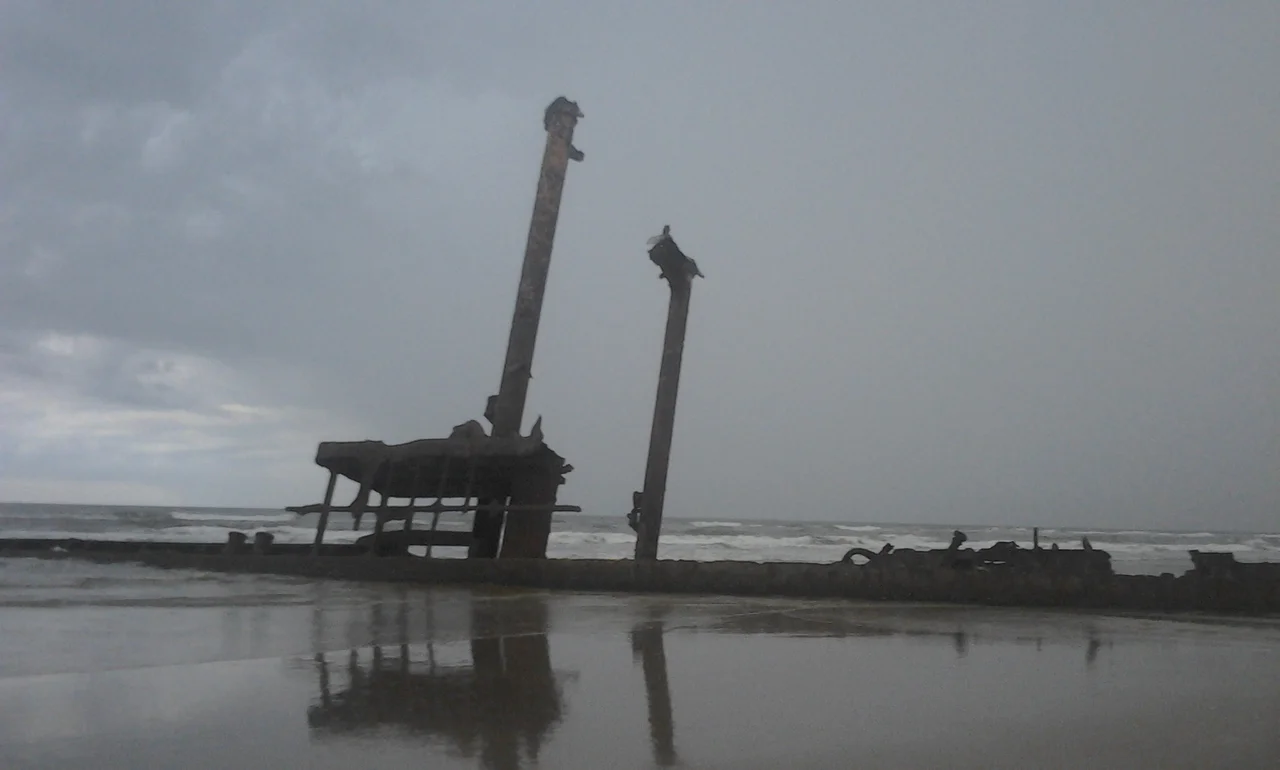
Cassino's flat immensity has attracted some unlikely visitors. On 12 November 1966, as a total solar eclipse darkened the sky above the beach, NASA scientists and the U.S. Army stood on this sand and fired sounding rockets into the upper atmosphere to study it in the eclipse's shadow. A decade later the beach claimed a permanent resident: the ship Altair, driven aground by a fierce storm in June 1976, has rusted on the sand ever since, sixteen kilometers from Cassino's center, a hulk slowly surrendered to salt and tide. Nearer the town stands a cement statue of Iemanjá, the ocean goddess of Afro-Brazilian faith, sculpted by the local artist Erico Gobbi and facing out toward the water she is said to rule.
The Sailing Cart and the Sea Lions
Where the beach meets the port, the great breakwaters reach out into the Atlantic, walls of stone built to keep the navigation channel to Rio Grande open. Along the western jetty, the Molhe Oeste, you can ride something delightfully odd: a small cart pushed by sail, gliding along tracks for roughly four kilometers out toward a lighthouse, a journey of about twenty minutes with dolphins sometimes surfacing alongside. The waters here teem with marine life. Cassino is celebrated for hosting an enormous gathering of sea lions, drawn to the rich southern Atlantic, and visitors take to boats to watch the animals haul out and bask, a wild counterpoint to the beach's faded resort past.
A Beach Built for Extremes
Everything about Cassino runs to excess, even its sports. The beach hosts the Cassino Ultra Race, billed as the largest beach ultramarathon in the world, sending runners pounding 230 kilometers across the sand, beginning down near the Chuí frontier and finishing at Cassino itself, with shorter punishing distances of 135 and 73 kilometers for those who prefer mercy. Around 150,000 visitors come each year, peaking in the southern summer between December and January, to swim, surf, and simply stand on a shore that seems to have no end. In 1994, Guinness World Records made it semi-official, recognizing Praia do Cassino as the world's longest beach, a title forever shadowed by the paradox that makes any such measurement impossible to truly settle.
From the Air
Praia do Cassino runs along the South Atlantic coast of Rio Grande do Sul, with its northern, developed end near the port of Rio Grande at approximately 32.19°S, 52.16°W. From the air it is one of the simplest and most striking features imaginable: a single dead-straight line of pale sand separating the dark ocean from the green coastal plain, extending southwest beyond the horizon toward the Chuí Stream and the Uruguayan border. The defining navigational landmarks are the long parallel breakwaters (the Molhes) reaching into the Atlantic at the entrance to Rio Grande's port, a lighthouse at the end of the western jetty, and the rusting wreck of the Altair on the sand some 16 km south of town. Nearest airports are Rio Grande / Gustavo Cramer (ICAO SJRG, formerly SBRG) immediately inland and Pelotas–João Simões Lopes Neto International (ICAO SBPK) to the northwest. Recommended viewing altitude 2,000 to 4,000 feet to trace the shoreline and the port jetties; the open coast is prone to sea fog, haze, and brisk onshore winds off the South Atlantic.
Nearby Stories
- Pelotas 28 km away
- Taim Ecological Station 31 km away
- Jaguarão 60 km away
- Lagoa dos Patos 98 km away
- Lagoa do Peixe National Park 131 km away
- Melo, Uruguay 136 km away
- 1957 Bagé VARIG Commando Crash 146 km away
- Battle of the River Plate 299 km away