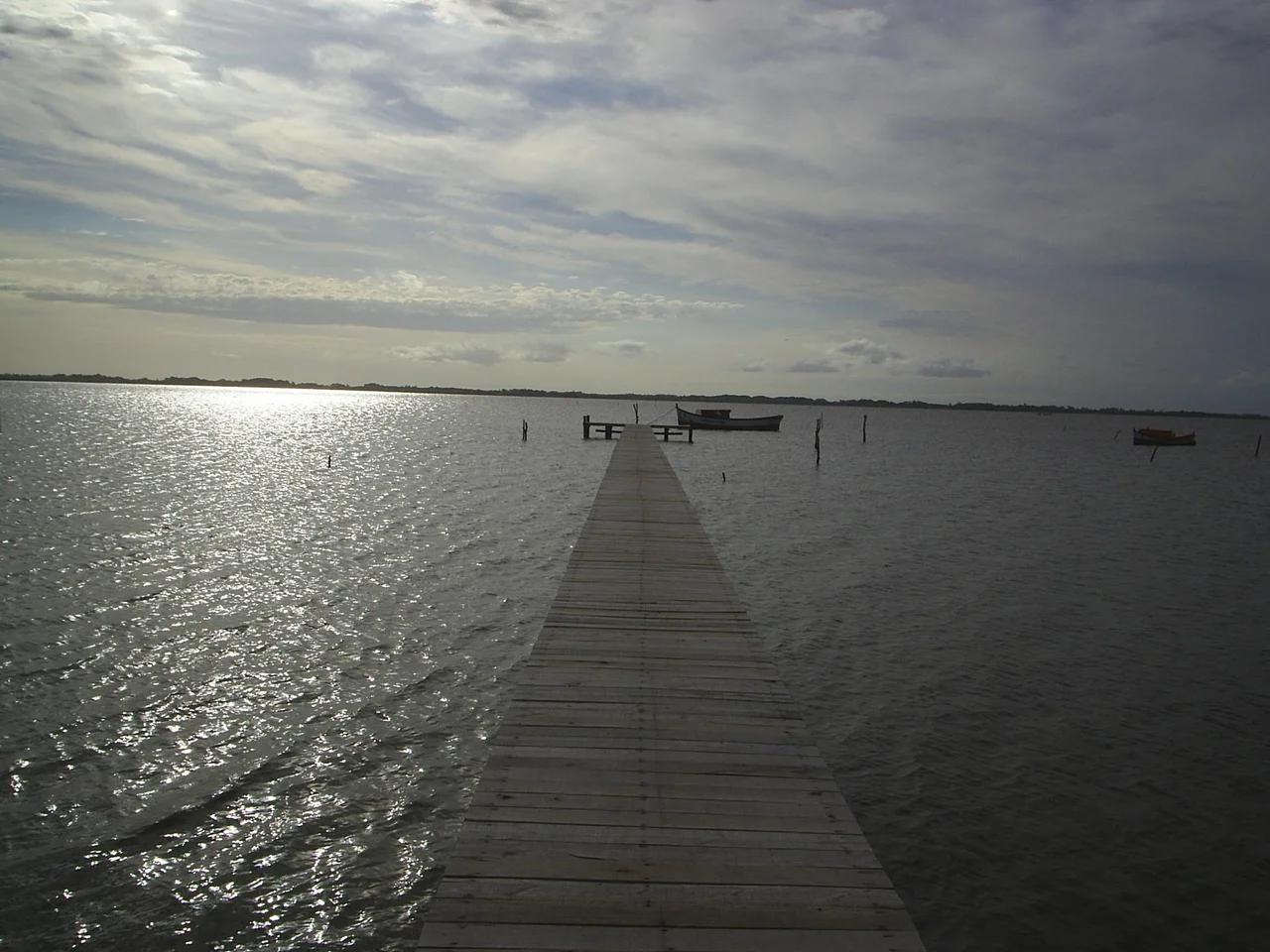

Lagoa dos Patos
From the International Space Station, it looks like a tear in the coast of southern Brazil, a long dark sheet of water angled against the green of the land. The Lagoa dos Patos, the Ducks' Lagoon, is the largest lagoon in all of Brazil and the largest coastal lagoon in South America. Stretch a measuring tape across it and you cover an area slightly smaller than Jamaica. It is also the largest choked coastal lagoon in the world, meaning it is nearly sealed from the ocean, the entire vast body breathing through a single narrow inlet at its southern tip.
An Inland Sea
The numbers strain the imagination. The lagoon covers roughly ten thousand square kilometers, occupying close to a third of the entire coastal plain of Rio Grande do Sul. It runs northeast to southwest behind a sandbar about five miles wide that separates it from the open Atlantic. For all that size, it is strikingly shallow, averaging only a few meters deep, with a gentle tidal range of less than half a meter. The great Guaíba river system pours fresh water into its northwestern end near Porto Alegre, through the maze of channels called the Jacuí Delta, while the Camaquã River feeds it from the west. This is not quite lake and not quite sea. It is something in between, and that betweenness defines everything that lives in it.
Where Salt Meets Fresh
The lagoon's character is a tug-of-war between river and ocean. Most of the time fresh water dominates, but under the right conditions, when southern winds blow hard, lagoon levels drop, and spring tides surge, salt water can push astonishingly far inland, penetrating up to two hundred kilometers north from the single inlet near Rio Grande city. That shifting boundary makes the water brackish and biologically rich, a nursery for fish and a haven for birds. Black-necked swans and coscoroba swans glide its margins, and Chilean flamingos wade the shallows in their improbable pink. The lagoon is fed and flushed in slow rhythm, an estuary on a scale that few places on Earth can match.
Dolphins at the Door
At the narrow mouth near Rio Grande, the wildlife turns spectacular. The Lagoa dos Patos estuary hosts the largest known population of Lahille's bottlenose dolphin, a southern lineage of the species, and these dolphins patrol the inlet where lagoon water trades places with the sea. Watch the channel long enough and dark fins break the surface, working the same currents that fishing boats have used for centuries. On rare occasions the spectacle grows larger still: southern right whales, ocean giants that breed off the South American coast, have wandered through the Rio Grande outlet and into the lagoon's edge, lost leviathans in an unexpected place.
Life on the Shore
People have always gathered at this water. The lagoon's largest and most fertile island, the Ilha dos Marinheiros, the Sailors' Island, sits near the eastern shore and belongs to the municipality of Rio Grande, its piers reaching out into the shallows. Ringing the lagoon are towns whose lives turn on it, fishing communities and ports strung along the coast: Rio Grande and Pelotas at the south, then São Lourenço do Sul, Tapes, Arambaré, Mostardas, Tavares, and São José do Norte tracing its long shoreline. Near Pelotas, the navigable São Gonçalo Channel links the Lagoa dos Patos to its smaller sister, the Lagoa Mirim, threading the two great waters of Brazil's far south into one connected system.
From the Air
The Lagoa dos Patos dominates the coast of Rio Grande do Sul, oriented northeast to southwest; a representative center point is roughly 31.15 degrees south, 51.39 degrees west, though the lagoon spans well over 250 km from the Jacuí Delta near Porto Alegre down to the single inlet at Rio Grande. From altitude it is unmistakable: an immense pale-to-dark sheet of water hemmed from the Atlantic by a thin sandbar and barrier dunes, with the Ilha dos Marinheiros visible near the southern end. Surrounding terrain is flat coastal plain, rarely above 6 meters, so the lagoon reads as the defining landmark for hundreds of kilometers. Gateways along its shores include Rio Grande (SBRG) and Pelotas (SBPK) at the south; the major hub, Salgado Filho International in Porto Alegre (SBPA), sits at the lagoon's northwestern head. Expect strong, persistent winds across the open water and humid subtropical conditions with seasonal coastal fog.
Nearby Stories
- Lagoa do Peixe National Park 5.7 km away
- Pelotas 45 km away
- 2009 Brasil de Pelotas Bus Disaster 67 km away
- Itapuã State Park 81 km away
- 1989 Santa Elmira Massacre 85 km away
- Santa Cruz do Sul 141 km away
- Festival de Gramado 174 km away
- Battle of the River Plate 337 km away