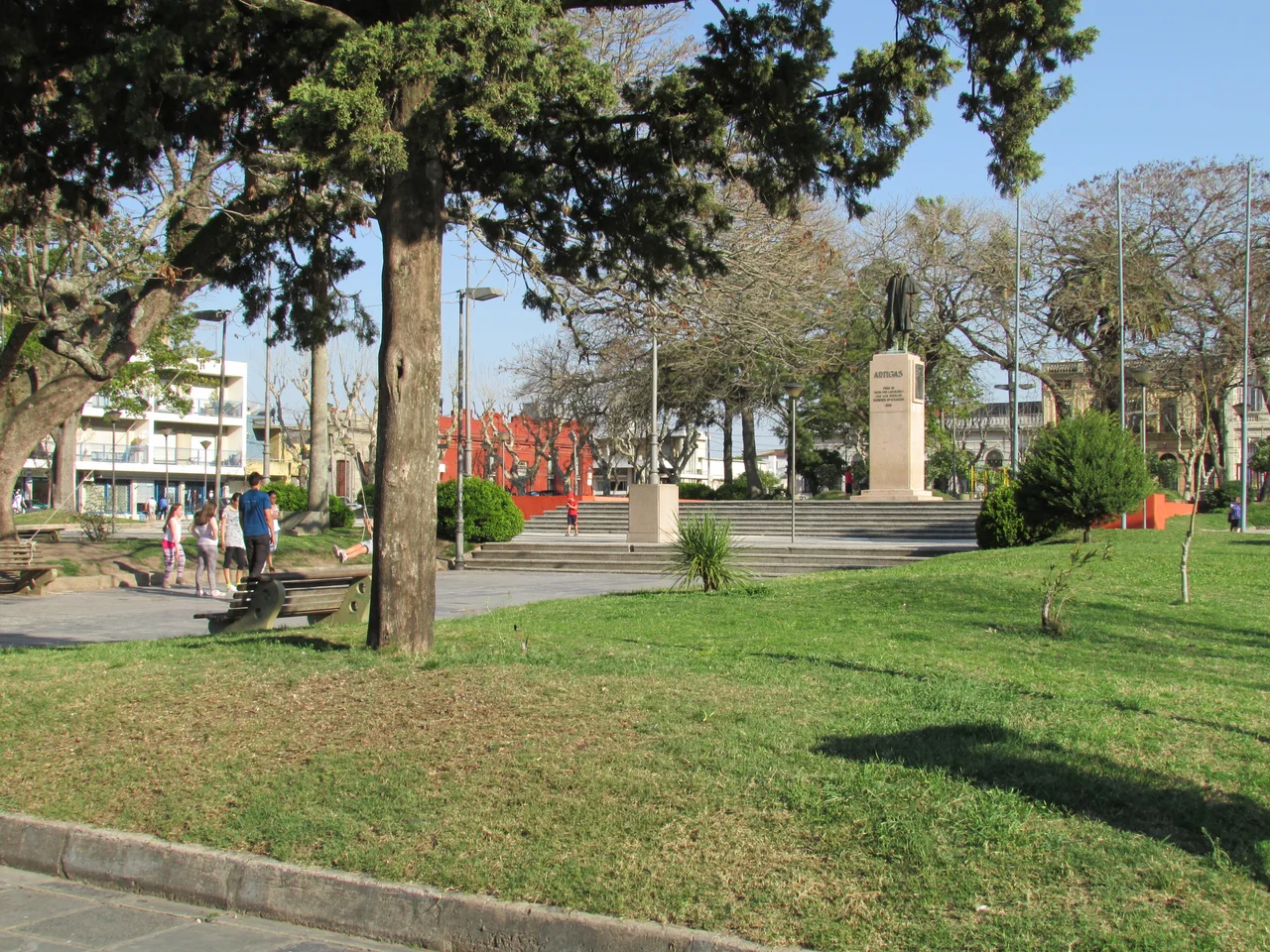

Melo, Uruguay
In 1988, Pope John Paul II came to Melo, and a man decided to get rich on toilets. The town braced for hordes of Brazilian pilgrims pouring across the nearby border to see the pontiff, and one enterprising resident reasoned they would all, sooner or later, need a bathroom. He built one and prepared to charge admission. The crowds never came as imagined, and the scheme collapsed - a small human comedy of hope and miscalculation that became the 2007 film El Baño del Papa, "The Pope's Toilet." It is the kind of story Melo tells well: a quiet capital in Uruguay's far northeast, where the big world occasionally arrives and ordinary people improvise their response.
The Poet of America
Melo's most luminous native was born here in 1892: Juana Fernández Morales, who the world would come to know as Juana de Ibarbourou - and then simply as "Juana de América," Juana of America. She became one of the most beloved poets of the Spanish-speaking world, her early verse vivid and sensual, her later work bound tightly to the natural landscape she loved. Three times - in 1959, 1960, and 1963 - her name was put forward for the Nobel Prize in Literature. Her face appears on Uruguay's 1,000-peso banknote, and her childhood home in Melo is preserved as a museum. That a small interior town produced a poet of such reach is a point of deep local pride, and her birthplace remains one of the city's quiet shrines.
A Capital of the Cattle Country
Melo was founded on June 27, 1795, by Agustín de la Rosa, an officer of the Spanish Empire, and named for Pedro Melo de Portugal, a colonial official of Portuguese royal blood. Sitting close to Brazil, the young "Villa de Melo" was a frontier prize: Portuguese forces invaded it in 1801, 1811, and again in 1816. When Uruguay won independence, Melo became the capital of Cerro Largo, one of the nine original departments of the republic. This is gaucho country, the world of the mounted cattlemen and the caudillos who led them - so much so that a historian framed his study of Uruguay's last great horseback leaders partly around this corner of the nation. The land remains tied to livestock, and the local political loyalties run deep and old, anchored for generations to the White Party of Manuel Oribe.
The Coldest Corner
Melo holds a record no Uruguayan town wants in summer but every schoolchild remembers: the lowest temperature ever recorded in the country. On June 14, 1967, the thermometer fell to minus eleven degrees Celsius - twelve degrees Fahrenheit - in this northeastern city. It is a startling number for a nation most people picture as warm and temperate. Melo's humid subtropical climate brings hot summer days that cool sharply at night, and winters marked by frequent frosts and thick fog that settles over the streams and pastures. The rain spreads evenly through the year. But it is that single frigid winter morning in 1967 that fixed Melo in the national memory as the place where Uruguay came closest to truly freezing.
Streams, Stone, and Memory
The Arroyo Conventos, a tributary of the Tacuarí River, runs along the western edge of Melo, and the surrounding department is laced with such streams and old crossings. Near the city stands the Posta del Chuy, a stone inn beside an ancient bridge over the Chuy del Tacuarí creek - a relic of the era when travelers needed waystations on the long rides between settlements. Today Melo is the ninth most populous city in Uruguay, home to around 56,000 people as of the 2023 census, a regional hub where Routes 7 and 8 cross. It keeps its museums, its cathedral, its memory of the poet and the pope. For all its modern function as a departmental capital, Melo still feels like what it has always been: a gathering point in the wide gaucho country of the northeast, near the border, far from the coast, proud of its own.
From the Air
Melo sits at 32.37°S, 54.17°W, at the center of Cerro Largo Department in northeastern Uruguay, where Routes 7 and 8 intersect, about 60 km south of the Brazilian border at Aceguá. From the air, look for the urban grid set among rolling cattle country, with the Arroyo Conventos tracing the western edge of the city and the broader network of streams feeding the Tacuarí River. The local field is Cerro Largo International Airport (ICAO: SUMO, IATA: MLZ), about 5 km northwest of the city. The region falls within the Montevideo flight information region; the main long-haul gateway is Carrasco International at Montevideo (ICAO: SUMU), roughly 320 km south-southwest. Winters here bring frequent frost and dense fog - Melo holds Uruguay's record low of -11°C - so morning visibility can be poor in the cold season; clear days at low to medium altitude offer the best view of the city and its surrounding pastoral landscape.
Nearby Stories
- Quebrada de los Cuervos 29 km away
- Jaguarão 42 km away
- Cerro Chato 53 km away
- Minas de Corrales 89 km away
- 1957 Bagé VARIG Commando Crash 89 km away
- Santa Vitória do Palmar Meteorite 97 km away
- Cisplatina 125 km away
- 2009 Brasil de Pelotas Bus Disaster 135 km away