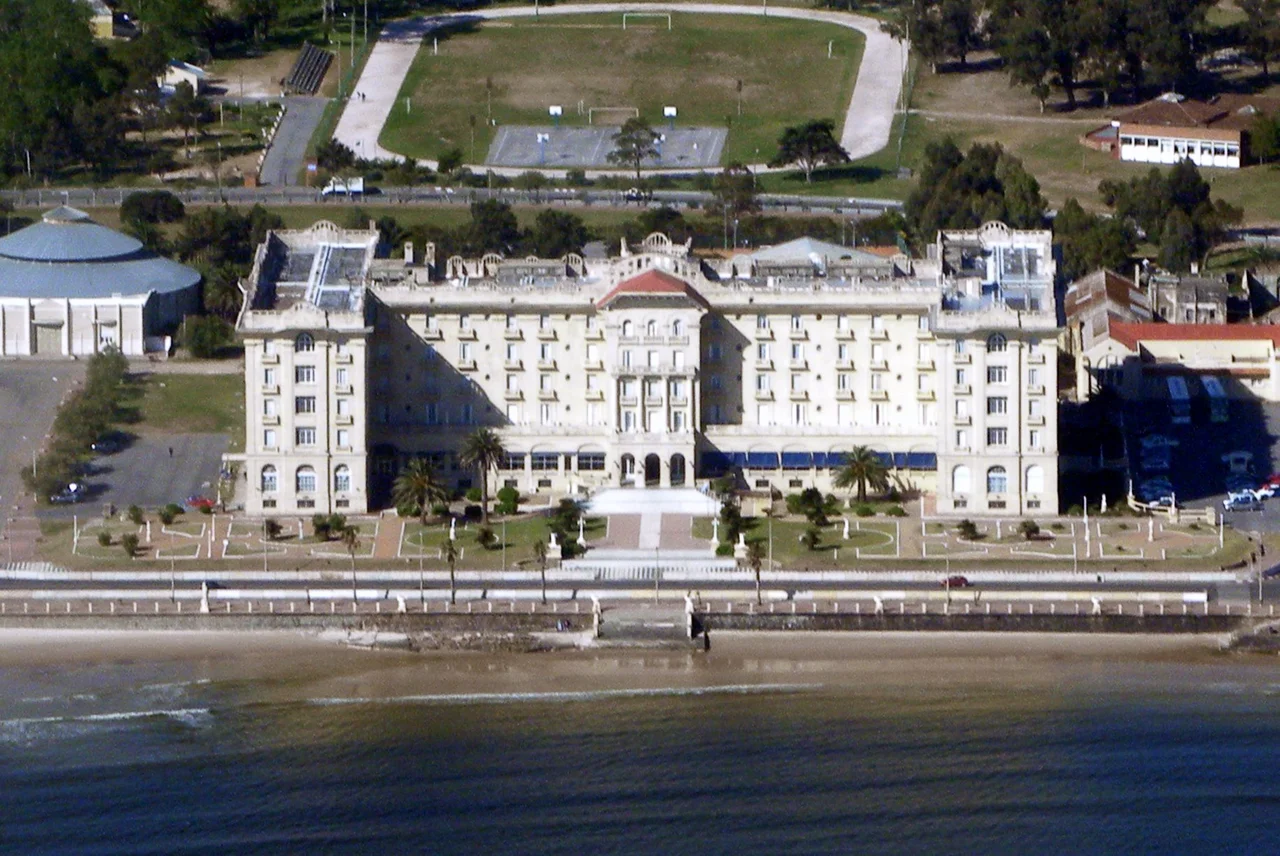

Argentino Hotel
Look down on the Argentino Hotel from the air and you are not seeing a hotel at all. You are seeing the astrological glyph for the planet Uranus, pressed into the Uruguayan coastline in stone and stucco. This was no accident. Francisco Piria, the man who dreamed the building and the entire town of Piriápolis around it, was a practicing alchemist who believed that geometry, placed correctly on the earth, could bend the world toward fortune. The hotel was the keystone of that belief. When it opened on Christmas Eve in 1930, it was, for years, the largest hotel in South America.
A Mind Like No Other
Francisco Piria was born in 1847 to an Italian family, and he was many things at once: a businessman, a writer, a politician, and an esotericist who took alchemy seriously as a practical art. He did not merely collect occult symbols the way a wealthy man collects paintings. He believed in them. He had wanted to call his seaside city Heliopolis, the city of the sun, and he laid out its principal buildings so that, viewed from above, they would echo the constellation of Aquarius. The Argentino Hotel sat at the heart of this scheme. To Piria, it was not just a place for guests to sleep. It was a working part of a vast, deliberate design meant to channel something larger than tourism.
Built to Astonish
The numbers alone were staggering for their time. Piria conceived the hotel for 1,200 guests. In 1920, Uruguayan president Baltasar Brum himself laid the cornerstone. The finished building stretched 120 meters across its front, ran 70 meters deep, and rose six floors. It cost five million pesos, an enormous sum, and Piria spared nothing on its contents. He imported linen from Italy, crockery from Germany, glassware from Czechoslovakia, and furniture from Austria. Inside the entrance, a staircase climbs toward the rooms beneath a stained-glass window five square meters wide, glowing with what early visitors described as innumerable iridescent colors. The architect of record was Pierre Guichot, but the vision behind every detail was Piria's own.
Healing from the Sea
Piriápolis was conceived as a place of restoration, and the Argentino was its temple of well-being. On the floor below the main level, Piria installed the town's first facilities for thalassotherapy, the practice of healing through seawater. Guests could take hot and cold seawater baths in private showers and bathtubs, work through routines in a Swedish gymnastics section, or visit the hairdressing salons before dinner. A century before wellness tourism became a marketing phrase, Piria built an entire establishment around the idea that the ocean itself could mend the body. The saltwater pools and thermal spa still draw visitors who climb the great staircase looking for the same thing earlier generations sought.
The Hotel Keeps Living
Most grand hotels of that era have become museums, ruins, or memories. The Argentino simply kept working. It belongs to the Uruguayan state and is run under a long concession that extends to 2047. It earned a formal certification for physical accessibility under Uruguay's UNIT 200 standard, and in 2021 it opened its doors to small dogs traveling with their owners. Each year the building hosts the international film festival Piriápolis de Película, screening features and shorts free of charge, and the Grand Prix of Piriápolis has roared past its front. The Uruguayan film Whisky shot scenes inside its walls. Nearly a century on, the alchemist's keystone is still doing exactly what he built it to do.
From the Air
The Argentino Hotel sits at approximately 34.863 degrees south, 55.279 degrees west, on the waterfront of Piriápolis in Uruguay's Maldonado Department. Its enormous six-story facade, 120 meters wide and pale against the dark Atlantic, makes it the single most recognizable structure on this stretch of coast. From the air the distinctive massing reads clearly even before the town resolves. The nearest airport is Capitán de Corbeta Carlos A. Curbelo International (ICAO: SULS), at Laguna del Sauce roughly 25 km east. Montevideo's Carrasco International (ICAO: SUMU) lies about 90 km west. Best viewing is in clear summer light, December through March, when haze off the Río de la Plata is minimal.
Nearby Stories
- 2012 Air Class Líneas Aéreas Fairchild Swearingen Metroliner crash 8.4 km away
- Laguna Garzón Bridge 27 km away
- Minas 31 km away
- Cerro Catedral (Uruguay) 32 km away
- Tronador (rocket) 124 km away
- Nueva Helvecia 128 km away
- Mundo Marino 181 km away
- South Georgia Island 2554 km away