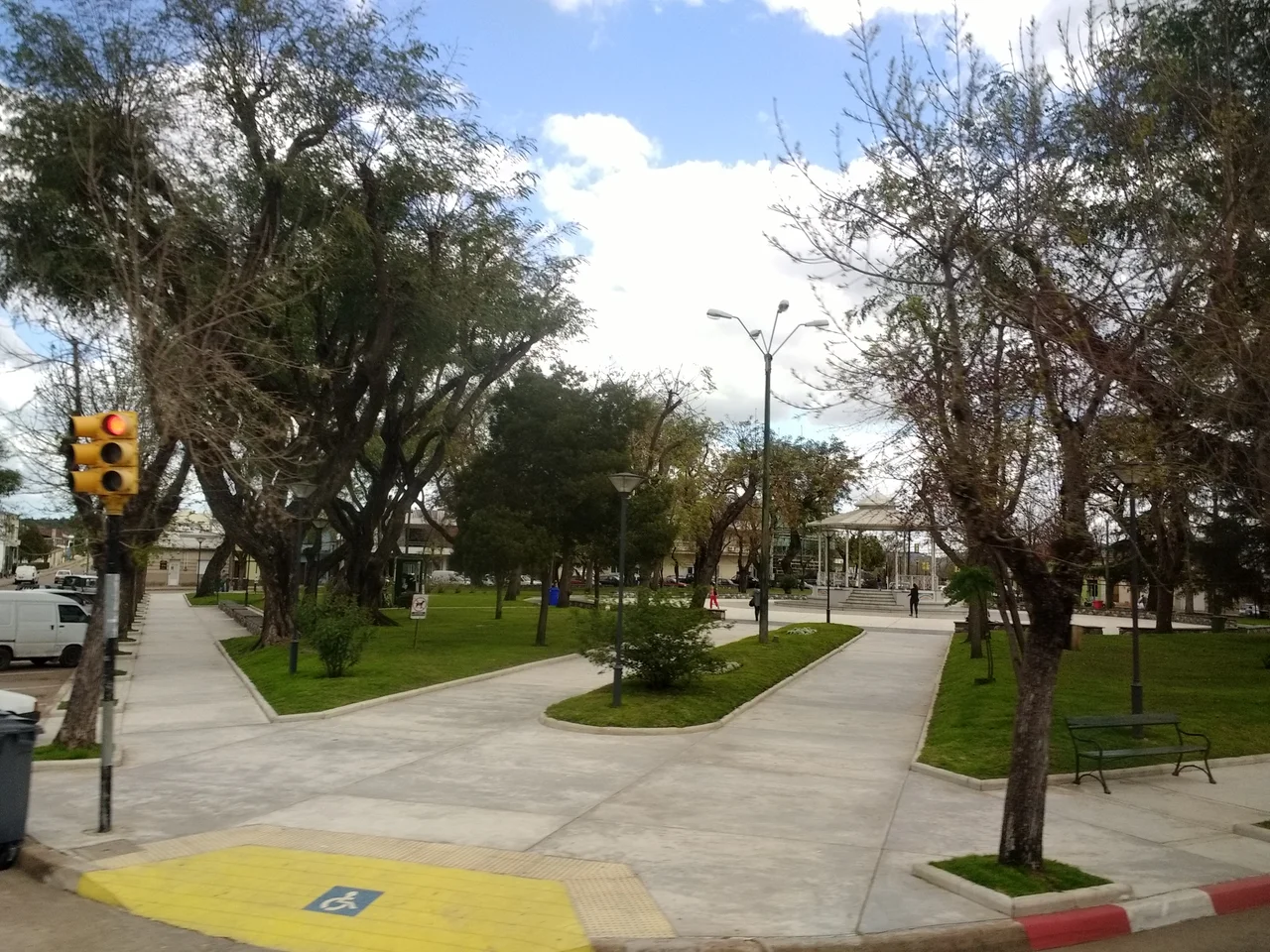

Minas
Pour a glass of mineral water almost anywhere in Uruguay and there is a good chance it came from a spring in the hills above Minas. This is unusual company for a town of its size: a quiet provincial capital, tucked between the ranges of southern Lavalleja where Routes 8 and 12 cross, that nonetheless supplies the country's most famous bottled water and gave Uruguay one of the leaders of its independence. Minas does not announce itself the way the coast does. It sits inland among the sierras, framed by the wooded basins of the Arroyo San Francisco and Arroyo Campanero, and its drama is the slow kind, written into rock that is over a hundred million years old and into festivals that fill its little stadium twice a year.
Spanish Families and the Zones of the Mines
The town carries mining in its name, though its real harvest turned out to be water and stone. The idea was first floated in 1753 by José Joaquín de Viana, the governor of Montevideo, who wanted a settlement in what he called the zones of the mines and commissioned Rafael Pérez del Puerto to lay out its grid, a plan whose bones the streets still follow. The settlement itself came in 1783, when families from the Asturias and Galicia regions of Spain put down roots here after a failed attempt to colonize Patagonia. Status arrived in stages: a town in 1830, capital of its department in 1837, a city in 1888. In 1927 the department was renamed for the independence hero born here, and Minas became the capital of Lavalleja.
The Water of the High Stones
Just southwest of town, the Parque Salus shelters the spring that made the name Salus a Uruguayan household word. A group of entrepreneurs acquired the land in 1892 and began bottling water from the source in 1902; more than a century later, Salus remains the country's leading mineral water, sold nationwide and exported to Brazil under the name Fuente del Puma. The puma is no marketing invention. Local legend tells of a big cat that came to drink from a spring in a grotto in these hills, and the source still carries its name. To the east rises Cerro Arequita, a volcanic dome some 120 million years old whose Guaraní-rooted name evokes water seeping from caves in the high rock, filtrations that still drip inside it today.
The Hero and the Hill That Honors Him
Minas is the birthplace of Juan Antonio Lavalleja, the revolutionary who helped wrest Uruguay free during its independence struggle and whose name the surrounding department now bears. At the eastern edge of town, Cerro Artigas lifts a park crowned by an equestrian statue of José Artigas, the father of Uruguayan nationhood, sculpted by Stelio Belloni. The town has bred more than soldiers and statues: the writer Juan José Morosoli, the philosopher and historian Arturo Ardao, the much-traveled footballer Sebastián Abreu, and the folk musician Carlos Paravís all came from here. Twice a year the place fills with music, when the April festival Minas y Abril and October's Semana de Lavalleja draw crowds into the little stadium in Parque Rodó, the old zoological garden turned green heart of the town.
Pilgrims, Waterfalls, and Serra Country
The land around Minas rewards anyone willing to leave the grid. On Verdún Hill stands the National Sanctuary of Our Lady of Verdún, a pilgrimage shrine that draws the devout from across Uruguay. Sixteen kilometers east, the Parque Salto del Penitente hides a tall waterfall in the hills; northeast, about twenty-five kilometers out, the scenic village of Villa Serrana scatters across the slopes in a landscape of rolling sierra. This is some of Uruguay's most genuinely hilly country, a green, folded contrast to the flat pampas and surf coast that define most outsiders' picture of the nation. Minas is the doorway to it, an inland town that trades beaches for ridgelines and pours the country its water besides.
From the Air
Minas lies at 34.38°S, 55.24°W in the sierras of southern Lavalleja, inland from Uruguay's Atlantic coast at the junction of Routes 8 and 12. From the air the town is a tidy grid set in a basin of green hills, distinct from the surrounding pasture; the volcanic dome of Cerro Arequita to the east and the wooded stream valleys are useful landmarks. This is not a coastal flight: the nearest sizable airport is Montevideo's Carrasco International (SUMU / MVD), roughly 110 km southwest. Punta del Este's Capitán de Corbeta Carlos A. Curbelo International (SULS / PDP) is about 80 km south-southeast. The hills can generate afternoon cloud buildup in summer; clearest views of the sierras come on crisp, dry mornings.
Nearby Stories
- Cerro Catedral (Uruguay) 16 km away
- Argentino Hotel 27 km away
- Laguna Garzón Bridge 31 km away
- Hotel Carrasco 32 km away
- Museo de la Memoria (Uruguay) 60 km away
- Battle of Sarandí 74 km away
- Treinta y Tres 106 km away
- Cerro Chato 114 km away