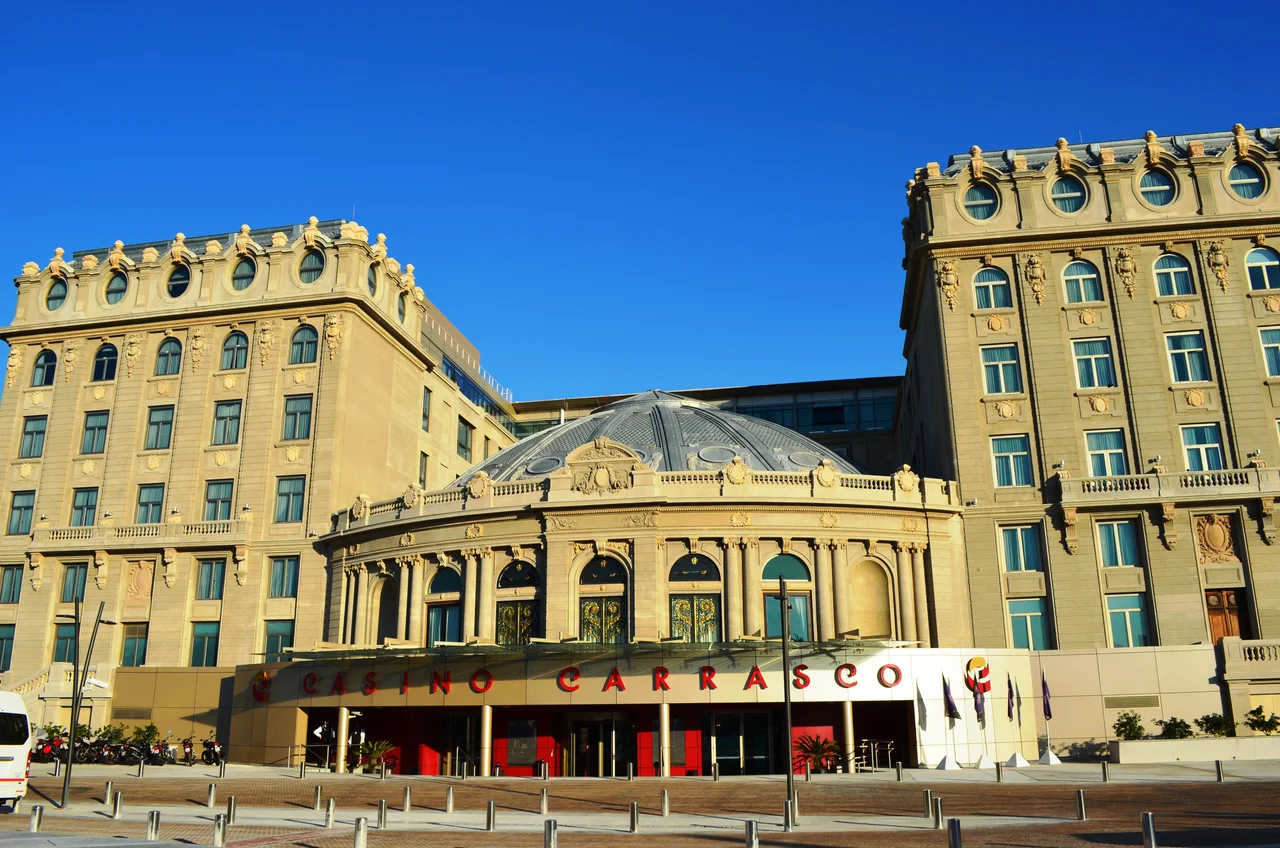

Hotel Carrasco
When the Hotel Carrasco finally opened its doors on 29 January 1921, it had already been waiting nine years to exist. Construction had begun in 1912, then halted when the First World War cut off the flow of materials and money from Europe. For most of a decade the monumental shell stood unfinished above the dunes east of Montevideo, a palace stalled mid-dream. When it was at last completed, it crowned a brand-new garden suburb on the Atlantic shore and announced that Carrasco had arrived.
A Resort Conjured from Sand
The hotel was never meant to stand alone. It was the centerpiece of an entire neighborhood willed into being by the developer Alfredo Arocena and his Balneario Carrasco company, who dreamed of a refined seaside resort where there had been little but coastline. To design it, they brought in Carlos Thays, the celebrated French-Argentine landscape architect trained under Edouard Andre, the same designer behind grand parks across the Americas. Thays laid out Carrasco as a green garden suburb of curving avenues and shaded squares, and the hotel rose at its heart as the reason to come. Its style was eclectic and historicist, neoclassical and baroque at once, modeled on the great palace hotels of Europe.
Einstein Slept Here
Almost from the start, the Carrasco became Montevideo's address for the famous. In 1925, Albert Einstein lodged here during his South American tour, fresh from the revolution he had worked on the nature of space and time. In 1934, the Spanish poet and playwright Federico Garcia Lorca stayed within its walls, a few short years before his murder at the start of the Spanish Civil War. The guest list reflected the hotel's role as a meeting point of two worlds - a place where European intellectual life touched down on the River Plate. Down in the basement, the casino kept the rooms above lively, and the building became shorthand for glamour itself.
The Long Silence
Glamour does not always last. The hotel was declared a National Historical Heritage site in 1975, but recognition could not save it from decline. In 1997 the Carrasco closed its doors, and for sixteen years the belle-epoque landmark sat dark and empty on the Rambla, its grandeur fading behind shuttered windows. Locals passed the silent palace and remembered what it had been. It is a familiar arc for great old buildings - splendor, abandonment, and the long uncertainty of whether anyone will care enough to bring them back.
A Palace by Two Hands
The building that survived all this drama was the work of the architects Gaston Mallet and the Swiss Jacques Dunant, who gave Carrasco the silhouette of a European grand hotel transplanted to the South Atlantic shore. Its eclectic-historicist design mixes neoclassical restraint with baroque flourish, all of it oriented toward the sea so that guests could take in the Rio de la Plata from its terraces. The hotel was conceived as the anchor of a place meant for leisure - the casino in the basement, the ballrooms above, the beach and gardens just beyond the door. More than a building, it was a promise about what the new century on this coast might feel like: gracious, modern, and unmistakably grand.
A Second Opening
Someone did. Beginning in 2009, a careful restoration brought the building back over four years, and on 7 March 2013 the Carrasco reopened - now the Sofitel Montevideo Casino Carrasco and Spa, with 116 rooms and suites, a restored casino, and a restaurant named 1921 for the year it first welcomed guests. The revival rippled outward, just as Thays had once intended for the whole neighborhood: the surrounding streets filled with new life, and Rostand Street and its plaza became one of the city's favorite places to stroll. Nearly a century after it first opened, the seaside palace was once again the heart of Carrasco.
From the Air
The Hotel Carrasco stands on the Rambla, Montevideo's coastal boulevard, at roughly 34.891 degrees south, 56.055 degrees west, in the leafy Carrasco neighborhood on the city's eastern edge. From the air it reads as an ornate, light-colored block facing directly onto the broad waters of the Rio de la Plata, set back from the long ribbon of beach. It sits only about 5 km west of Carrasco/General Cesareo L. Berisso International Airport (ICAO: SUMU), which shares the neighborhood's name and makes a natural reference point on approach. The smaller Angel S. Adami Airport (ICAO: SUAA) lies across the city to the northwest. Best viewed at lower altitudes; the contrast between the green garden suburb, the pale building, and the brown estuary is sharpest on clear days.
Nearby Stories
- Piriápolis 24 km away
- Minas 40 km away
- Tronador (rocket) 67 km away
- Nueva Helvecia 69 km away
- La Plata Museum 122 km away
- Battle of Sarandí 126 km away
- Mundo Marino 145 km away
- South Georgia Island 2584 km away