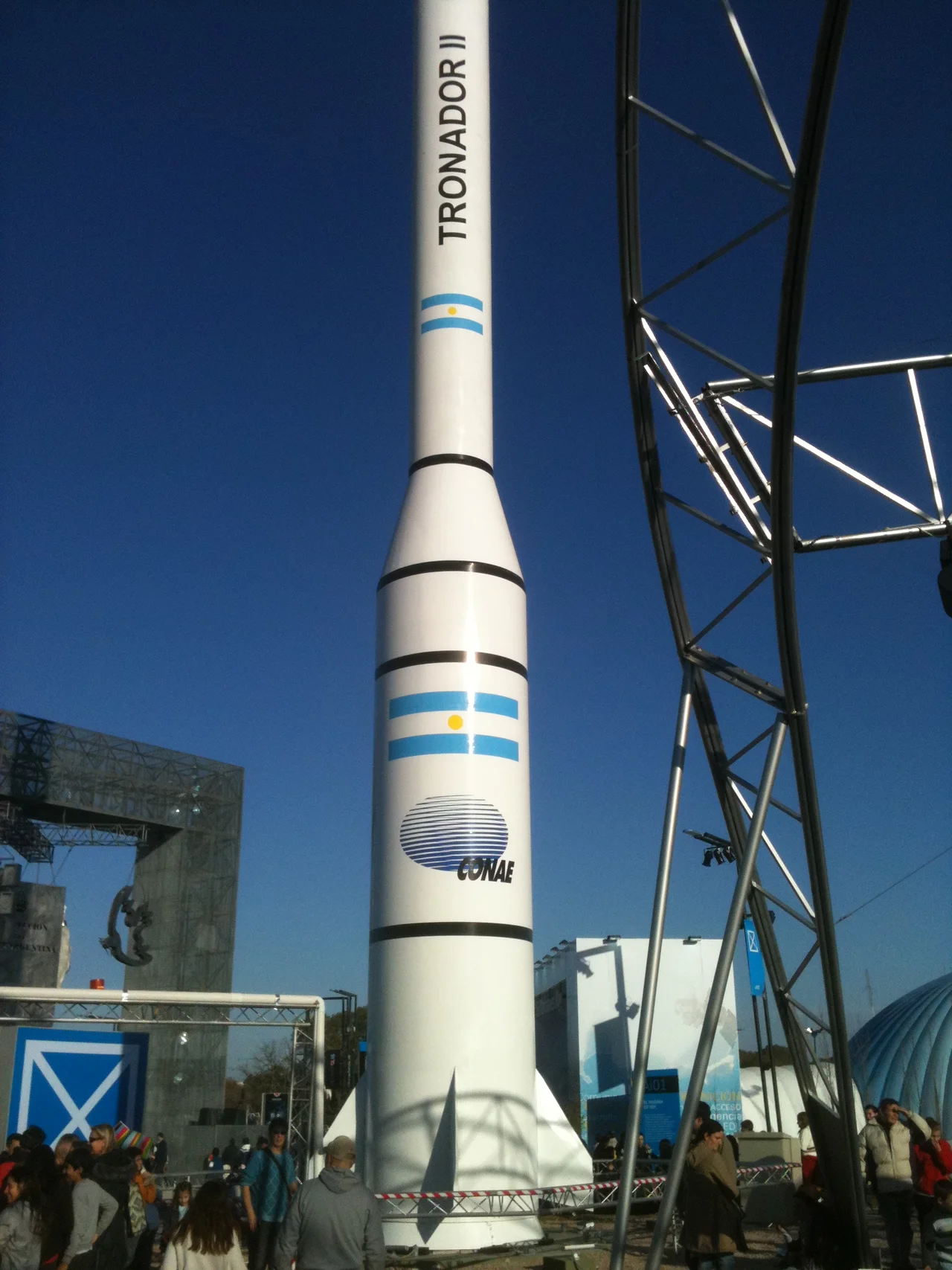

Tronador (rocket)
Eight seconds. That is how long the VEx-5A burned before its engine starved on the evening of 21 April 2017, hung in the air over the marshes south of Buenos Aires, and fell back onto its own launch pad in a sheet of orange flame. It was Argentina's third attempt to fly a prototype of the Tronador II, and like the others it failed in full view of the cameras. Yet the people watching from the scrubland at Pipinas did not pack up and go home for good. Tronador means "Thunderer" in Spanish, and a country that has named a rocket after thunder does not give up easily on hearing it roar.
The Long Road to Orbit
Only a small club of nations can launch a satellite using a rocket they designed and built themselves. Argentina wants in. Run by CONAE, the country's national space commission, the Tronador program set out to develop a liquid-fueled launcher capable of placing a roughly 500 to 600 kilogram payload into low Earth orbit. It is a famously hard problem, and Argentina chose the hard version of it: not solid fuel bought off a shelf, but liquid oxygen and refined kerosene, the same demanding chemistry that powers the world's great rockets. Progress has come in fits and starts, threaded through changing governments, tight budgets, and the simple, unforgiving physics of getting a metal tube to leave the planet.
Learning by Flying
The Tronador story is told in prototypes, each one a small machine sent up to teach the engineers a single hard lesson. The early Tronador I rose on test hops; in 2008 a payload module packed with navigation electronics rode a borrowed booster to the edge of space and parachuted back into the sea, where it was fished out and studied. Then came the VEx series, the technology demonstrators. VEx-1A barely cleared the ground in 2014, undone by interference between rocket and pad, before a safety system cut the fuel and saved it from exploding. Months later VEx-1B flew clean to 2,200 meters and splashed down under its chutes. Each flight, success or wreck, was data, and data was the point.
The Spaceport in the Marsh
The launches happen at Pipinas, in Punta Indio district, where the pampas flatten out toward the wide brown mouth of the Río de la Plata. It is an unlikely cathedral of space flight. There are no gantries crowding the sky, no crowds in grandstands, just a launch pad on quiet coastal land where shorebirds wade and the horizon is mostly water. From here the rockets head out over the estuary, so that even when they fail they fall toward the sea rather than toward people. A full-scale model of the Tronador II has stood at the site like a promise of the real thing to come, white and slender against the enormous southern sky.
Still Building the Thunder
The program has been declared dead and then revived more than once. After the 2017 explosion, the experimental VEx flights were halted; in 2021 the effort was publicly reactivated, and by 2022 a new generation of test vehicles, the TII-70 and TII-150, was announced to prove out engines and systems before any full orbital attempt. The engineers have been quietly modernizing along the way, including the additive manufacturing of a regeneratively cooled thrust chamber, the kind of finicky, expensive part that separates a rocket that works from one that does not. An Argentine satellite riding an Argentine rocket from Argentine soil has not happened yet. The work to make it happen has not stopped.
From the Air
The Tronador test launch site sits near Pipinas, in Punta Indio district of Buenos Aires Province, at approximately 35.52°S, 57.18°W, on flat coastal land along the southwestern shore of the Río de la Plata estuary. Recommended viewing altitude is 3,000 to 5,000 feet AGL for context on how the pampas meet the wide brown water of the estuary, with the launch area facing seaward to the east. Visual landmarks: the broad, almost oceanic mouth of the Río de la Plata to the northeast, and the small town of Pipinas inland. Nearest major airports are Buenos Aires Aeroparque Jorge Newbery (ICAO: SABE) roughly 130 km to the north-northwest, and Ezeiza / Ministro Pistarini International (ICAO: SAEZ) to the northwest. Coastal haze and onshore marine layer are common; clearest viewing is typically on crisp, dry days outside the humid summer afternoons.
Nearby Stories
- Chascomús 32 km away
- German cruiser Admiral Graf Spee 49 km away
- La Plata 53 km away
- Campos del Tuyú National Park 59 km away
- Museum of Pre-Columbian and Indigenous Art 84 km away
- La Plata Museum 87 km away
- Aerolíneas Argentinas Flight 644 172 km away
- South Georgia Island 2563 km away