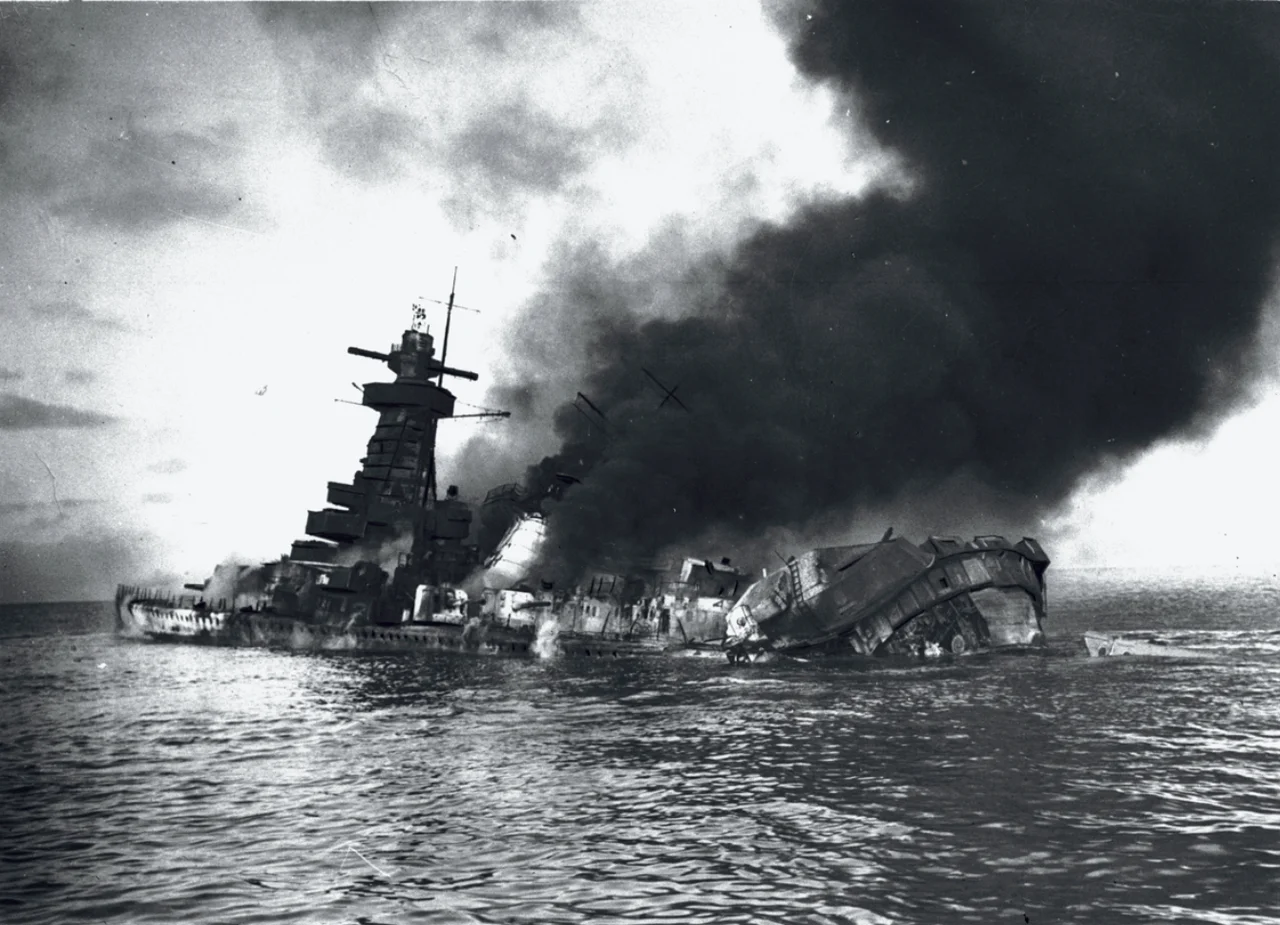

German cruiser Admiral Graf Spee
On the night of 17 December 1939, a crowd of twenty thousand people lined the waterfront of Montevideo to watch a warship die. Out in the roadstead, the Admiral Graf Spee - one of Nazi Germany's most feared raiders, the ship the British called a pocket battleship - settled into the shallow brown water of the Río de la Plata as her own crew's scuttling charges tore her open. Jets of flame leapt skyward; a vast cloud of smoke rolled across the estuary. She would burn for two more days. Her captain had only forty men aboard for the end, and he had chosen this fate deliberately, to keep his sailors alive and his secrets from the enemy. The wreck still lies there, in barely eleven meters of water, where the great river meets the Atlantic.
The Raider Built to Break the Rules
The Treaty of Versailles was supposed to keep Germany's warships small - no more than 10,000 tons. The Admiral Graf Spee was a lie wrapped in steel. Laid down at Wilhelmshaven in 1932 and commissioned in January 1936, she was officially within the limit but in truth displaced over 16,000 tons fully loaded. Her designers gave her six 28-centimeter guns in two triple turrets, enough to outshoot any cruiser, and diesel engines that drove her at 28 knots - fast enough to outrun nearly anything that could outgun her. She was the first German warship fitted with radar. Named for Admiral Maximilian von Spee, who died with his sons and his squadron off the Falklands in 1914, she was conceived as a lone hunter: a ship designed to vanish into the world's oceans and prey on enemy commerce, faster than the strong and stronger than the fast.
A Hunter Who Killed No Sailors
When war came in September 1939, the Graf Spee slipped into the South Atlantic to raid Allied merchant shipping. Over three months she sank nine vessels - and here the story turns on its captain, Hans Langsdorff, an officer of the old school. Langsdorff fought by prize rules, the older laws of the sea: he stopped each ship, searched her, and took off her crew before sinking her. He once ordered a distress signal sent on a victim's behalf so her sailors would be rescued. Across all nine sinkings, not one merchant seaman died. He housed his prisoners aboard, transferred them to his supply ship, and treated them with a courtesy the war was already burning away elsewhere. The captured captains and engineers who later spoke of him described not a Nazi but a sailor - a man waging a brutal trade with as much mercy as it allowed.
The Battle of the River Plate
At dawn on 13 December 1939, the masts of three British cruisers rose over the horizon. Commodore Henry Harwood had guessed where the raider would come, and split his ships - Exeter, Ajax, and Achilles - to divide her fire. Langsdorff chose to fight rather than run. For more than an hour the four ships hammered one another across the estuary. The Graf Spee's heavy guns wrecked Exeter, disabling her turrets and killing 61 of her crew, and damaged Ajax badly. But the British light cruisers pressed in relentlessly, and the German ship was struck roughly seventy times. Thirty-six of her own sailors were killed and sixty wounded, Langsdorff himself among them, twice cut by shell splinters as he stood exposed on the open bridge. Damaged and low on ammunition, the raider broke off and ran for the neutral harbor of Montevideo, the British cruisers shadowing her to the river's mouth.
Tricked Into a Choice He Could Not Win
In Montevideo, Langsdorff buried his dead with full military honors and sent his wounded ashore. Neutral Uruguay gave him only 72 hours. The damage to his fuel-purification plant made the long voyage home doubtful, and British intelligence now waged a quieter war - a torrent of false signals convincing him that a battle fleet was massing offshore. In truth the nearest heavy ships were 2,500 miles away. Langsdorff believed the bluff. He could try to break out and be destroyed, taking his crew with him, or he could scuttle. He would not spend his sailors' lives on a hopeless gesture. On 17 December he took the ship out and sank her. Three days later, in a Buenos Aires hotel room, he shot himself - lying upon the ship's old battle ensign, in full dress uniform. He had written first to his wife, his parents, and the German ambassador. A captain of honor, he wrote, could not separate his fate from his ship's. He was buried in Buenos Aires; even Allied officers came to pay respects to the man who had sunk their ships but spared their men.
What the River Still Holds
The wreck was partly broken up in the 1940s, but pieces of the Graf Spee remained visible above the water for years, and much of her still rests on the riverbed. Salvors raised a gunnery rangefinder in 2004 and, two years later, the great bronze eagle and swastika from her stern - a relic that has troubled Uruguay ever since. Locked in a naval warehouse, it has been the subject of court battles and a proposal to melt it down and recast it as a dove of peace. That plan, too, was abandoned, the government concluding it would divide more than it would heal. So the emblem sits in storage, and the hull lies in the shallows, and the city that watched the ship burn has never quite finished deciding what to do with what the war left behind. The Battle of the River Plate is remembered still - the first naval battle of the Second World War, fought and ended within sight of Montevideo's shore.
From the Air
The wreck of the Admiral Graf Spee lies at roughly 34.97°S, 56.30°W, in the shallow waters of the Río de la Plata just off Montevideo, Uruguay, where the estuary opens toward the Atlantic. The site is in only about 11 m of water near the harbor approaches; the city's skyline and port are the obvious visual reference. Montevideo's Carrasco International Airport (SUMU) lies about 20 km east of the city center. Across the estuary, Buenos Aires's Aeroparque Jorge Newbery (SABE) is roughly 200 km west-southwest. Recommended viewing altitude over the estuary is 2,000-4,000 ft. The brown, sediment-laden water of the Plata rarely reveals the wreck itself, but the broad river mouth and Montevideo's harbor mark the spot. Visibility is best in clear morning conditions; the estuary is prone to haze.
Nearby Stories
- Nueva Helvecia 46 km away
- Tronador (rocket) 46 km away
- Piriápolis 56 km away
- Minas 67 km away
- La Plata Museum 90 km away
- Battle of Sarandí 127 km away
- Mundo Marino 135 km away
- South Georgia Island 2599 km away