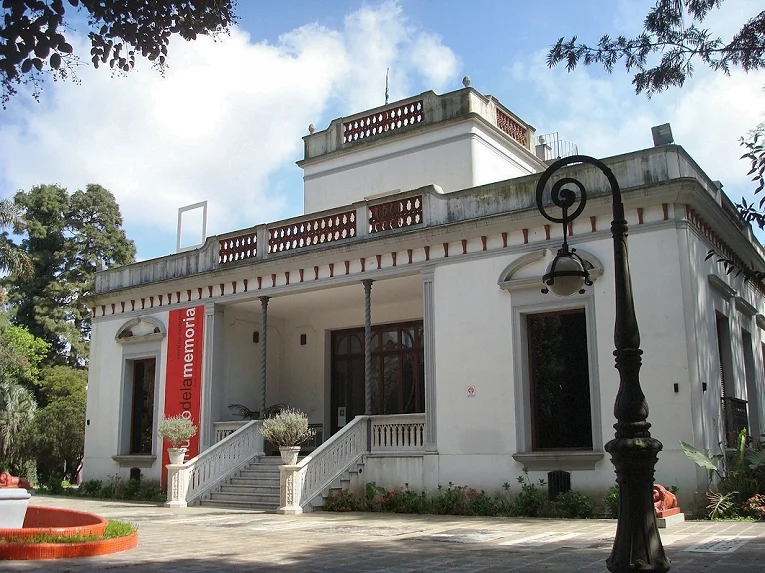

Museo de la Memoria (Uruguay)
There is a word in Uruguay that families learned to fear: desaparecido, the disappeared. Between 1973 and 1985, the country lived under a civic-military dictatorship that imprisoned, tortured, and vanished its own citizens, and for the relatives of the disappeared there was no body, no grave, no certainty, only an absence that never resolved. The Museo de la Memoria, or MUME, exists to hold that absence with care. Set in a graceful old country house and its gardens on the northern edge of Montevideo, it is a place built not to forget. It remembers the people the state tried to erase, and it asks a young democracy to look squarely at what was done in its recent past.
The Years of Fear
Uruguay had long thought of itself as the calm democracy of South America, but on June 27, 1973, President Juan María Bordaberry dissolved parliament and handed power to the military, and the country joined the grim regional pattern of dictatorship. The state turned its machinery against its own people. Citizens were arrested for their politics, held without trial, tortured in detention, and some were made to disappear entirely — at least 197 confirmed enforced disappearances — their fates hidden from the families who searched for them. Others resisted at real cost. The dictatorship lasted until 1985, and when it ended it left behind a wound that the country is still tending. The MUME was created to commemorate the victims of these crimes and to honor the Uruguayans who stood against the oppression, so that the memory would not fade with the generation that lived it.
A House With Many Lives
The setting carries its own long story. The house was built in 1878 as the country retreat of Máximo Santos, a soldier who would serve as president of Uruguay from 1882 to 1886. He sold it soon after leaving office, and in time it passed to Rezcala Neffa, a Lebanese immigrant who became a wealthy Uruguayan industrialist and philanthropist; he gave the property to the navy, which used it for the workshops of its Hydrographic Service. By the 1970s the navy had abandoned the site and it fell into ruin. The city of Montevideo, by then the owner, began restoring the derelict buildings in 2000, helped by a gift of US$800,000 from the supermarket chain Disco, and finished the work in 2005. What had been built for one man's leisure became a place dedicated to a nation's conscience.
Remembering on Human Rights Day
The museum opened to the public on 10 December 2007, a date chosen with intent: it is International Human Rights Day. Run by the city government of Montevideo, the MUME organizes its permanent exhibition around several key themes drawn from the dictatorship and the struggle to recover democracy. Its stated aims are plain and unflinching: to educate new generations about the country's recent history, to promote respect for human rights, and to keep alive the fight for liberty, democracy, and social justice. In doing so it consciously reaches for something larger, weaving these values into the fabric of Uruguayan identity itself, insisting that they belong at the center of what the nation understands itself to be.
The Garden Around the Grief
Surrounding the house is a park unlike any other in the city, the only nineteenth-century parkland in Montevideo to survive essentially unchanged, declared a National Historic Monument along with the house. It was landscaped in an eclectic spirit, borrowing from Italian Renaissance gardens and the period's faith in healthful country air. A long tree-lined avenue leads in; within are gardens of exotic species, a greenhouse, fountains, sculpture, artificial caves, an aviary, and a folly shaped like a small castle, built once for the amusement of children. The serenity is not an accident of contrast. A place that holds such heavy memory needs room to breathe, and visitors who come to confront the darkest chapter of Uruguay's past can carry that weight beneath old trees, in quiet.
From the Air
The Museo de la Memoria sits in the Prado district on the northern side of Montevideo, at 34.84°S, 56.20°W, roughly 9 km inland from Ciudad Vieja and the harbor on the Río de la Plata. From the air the museum's distinctive surviving nineteenth-century parkland, a green island of mature trees and gardens within the city fabric, is the best visual marker. Carrasco/General Cesáreo L. Berisso International Airport (ICAO: SUMU) lies about 20 km to the southeast along the coast, while Ángel S. Adami Airport (ICAO: SUAA) sits closer to the northwest. Best viewed at lower altitudes in clear weather, when the wooded grounds stand out against the surrounding streets.
Nearby Stories
- Piriápolis 24 km away
- Minas 40 km away
- Tronador (rocket) 67 km away
- Nueva Helvecia 69 km away
- La Plata Museum 122 km away
- Battle of Sarandí 126 km away
- Mundo Marino 145 km away
- South Georgia Island 2584 km away