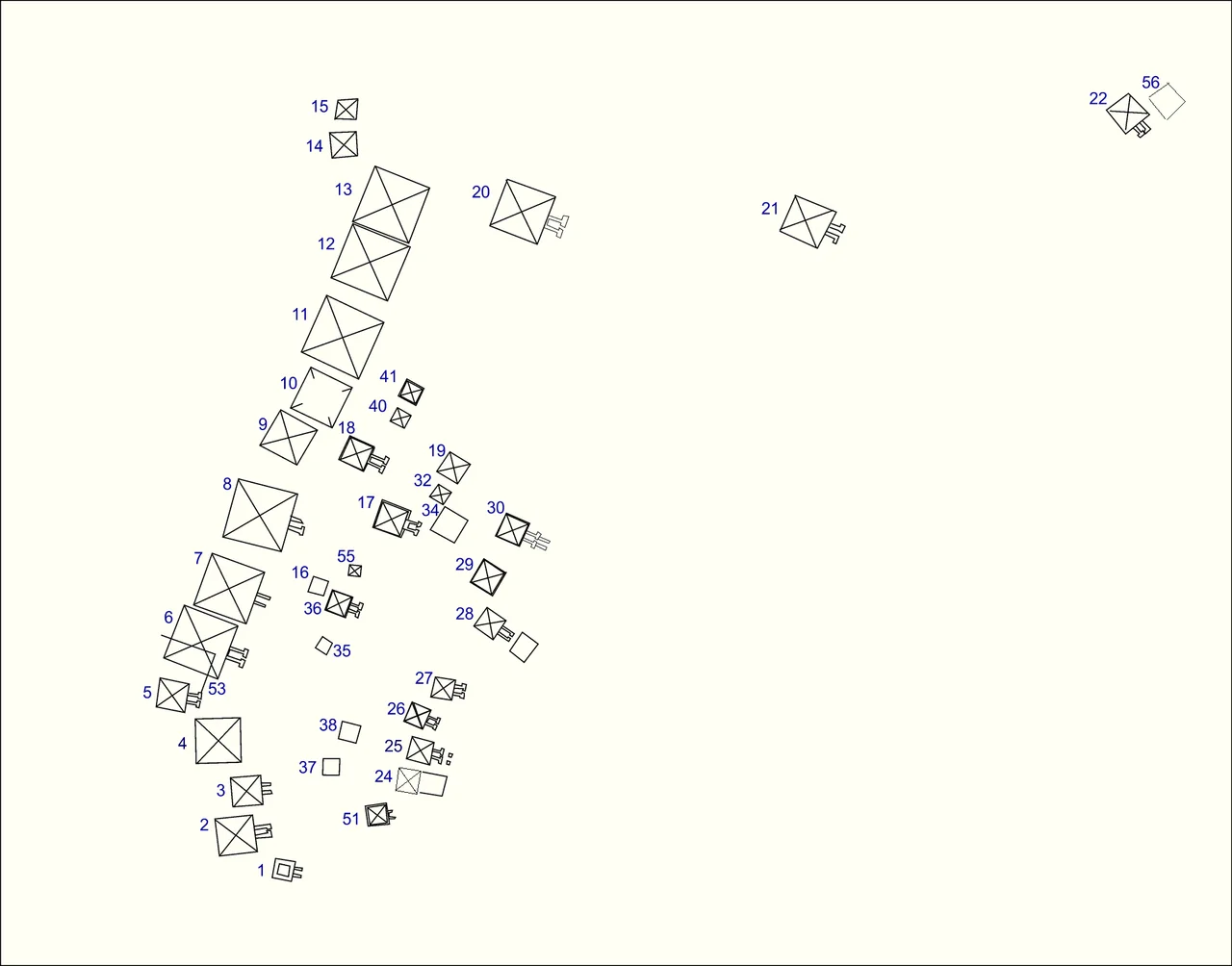

Pyramids of Meroë
In 1834, an Italian treasure-hunter named Giuseppe Ferlini blew the top off Pyramid N6 at Meroë, looking for gold. He found it: gold bracelets, signet rings, Usekh collars - the personal regalia of Queen Amanishakheto, one of the ruling queens of Kush. The hoard ended up in museums in Berlin and Munich, and the pyramid stayed decapitated. That story gets told a lot. The one that matters more is this: at Meroë, a female pharaoh's tomb was important enough to draw a treasure-hunter halfway across the world - because Kush kept putting women on its throne.
Three Cemeteries, One Kingdom
The Pyramids of Meroë are not one pyramid field but three, scattered across a few kilometers of desert near the ancient capital of the same name. Together they hold more than a thousand graves, of which at least 147 were pyramids. The Southern Cemetery came first in the Meroitic period, starting around 270 BCE, and received the first two or three generations of royal Kushite burials - around 90 burials with superstructures, at least 24 of them pyramids. Kings Amanislo and Arakamani rest here, along with Queen Bartare and other royal family members. The tombs have been heavily pillaged over the centuries. What survives is the architecture itself: steep-sided sandstone pyramids far smaller than their Egyptian cousins, often clustered shoulder to shoulder, their small chapels still carrying traces of carved reliefs that show the dead king receiving offerings from his gods.
The Northern Cemetery: Where the Queens Rose
After a generation or two, the Kushite monarchy shifted its burial grounds north. The Northern Cemetery contains 41 known pyramids - the resting places of 30 kings, eight queens regnant, and three princes. That figure, eight ruling queens, is one of the most striking facts about Kush. In a Mediterranean world where female pharaohs were rare and ambiguous, the Kandakes of Kush - Amanitore, Amanishakheto, Amanikhatashan, Amanipilade - wielded full royal power and were buried with full royal honors. Queen Amanitore's pyramid (N1) stands at the head of the field. The largest pyramid in the Northern Cemetery, N11, likely belonged to Queen Nahirqo. Many of the smaller pyramids still carry their attached chapels on the eastern side, cramped little rooms where priests would have left offerings for the ruler on the other side of the wall.
The Western Cemetery and a Longer Story
The Western Cemetery holds the longest continuous record of Kushite death. Burials here began in the 9th century BCE and continued deep into the Meroitic period - more than 800 graves, at least 82 of them pyramids, none belonging to monarchs. This was where the court nobility went: viceroys, generals, scribes, princes like Tedeqen. Walking among these pyramids today you pass a cross-section of Kushite society - the people who ran the kingdom, advised the queens, administered the iron furnaces and the caravan trade that made Meroë wealthy. The tombs are smaller. The stories, when we can recover them from inscriptions, are more intimate.
The Flood, and What Comes Next
On 8 September 2020, for the first time in recorded history, the Pyramids of Meroë were threatened by flood. A once-in-a-century rise of the Nile lapped at structures that had stood dry in the desert for two thousand years. Sudanese archaeologists built emergency sandbag barriers and watched the water. It receded. The pyramids held. Climate change makes future floods more likely, and so do the political crises that keep interrupting preservation work in Sudan. But the Pyramids of Meroë, designated a UNESCO World Heritage Site in 2011, are still here - rising in serried clusters above the yellow sand, each one pointing straight up into a sky the Kushites once read for signs of their gods.
From the Air
Located at 16.94N, 33.75E near Bagrawiyah, in River Nile State, Sudan, about 200 km northeast of Khartoum on the east bank of the Nile. Recommended viewing altitude: 4,000-8,000 feet AGL - the three cemeteries cover a compact area of maybe 2-3 km and make a dramatic pattern against the desert. Look for the dense cluster of steep-sided pyramids on a low ridge east of the river. Nearest major airport is Khartoum International (HSSS), about 200 km south-southwest. The site sits at the western edge of the Bayuda Desert; expect excellent visibility most of the year except during haboob season (roughly April through June).
Nearby Stories
- Ghaba 14 km away
- Esh Shaheinab 89 km away
- Wadi Seidna Air Base 139 km away
- Northern Sudan 157 km away
- Monastery in Ghazali 220 km away
- Red Sea State 261 km away
- Kassala 282 km away
- El-Gadarif 354 km away