.jpg)
Queen of Peace Cathedral, Long Xuyên
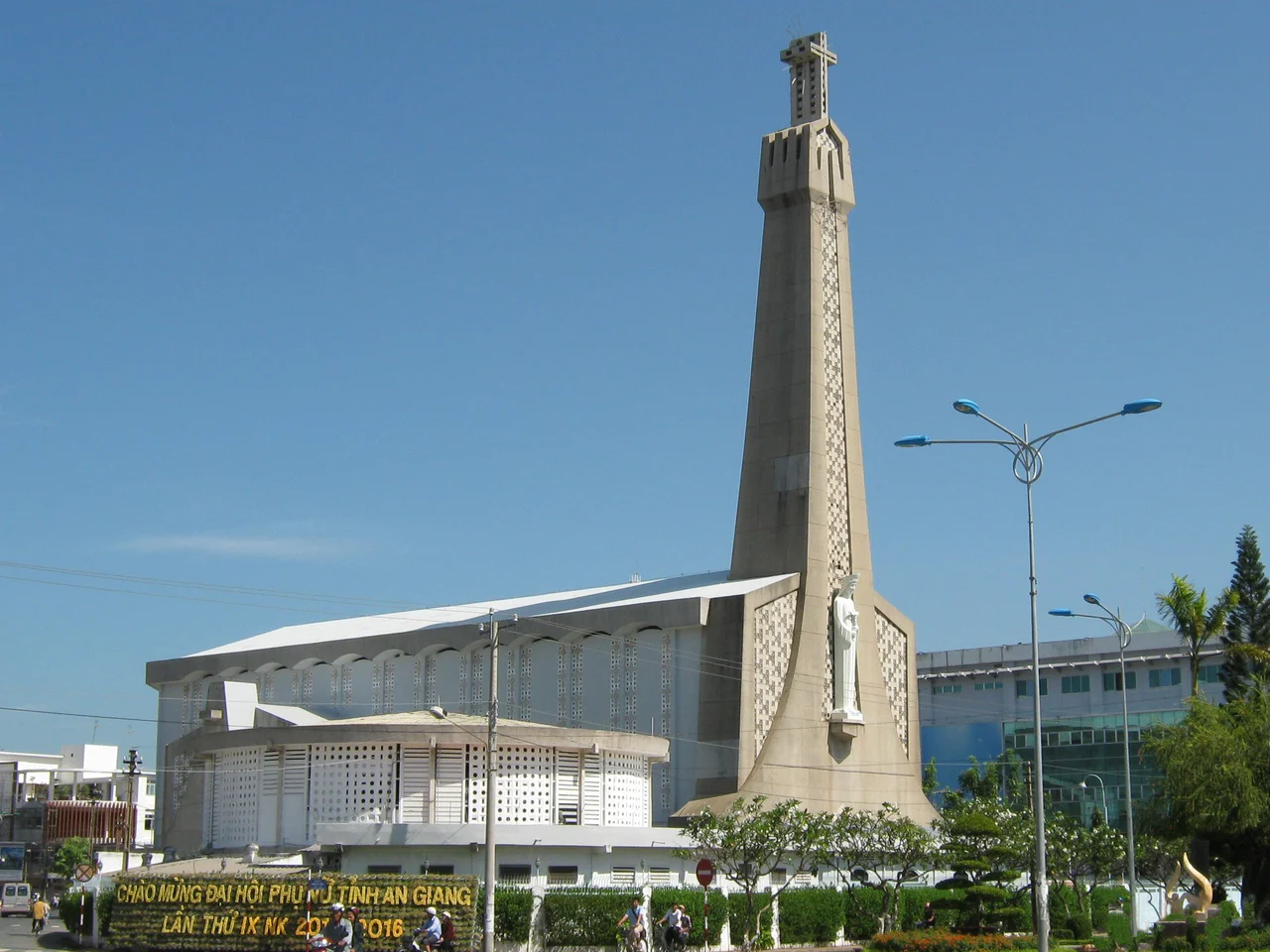
In the Mekong Delta nothing stands up. The land runs to the horizon as a grid of paddy, canal and dyke, and the tallest things in it are coconut palms and the masts of cargo boats on the Hậu River. So a bell tower of 55 metres is not an architectural detail here. It is the landmark, visible from the water long before the town gathers itself around it. The Queen of Peace Cathedral was consecrated on 15 August 1973, the Feast of the Assumption, in a country that had signed a peace agreement in January and would go on fighting for two more years. Whoever chose the dedication was not being sentimental.
The Congregation That Arrived by Canal
Catholicism was thin on the ground in this corner of the delta for most of its history. Before 1954, the provinces of An Giang and Kiên Giang together held roughly 30,000 Catholics spread across about ten parishes, a scattering among a rice-farming population that was overwhelmingly Buddhist. Then came the partition of Vietnam and the great movement of people southward, and everything changed within a decade. Families from the north settled along the Cái Sắn canals west of Long Xuyên, on land that had to be drained before it could be farmed, and the parish rolls swelled. On 24 November 1960, Pope John XXIII issued the bull Christi Mandata, carving the Diocese of Long Xuyên out of the two provinces and naming Micae Nguyễn Khắc Ngữ its first bishop. He would hold the post for thirty-seven years.
Sixty Metres by Eighteen
Work on the building had already begun in 1958, under the direction of Father Piô Nguyễn Hữu Mỹ. Once the diocese existed, the plans grew: the finished church runs 60 metres long, 18 wide and 20 high, with the bell tower carrying the eye far above that. For its first twelve years the diocese made do with the Church of Saint Thomas, a modest structure dating from 1903, which served as cathedral until 1972. The new church took over the following year. A large statue of the Virgin stands on the façade — she is the Queen of Peace the building is named for, and the reason it is also known simply as the Regina Pacis. Nothing about the design reaches for the French colonial gothic of Saigon's Notre-Dame; this is a church of the 1950s and 1960s, built by and for a congregation that was still settling the land around it.
A Town of Many Faiths
The cathedral does not have Long Xuyên to itself. The town grew from a market established in 1789 beside the Tam Khê canal, and it kept the habits of a market: everybody trades with everybody. The floating market still forms on the Hậu at dawn, boats nosing together with vegetables and rice stacked on the decks. Hòa Hảo Buddhism — a reformist movement that dispensed with temples, monks and ceremony in favour of prayer at home — was founded in An Giang in July 1939 by Huỳnh Phú Sổ, in the village that gave the faith its name, and it spread through the delta within a few years. A Cao Đài temple stands in town as well. Some 286,140 people lived here as of 2022, and across the whole diocese roughly 233,018 Catholics form about five per cent of the population — a visible minority, well organised, running 164 parishes.
The Map Redrawn
On 12 June 2025 Vietnam's National Assembly passed Resolution 202/2025/QH15 and Long Xuyên stopped being a provincial capital. Kiên Giang was folded into An Giang to create a province of nearly five million people, with the seat of government moved to Rạch Giá on the coast; Long Xuyên became one ward among fourteen. There is a quiet symmetry in it. The diocese that Rome drew in 1960 covered precisely those two provinces, An Giang and Kiên Giang, and had spent sixty-five years operating across a boundary the state has now erased. The cathedral's jurisdiction did not change at all. Only the map around it did.
From the Air
The cathedral stands at 10.3816°N, 105.4396°E on the right bank of the Hậu (Bassac) River, the western of the Mekong's two main channels. Ground elevation is barely above sea level, so the 55-metre bell tower is the dominant vertical feature for many kilometres — the easiest way to fix Long Xuyên from the air. Best viewing altitude is 2,000-4,000 ft, low enough to read the canal grid radiating northwest toward Cái Sắn and the Cambodian border. Nearest airports are Rạch Giá (VVRG) about 60 km southwest and Cần Thơ International (VVCT) about 55 km southeast; Phú Quốc (VVPQ) lies out in the Gulf of Thailand. Haze is common in the dry season from December to April; the southwest monsoon brings heavy convective build-ups from May to October.
Nearby Stories
- Battle of Tri Phap 16 km away
- Kiên Giang province 26 km away
- Hà Tiên 32 km away
- Búng Bình Thiên 33 km away
- Sóc Trăng 59 km away
- Bokor National Park 82 km away
- Phú Quốc Prison 84 km away
- Ben Duoc Memorial Temple 84 km away