.jpg)
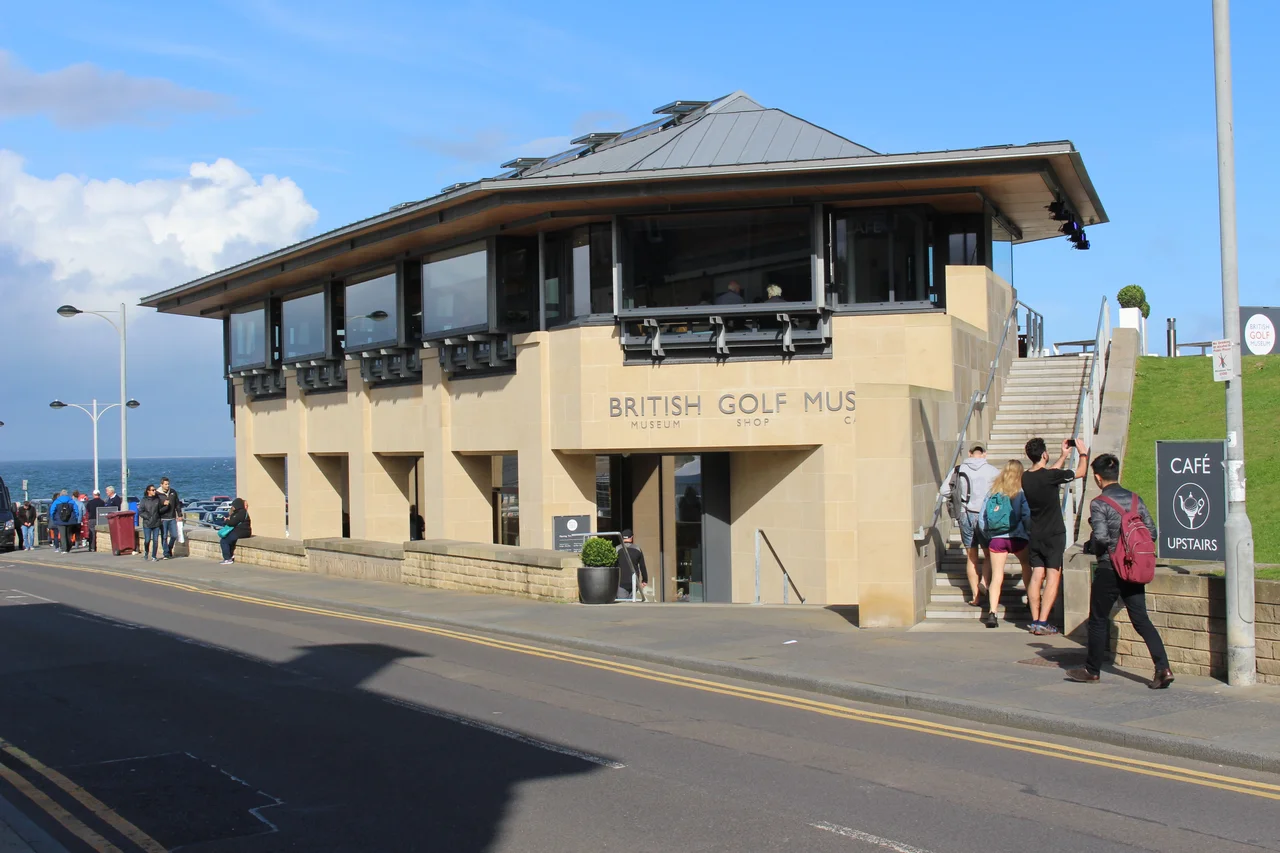
R&A World Golf Museum
Poppy Wingate's shoes are in a glass case. They are leather, scuffed at the toe, the laces tied the way she tied them more than a century ago when she was one of the early stars of the British women's amateur game. A few cases over sit Rhona Adair's golf balls, gutta-percha, fingered smooth in another era's grip. The R&A World Golf Museum collects what most sports museums never bother with: the artefacts of the women who built the women's game when nobody was looking, the proof that golf has always been bigger than the version of it that got televised.
Across From the Clubhouse
The museum opened in 1990 in a single-storey building behind the clubhouse of the Royal and Ancient Golf Club of St Andrews, the body that has codified the rules of golf, alongside the USGA, since 1754. It carried the British Golf Museum name until a renovation and expansion completed in 2015, followed by a rebranding as the R&A World Golf Museum when it reopened in June 2021. The building now extends to about 580 square metres, with a rooftop cafe that looks out over the Old Course, the West Sands beyond, and the cold North Sea behind that. The R&A owns and operates the museum directly. It is the official keeper of the sport's documented history, which means it has the rules, the trophies, the wooden-shafted clubs of the gutta-percha era, and the paintings of Old Tom Morris that the man himself sat for.
Medieval to Modern
The collection traces golf from medieval beginnings, when something resembling the game was being played in the Low Countries and on the Scottish links, through the codification of the rules at St Andrews and Edinburgh in the 18th century, and on to the modern professional tours. Hickory shafts give way to steel give way to graphite. Featheries, the leather-stitched balls stuffed with boiled goose feathers, give way to gutta-perchas, which give way to rubber-core balls, which give way to the multi-layer modern. Clubs that look like garden tools become precision instruments calibrated to fractions of a millimetre. The exhibits chart not just the equipment but the social history: the men's amateur game, the women's amateur game, the slow rise of professional golf out of the caddie's bag and into the country club, and the global game that now spans every continent.
The Women's Museum That Came North
There is a particular story embedded in this collection. In April 1939, a group of women at the Lady Golfers' Club in London opened a small museum dedicated to the women's game, with Issette Pearson as president and Mabel Stringer as chairman. Pearson had organised the British Ladies' Amateur Championship in 1893 and had spent her life advocating for women's golf to be taken seriously. When the Lady Golfers' Club merged with the Golfers' Club in 1961, the museum lost its home. For the next quarter-century the collection wandered: from London clubs to the Colgate-Palmolive offices to the National Museum of Antiquities in Edinburgh. In the late 1980s it joined the new St Andrews museum, where its founders' acquisitions, including the balls and the shoes, sit in the same rooms as the men's trophies. It is a quiet act of restoration: the women who built the women's game, brought home to the sport's intellectual capital.
From the Air
Located at 56.34 N, 2.80 W, at the northwest edge of St Andrews, immediately opposite the R&A clubhouse and adjacent to the Old Course. The nearest airport is Dundee (EGPN), about 12 miles northwest. Leuchars Station (EGQL, military) is about 5 miles north. Edinburgh (EGPH) is roughly 45 miles southwest. From the air, the museum is a low modern building set against the famous links of the Old Course and the long arc of West Sands beach. Best viewed at 2,000-3,000 feet AGL on approaches passing the Fife coast.
Nearby Stories
- Tantallon Castle 2.2 km away
- Battle of Kinghorn 4 km away
- Lindores Abbey 4.1 km away
- Battle of Dun Nechtain 11 km away
- Eyemouth Disaster 20 km away
- Edradour Distillery 35 km away
- Eyemouth Lifeboat Station 52 km away
- River Dee Ferryboat Disaster 60 km away