.jpg)
Rackwick
George Mackay Brown called it the hidden valley of light. The Orcadian poet wrote about Rackwick from the other side of Scapa Flow in Stromness, looking across to the high hills of Hoy and the small green opening between them where this little township sits. In his poem he called it Orkney's last enchantment. Walk down the lane into Rackwick on a clear summer evening and you understand the line immediately - the way the sea light pours up the valley between Moor Fea and Mel Fea and Red Glen and fills the whole bowl of land, the way the dark cliffs frame it, the way the sound of the burns and the distant breakers is the only sound. Three families lived here year-round in 2016. Once there were many.
Where the Glens Meet
Two glacial U-shaped valleys feed into Rackwick from the north and east, each carrying a small burn - Rackwick Burn and South Burn - down to the bay. Three hills enclose the township on three sides: Moor Fea to the north, Mel Fea to the east, Red Glen to the south. The fourth side is the sea. Rackwick Beach is a curve of sand and large rounded boulders, the latter polished by centuries of Atlantic swells. The cliffs rise immediately on either side, dark and high, dominating the headlands. Only one road reaches Rackwick - a single-track lane that branches off the main Hoy road at Linksness and runs four miles southwest past the Dwarfie Stane, climbing over open moor and dropping into the valley. There is one car park, public toilets, and almost nothing else.
Bay of Jetsam
The name comes from Old Norse: reka-vik, meaning bay of jetsam. Things washed up here. Driftwood, fishing gear, whatever the Atlantic threw at the west coast of Hoy - and given the prevailing southwesterly weather, it threw plenty. The first known written reference to Rackwick is in Lord Sinclair's rental of Orkney from 1492. The first detailed map dates from 1791. People made a living here from crofting and fishing - the kind of dual existence that was the rule rather than the exception across much of small-island Scotland. The older farm buildings date from the eighteenth century. A schoolhouse opened in 1718 by the Society in Scotland for Propagating Christian Knowledge lasted just six years before closing. A second school opened in 1879 and closed in 1953 because there were no children left to teach.
Brown, Wishart, Maxwell Davies
The township was almost abandoned by the 1970s. Three figures helped change that, all of them artists. George Mackay Brown wrote about Rackwick from Stromness, sending visitors to it through his poems and stories. The landscape painter Sylvia Wishart, a close friend of Brown's, rented a cottage here through the 1960s and painted the valley repeatedly - her work is now held by the Pier Arts Centre in Stromness and beyond. The composer Peter Maxwell Davies, another friend of Brown's, moved to Rackwick in 1970 and lived in a remote clifftop cottage at Bunertoon until 1998, composing music shaped by the seabirds and the surf and the weather of this corner of Hoy. He served as Master of the Queen's Music from 2004 to 2014. The trio drew others in. A small resurgence followed - cottages restored, second homes carefully maintained, visitors who came for the silence.
What's at Rackwick Now
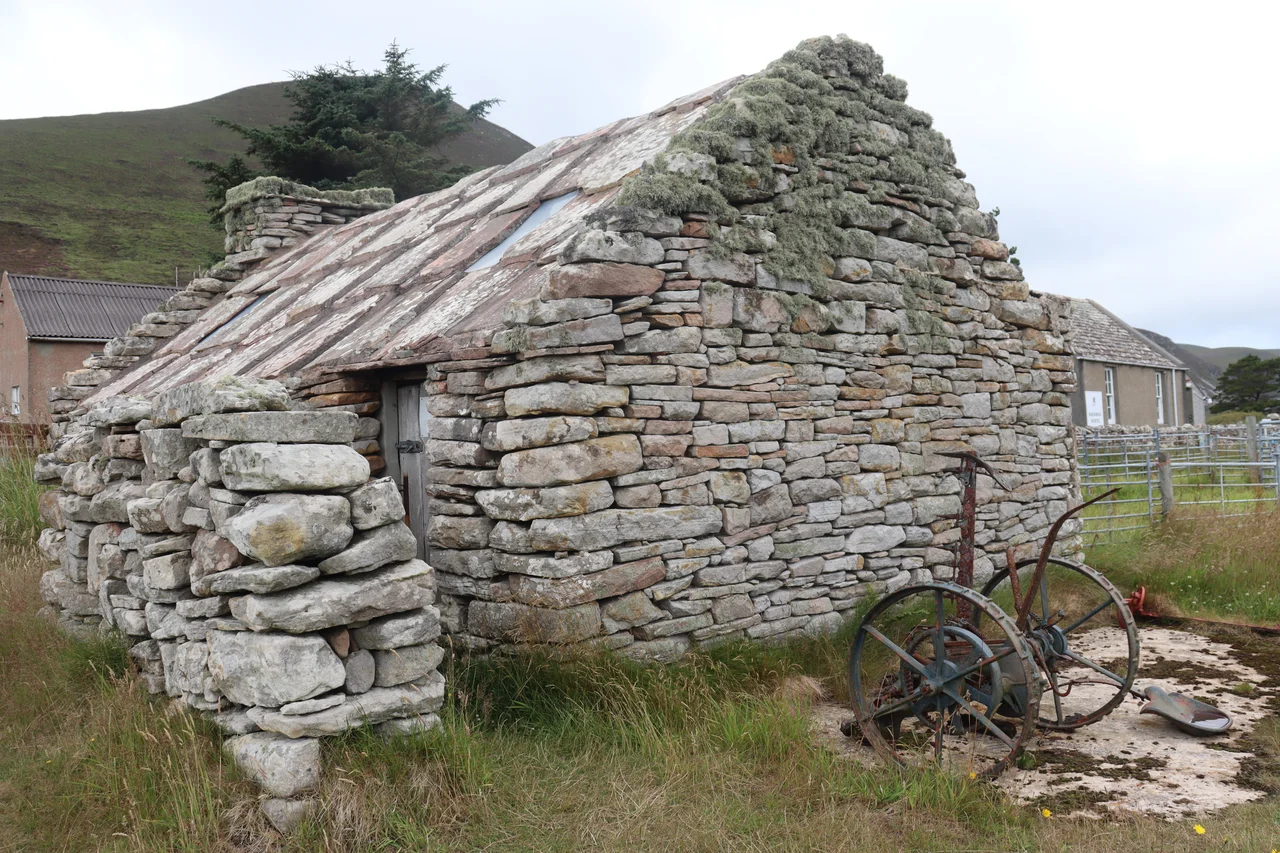
The Cra'as Nest museum - the old eighteenth-century croft, restored as it would have been - is the largest of a series of small unstaffed community-run museum buildings scattered through the valley. The old 1718 schoolhouse is another. Burnmouth is a bothy on the shore, run by the Hoy Trust, free to use for anyone who turns up with bedding. The Rackwick Outdoor Centre - housed in the former 1879 schoolhouse - is a hostel run by Orkney Islands Council. There is no shop, no pub, no cafe. Visitors who come for the day bring sandwiches. Visitors who stay overnight bring everything. Most of the cottages you pass are now second homes, used in summer and shut up against the winter gales.
Walking to the Old Man
Rackwick is the trailhead for the Old Man of Hoy walk. A clear path leaves the car park and climbs up the northern side of the valley, traversing the moor above Moor Fea, then drops to the cliff edge at the great sea stack - a six-mile round trip, three hours at a steady pace, with a final viewpoint that justifies the entire journey. Extend the walk along the cliffs to St John's Head - 335 metres of sheer drop, among the highest sea cliffs in Britain - and you add two more hours of as good a clifftop walk as Scotland offers. Above Rackwick itself, on Mel Fea, a Fairey Albacore (BF592) of 871 Squadron Royal Navy crashed in 1942, killing the pilot. The wreckage scattered across the hillside has been weathered down to little but small fragments. In WWII the valley held a light anti-aircraft battery and two searchlight batteries, fragments of which can still be found if you know where to look.
From the Air
Located at 58.873 N, 3.386 W on the northwest coast of the island of Hoy. From the air Rackwick appears as a small green valley opening to a curve of dark sandy beach on the southwest-facing coast - the only such opening on this stretch of high cliffs. The three enclosing hills (Moor Fea, Mel Fea, Red Glen) and the U-shaped glacial valleys are striking in good light. Kirkwall Airport (ICAO: EGPA) lies 16 nautical miles northeast on Orkney Mainland. The Old Man of Hoy sea stack lies 1.5 nautical miles northwest along the cliffs - the visual icon of this corner of Hoy. St John's Head cliffs (335 metres) lie just north of the Old Man. Ward Hill (481 metres) rises to the northeast, often holding cloud. Wick (ICAO: EGPC) lies 22 nautical miles south. Recommended cruise altitude 1,500-3,000 feet for the valley and full cliff coastline; descend to 1,000 feet for the Old Man and beach. Watch for the WWII Fairey Albacore crash site on Mel Fea overlooking the valley.
Nearby Stories
- HMS Sword Dance (1918) 9 km away
- Battle of Harpsdale 12 km away
- Copinsay 14 km away
- Broch of Gurness 16 km away
- Strathnaver Museum 20 km away
- HMS King Edward VII 21 km away
- Fair Isle 85 km away
- The Laki Eruption: The Volcano That Changed World History 939 km away