_(2).jpg)
RAF Linton-on-Ouse
In November 2008, a sixty-five-year-old pilot named Jim O'Neill was flying a four-seat Cessna 182 home from a Scottish family holiday when a stroke blinded him in mid-air. Somewhere over the North Sea, he was alive, conscious, and unable to see anything but a grey wash. Wing Commander Paul Gerrard, on a routine training flight from RAF Linton-on-Ouse, was diverted to intercept. For forty-five minutes, Gerrard flew formation beside O'Neill's Cessna and guided him by voice to the Linton runway. O'Neill landed safely. He could not see the runway. He could not see the ground. He landed because someone in another aircraft told him exactly when to flare. Eighty-three years of pilot training at Linton-on-Ouse came down, for one afternoon, to a single voice in a single radio.
Bomber Years
RAF Linton-on-Ouse opened on 13 May 1937 as a bomber airfield and the headquarters of No. 4 Group RAF. Wing Commander A. D. Pryor was the first commanding officer. When war began in September 1939, the bombers launched from Linton were initially carrying not bombs but leaflets, dropping propaganda over German cities in a curious phase of the war that historians have sometimes called the Twilight War. The leaflets shifted to bombs soon enough. In May 1941, the Luftwaffe struck back. Thirteen airmen died, including the station commander, Group Captain Garroway. The station's own records say Garroway was directing firefighting when he was killed, not sheltering. His son, also serving in the RAF, would be killed in action later. Linton became the kind of place where commanders kept records of where their men fell.
From Bombers to Jets
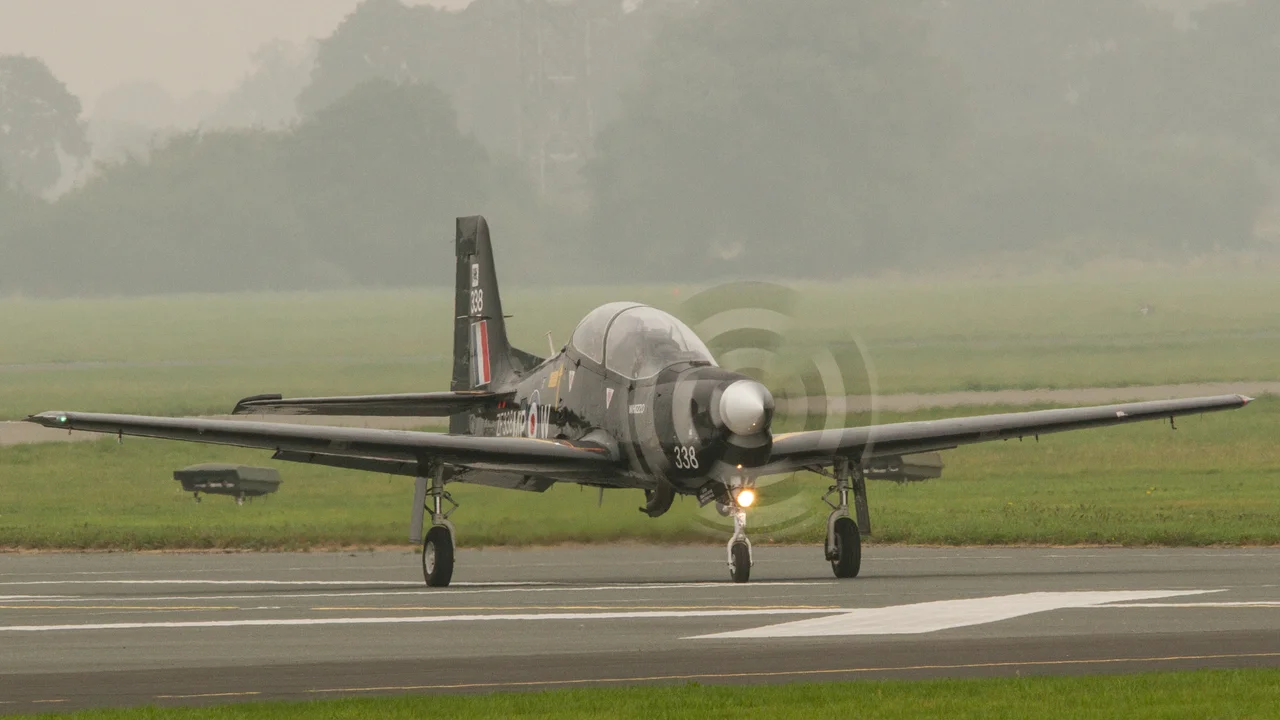
After 1945, Linton-on-Ouse pivoted from bomber operations to fighter command. The Gloster Meteor came first, the RAF's earliest operational jet fighter. The Canadair Sabre followed, then the Hawker Hunter, a sleek transonic fighter that for many British pilots of the 1950s remained the most beautiful aircraft they ever flew. The station closed temporarily in 1957 for care and maintenance. When it reopened, the role had shifted again. Linton became a basic flying training station. Generations of RAF pilots spent the start of their careers in Jet Provosts here. The BBC filmed three episodes of its Fighter Pilot series at Linton in 1979-80. From 1993 onward, the Short Tucano T1 took over as the primary trainer, a turboprop designed in Brazil and licence-built in Belfast.
The Final Decade
In October 2014, the Ministry of Defence announced that basic fast-jet training would relocate to RAF Valley on Anglesey, where the Beechcraft Texan T1 would replace the Tucano. Linton would close. The Yorkshire Universities Air Squadron, which had relocated to Linton in 2014 from RAF Church Fenton, continued flying Grob Tutor T1 aircraft. No. 72(R) Squadron departed in November 2019. Flying training ceased that October. Final student pilots graduated and the apparatus of decades-long pilot education moved west. The Yorkshire Universities Air Squadron was the final flying unit to leave, departing for RAF Leeming on 1 December 2020. The MOD notified the Civil Aviation Authority that the aerodrome would close on 18 December 2020. After 83 years, the runways at Linton stopped hosting take-offs and landings.
What Comes Next
In February 2021, the MOD confirmed that no alternative military use had been identified and the site would be sold by the end of 2023. In April 2022, the British government announced plans to convert the base into a reception and processing centre for asylum seekers, citing the £4.7 million daily cost of hotel accommodation. Local residents pushed back hard. The press coined the nickname "Guantánamo-on-Ouse," comparing the proposed remote-village migrant facility to the American detention camp. The Defence Secretary Ben Wallace cancelled the plan in August 2022. The future of Linton remained uncertain. In August 2021, the base served briefly as a quarantine facility for personnel returning from the Afghanistan evacuation under Operation Pitting, putting it back into a kind of military service for a few weeks before falling silent again.
Motor Racing on the Perimeter
In the summers of 1960 and 1961, parts of two runways and the perimeter track were used as the 1.7-mile Linton-on-Ouse motor racing circuit, with the RAF still operating from the base. The British Racing and Sports Car Club's northern branch organized the meetings. The 1960 race took place in torrential rain. Tony Hodgetts later recalled blue sparks coming off his fingers as he cranked the field telephone the marshals used to talk to race control. Jimmy Blumer dominated in his Cooper Monaco T49. The 1961 meeting was the last. A flag marshal was killed in an accident involving a Formula Junior driven by a serving RAF officer. The fatality led directly to a campaign by Tony Hodgetts and Garth Nicholls that changed how flag marshals worked. Instead of standing back to back, marshals now work face to face. The system, born from a death at Linton, is still used today.
From the Air
RAF Linton-on-Ouse occupied 54.05°N, 1.25°W, ten miles north-west of York, on the flat farmland of the Vale of York. Recommended viewing altitude 1,500-2,500 feet to read the runway pattern and the perimeter track. ICAO designator was EGXU. The aerodrome closed to flying on 18 December 2020. Nearest active airports: Leeds Bradford (EGNM) 22nm south-west and Teesside International (EGNV) 28nm north. The closed runways are still visible as concrete strips against the green of surrounding fields, with the River Ouse winding past 2nm to the south.
Nearby Stories
- Hole of Horcum 1.7 km away
- Sledmere House 8.3 km away
- Shibden Hall 8.7 km away
- Mount Grace Priory 8.8 km away
- Battle of Ferrybridge 9 km away
- 1975 Dibbles Bridge Coach Crash 11 km away
- Bolton Castle 13 km away
- Flixborough Disaster 19 km away