
RAF Stornoway
In the summer of 1952, scientists from Porton Down brought caged monkeys and guinea pigs to a pontoon off the Braighe beach near Stornoway, exposed them to clouds of plague bacteria, and waited to see what would happen. The trawler Carella, sailing innocently through the test cloud on her way out to Iceland, was placed under covert surveillance for the rest of her voyage back to Fleetwood. Nobody told her crew anything. That was Operation Cauldron, and that was RAF Stornoway, an airfield whose strangest work was always done behind the weather.
Four Runways in an Unusual Pattern
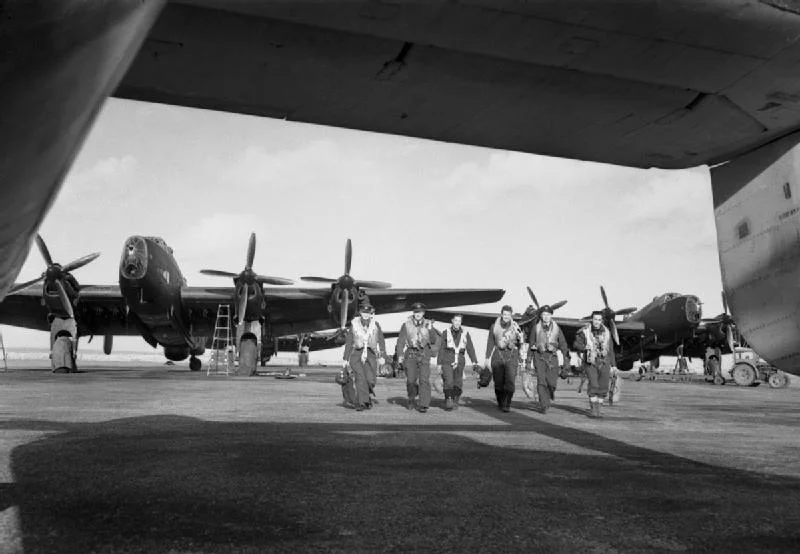
RAF Coastal Command laid out the original airfield in 1940, picking the windswept moor near the Lewis capital because the geography demanded it: aircraft hunting U-boats in the North Atlantic needed somewhere far enough north to reach the convoy lanes and somewhere with enough open ground to handle the maritime patrols. The four paved runways, completed by 1941, were arranged in what the official histories politely called 'an unusual layout' for Coastal Command, a configuration shaped by the prevailing Hebridean winds rather than any tidy diagram. The station's motto, fittingly, was 'Lead and Guide.' Reconnaissance crews from No. 18 Group flew long, lonely sweeps over grey water from here, and No. 66 Air-Sea Rescue Marine Craft Unit worked from Stornoway Harbour during 1943 and 1944, picking up airmen who had ditched somewhere between Lewis and the Faroes. When the war ended, the station was handed to the Ministry of Civil Aviation on 1 July 1946 and quietly became Stornoway Airport again.
The Cauldron and the Trawler
Operation Cauldron was meant to be invisible. The Chemical and Biological Defence Establishment wanted to know whether plague bacteria, sprayed into open air, would behave as a weapon. The Braighe, a thin causeway between Stornoway Bay and Broad Bay, was remote enough to make the work seem safe. The animals on the pontoon were not so lucky, and neither was the Fleetwood-based trawler Carella, outbound for Iceland, which steamed straight through one of the test clouds without anyone aboard noticing anything unusual. The MoD chose silence over warning. The crew were watched until they reached Fleetwood, then released back into civilian life. None of them got sick, but the secrecy lasted half a century, and the story only surfaced when declassification caught up with memory. It is difficult to walk that stretch of beach today and reconcile the bright machair grass with what was once weighed and released into the wind.
Listening to the V-Bombers
During the Cold War, Stornoway took on a second life as the hidden ear of Bomber Command. No. 112 Signals Unit was established here in 1960 as an electronic countermeasures evaluation outpost reporting to RAF High Wycombe. As Vulcan and Victor V-bombers flew practice approaches towards, over, and away from the unit, technicians measured signal strength, frequency bandwidths, and aerial performance, then shipped the results back to engineers who would refine the jamming equipment that would, in theory, get those bombers through Soviet radar in a war nobody wanted. The unit worked through the Cuban Missile Crisis. It worked through every dispersal exercise the Cold War invented. It closed in 1983, one year after the runway was extended in a £40-million programme to accept Panavia Tornado strike aircraft and the station was recommissioned as a forward operations base.
What the Wind Remembers
The forward operating base lasted sixteen years. RAF Stornoway closed for good on 31 March 1998, the Ministry of Defence sold the site to the Western Isles Council, and the airport went civilian once more. The Nissen huts came down. One technical building became a Christian school. Tom Clancy gave the place a fictional second war in Red Storm Rising, where displaced air wings from a damaged USS Nimitz fly missions from these same runways against Soviet-held Iceland. In the real Hebrides, what remains is quieter: a single working runway carrying flights to Inverness and Glasgow, and a sprawl of land where stunt shows and vehicle exhibitions now occupy ground that once hosted men listening intently for the sound of an empire's possible end.
From the Air
RAF Stornoway sits at 58.22 N, 6.33 W on the Eye Peninsula east of Stornoway town. Field elevation 26 ft; ICAO EGPO, IATA SYY. Two active runways (06/24 and 18/36), with 06/24 the long Cold War extension. Approaches from the east cross Broad Bay; the Braighe causeway and Old Battery Point lie just south of the threshold. Nearest diversion airfields are Benbecula (EGPL) about 65 nm south and Inverness (EGPE) about 90 nm east-southeast. Hebridean weather is changeable: maritime stratus, sudden squalls, and crosswinds from the Minch are routine.
Nearby Stories
- German submarine U-905 13 km away
- Loch Seaforth 13 km away
- Rua Reidh Lighthouse 19 km away
- The Minch 25 km away
- The Flannan Isles Mystery: The Lighthouse Keepers Who Vanished 33 km away
- Sollas 44 km away
- Sandwood Bay 84 km away
- The Laki Eruption: The Volcano That Changed World History 856 km away