
Raid on Griessie
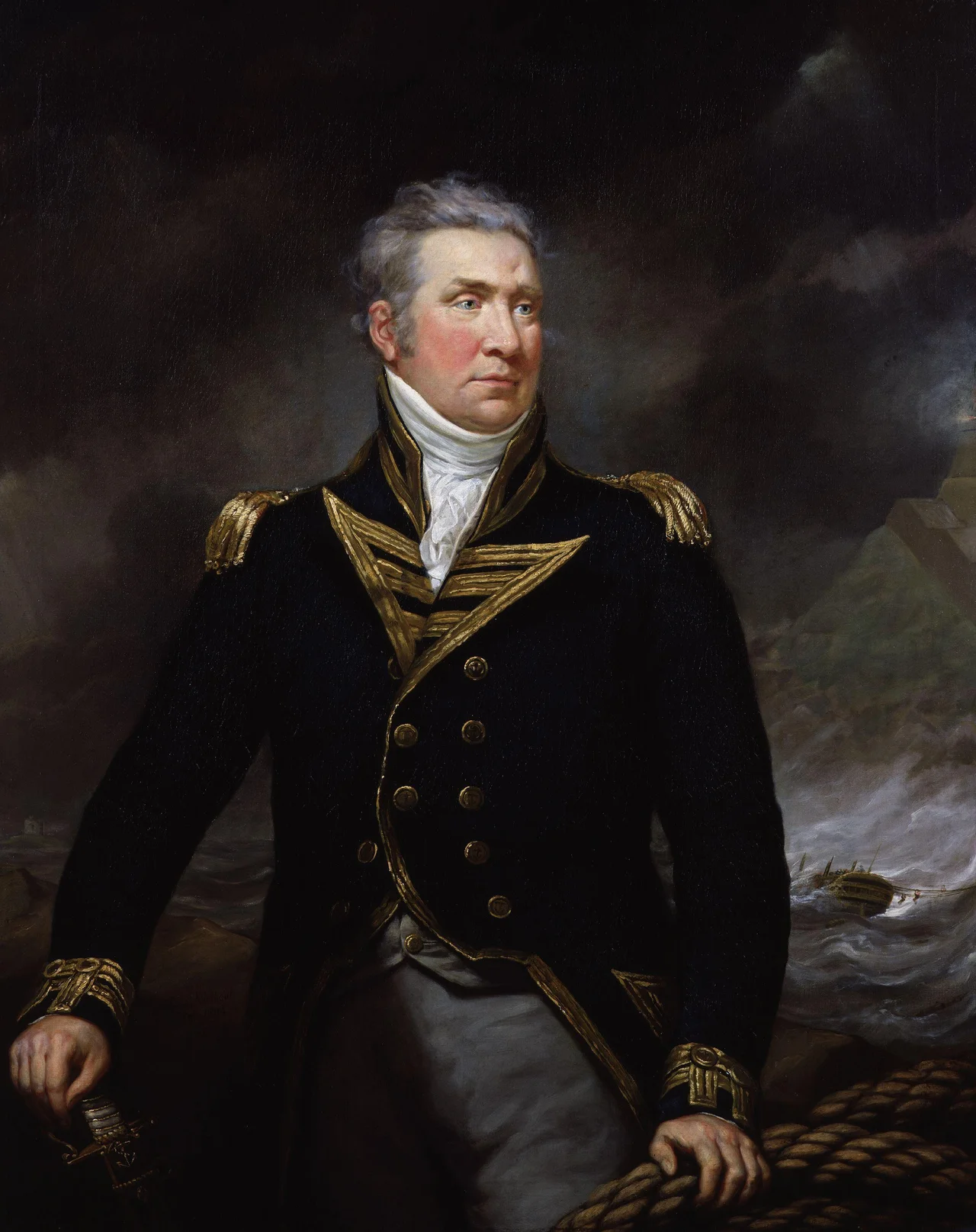
Captain William Cowell had a talent for defiance, even when the cause was already lost. An American serving in the Dutch navy, he commanded the last squadron of Dutch warships in the entire Pacific from the shallow anchorage at Griessie, near Surabaya on Java's northeast coast. When Rear-Admiral Sir Edward Pellew's British squadron appeared off the harbour on 5 December 1807 and sent a boat under a flag of truce demanding surrender, Cowell refused. Then he arrested the boat party. It was a bold gesture, but the three aging 68-gun ships of the line sheltering behind him were already relics of a navy that had been systematically dismantled across the previous eighteen months.
Pellew's Reckoning with the Straits
The campaign that ended at Griessie began with a merchant convoy and a French miscalculation. In 1804, a powerful French squadron operating from Batavia attacked British traders near the Straits of Malacca in the Battle of Pulo Aura. The attack failed, but it proved that warships based in Java could threaten the critical trade route between Britain and China. Rear-Admiral Pellew, commanding Royal Navy forces across the Indian Ocean, resolved to eliminate the threat entirely. He dispatched frigates to reconnoitre Dutch harbours throughout the East Indies beginning in mid-1806. The Dutch squadron under Vice-Admiral Pieter Hartsinck was modest -- three 68-gun ships of the line, three frigates, and several smaller vessels -- but even obsolete warships could prey on unescorted merchantmen. Pellew's frigates began picking them off. At the action of 26 July 1806, a Dutch convoy off Celebes lost the frigate Pallas. Three months later, the frigate Maria Riggersbergen was seized inside Batavia harbour itself.
Fire in the Roads of Batavia
Emboldened by these captures, Pellew launched a major raid on Batavia harbour on 27 November 1806. His squadron sailed directly into the bay. The surviving Dutch ships were driven ashore to avoid capture, and boarding parties under Pellew's son, Captain Fleetwood Pellew, set the wrecks ablaze. But the three ships of the line -- Kortenaer, Pluto, and Revolutie -- had escaped. Hartsinck had ordered them eastward before the attack, and Cowell took them 570 miles along the Javan coast to the protected anchorage at Griessie. Pellew could not pursue immediately. His ships were scattered across the Indian Ocean on separate operations, some as far west as the Red Sea. It took months to reassemble a striking force, during which time Pellew's son Fleetwood and Captain Peter Rainier scouted Javan waters in their frigates, locating the Dutch ships and raiding merchant shipping at Semarang.
Surrender and Sabotage
Pellew sailed from Malacca on 20 November 1807 with a mixed force: his flagship, a ship of the line under Fleetwood, frigates, sloops, and an East Indiaman carrying 500 soldiers of the 30th Regiment of Foot. After fifteen days coasting along Java, they reached Griessie on 5 December. When Cowell arrested the truce party, Pellew prepared for battle, ordering his larger vessels lightened to navigate the shallow straits. He exchanged fire with a Dutch gun battery on Madura Island. But the governor in Surabaya overruled Cowell, released the prisoners, and agreed to formal surrender terms on 7 December. The terms covered the Revolutie, Pluto, Kortenaer, and the Dutch East Indiaman Rustloff. When British boats finally entered the harbour, they found every ship scuttled, their hulks protruding from the shallows. Cowell had given the order even as surrender was being negotiated. Pellew could only burn what remained.
The Last Dutch Warship East of Africa
British landing parties went through Griessie systematically, burning military stores and demolishing the gun battery on Madura. Casualties on both sides were minimal -- the campaign's final act was fought with torches and crowbars rather than broadsides. But the strategic consequence was absolute. With the destruction of Cowell's scuttled squadron, no Dutch warship remained operational anywhere east of Africa. Pellew's Java campaign, conducted across two years with a dispersed force thousands of miles from home, had achieved its objective without a single fleet engagement. British forces returned to the East Indies in 1810, and an expeditionary force invaded and captured Java in 1811. The colony was returned to the Netherlands only after Napoleon's final defeat at Waterloo in 1815, under the Anglo-Dutch Treaty of 1814. By then, Pellew had moved on to the Mediterranean. The Indian Ocean was a British lake.
From the Air
Coordinates: 7.14S, 112.65E. Griessie (modern Gresik) sits on the northwest coast of Java near the mouth of the strait separating Java from Madura Island. The nearest major airport is Juanda International Airport (ICAO: WARR) serving Surabaya, approximately 20 km southeast. The shallow Madura Strait and the industrial port area of Gresik are visible from altitude. Surabaya, Java's second-largest city, sprawls to the south.
Nearby Stories
- Luconia Shoals 107 km away
- Spratly Island 143 km away
- Tango Maru 219 km away
- Fiery Cross Reef 250 km away
- The Line That Split a Sultanate 270 km away
- HMS Pelorus (1808) 278 km away
- South-East Asian Theatre of World War II 398 km away
- Zahro Express Disaster 600 km away