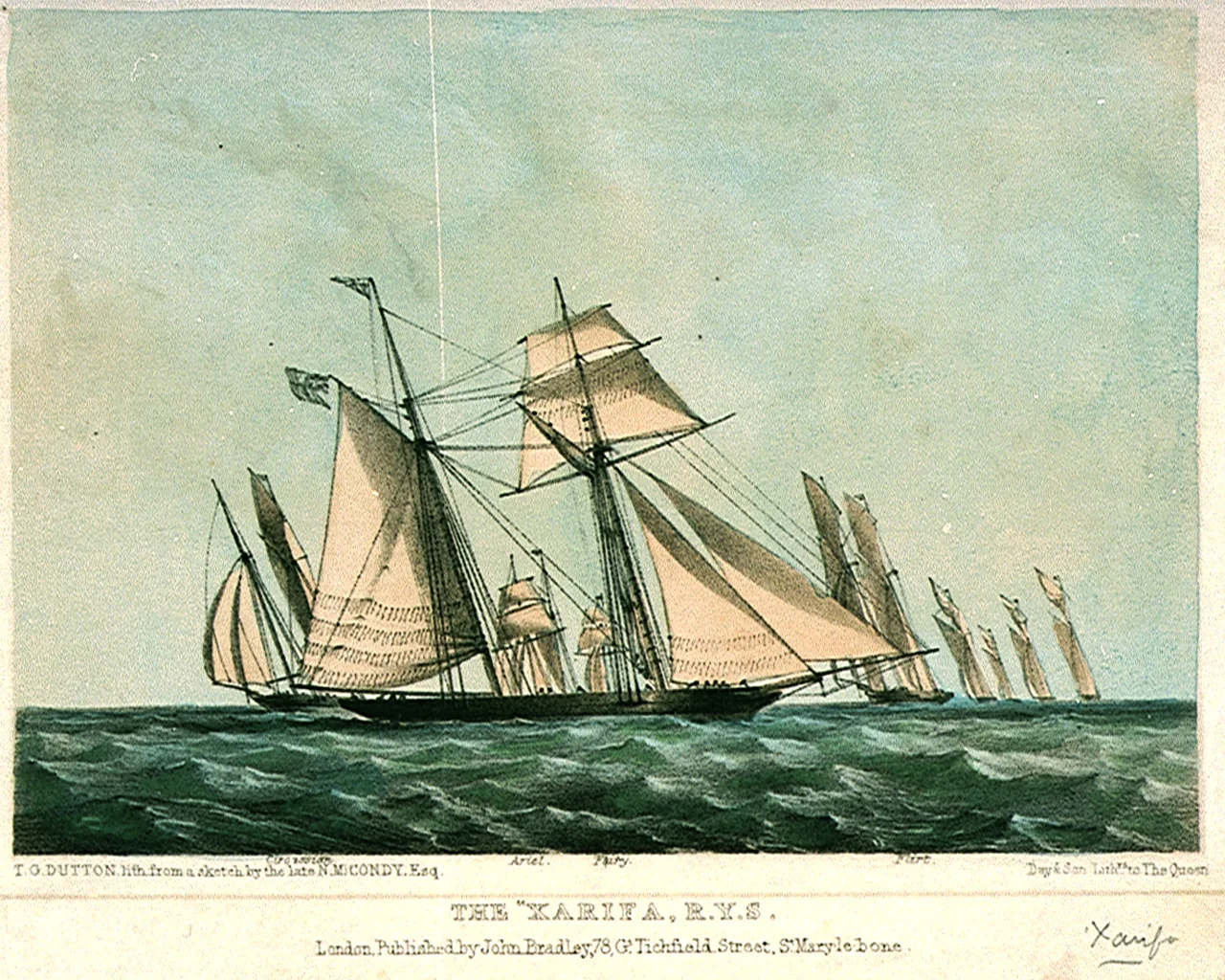

HMS Pelorus (1808)
Few warships have lived as many lives as HMS Pelorus. Launched in 1808 from the yards at Itchenor, England, this 18-gun sloop spent 36 years roaming the world's oceans under the British ensign before sinking, ironically, as a merchant vessel hauling opium off the coast of Borneo on Christmas Day 1844. In between, she fought French privateers in the Caribbean, chased smugglers off Ireland, freed over 1,350 enslaved people from Spanish slavers off West Africa, charted the sounds of New Zealand, survived a hurricane that buried her nine feet in Australian mud, and participated in the First Opium War. The river and sound that bear her name in New Zealand's South Island are her most enduring legacy -- though the story behind the name is far more harrowing than any map suggests.
Caribbean Fire and Irish Tobacco
Commissioned in July 1808, Pelorus sailed for the Leeward Islands that December and was present at the capture of Martinique in February 1809. Under Commander Thomas Huskisson, she enforced the blockade of Guadeloupe, and in October her crew cut out the French privateer schooner General Ernouf from under the guns of a shore battery at St. Marie. The French crew -- an estimated 80 to 100 men -- fled ashore as British fire silenced the batteries. After the Napoleonic Wars, Pelorus found new purpose chasing smugglers off Cork. Commander William Hamley seized more contraband vessels than any other ship over a three-year period, confiscating over 62,000 pounds of tobacco. One October night in 1823, an unidentified ship rammed Pelorus in the dark and sailed on, destroying her bowsprit and sending the foremast over the side. The crew rigged a jury-mast in heavy seas and limped back to Plymouth. Had the collision struck a few inches further aft, the sloop would have foundered.
The Human Cargo
In 1831, Pelorus joined the West Africa Squadron to suppress the transatlantic slave trade. The work was dangerous and morally complex. On 9 May 1832, she brought the Spanish slaver Segunda Theresa into Sierra Leone with 459 enslaved people aboard. In December 1834, she captured the slaver Sutil carrying 307 people, of whom 91 died of dysentery and disease before they could be freed. In January 1835, her boats sailed 60 miles up the Calabar River and ambushed the Spanish slaver Minerva, which carried 676 enslaved people; 206 died before reaching Sierra Leone. The boarding party of just 22 men faced double-shotted guns and small arms fire. Not all operations were clean. When Pelorus captured the slaver Pepita, which carried no enslaved people at the time, the boarding party manufactured evidence by placing people aboard after seizure. Captain Richard Meredith accepted responsibility. A court in Sierra Leone ordered Pepita returned to her master, and Meredith was charged 1,092 pounds in damages.
Naming a Sound
In 1837, Pelorus sailed for the Far East and Antipodes. She carried specie to Mauritius, visited the Cocos Islands at the request of John Clunies-Ross -- the self-styled King of the Cocos -- who feared a revolt among the inhabitants, and delivered an ultimatum to the King of Burma on behalf of the Governor-General of India. In Western Australia, she transported Governor James Stirling between Fremantle and King George Sound. But her most lasting contribution came in August 1838, when Lieutenant Phillip Chetwode -- commanding while Captain Harding was ill -- sailed Pelorus into Port Underwood, New Zealand, and began surveying the Marlborough Sounds. Chetwode named the river and sound after his ship, and the Chetwode Islands after himself. Those names remain on every map of New Zealand's South Island.
Buried in Mud, Lost to Opium
On 25 November 1839, a hurricane struck Pelorus while she lay at anchor off Port Essington in Australia's Northern Territory. Twelve crew members died. The ship was driven aground and, in Commander Augustus Kuper's words, 'buried 9 ft in the mud for 86 days.' A whaleboat under Captain Owen Stanley rescued the survivors. Remarkably, Pelorus was refloated, repaired, and sailed to join the First Opium War, arriving at Singapore in April 1841. But her naval career was over. She was laid up at Singapore and sold in 1842. Her new owners -- possibly the Pybus Brothers -- put her to work carrying opium to China. On Christmas Day 1844, she struck a shoal off the coast of Borneo in the South China Sea and sank. Captain Triggs took a gig and two passengers on a 100-mile voyage to Singapore, returned with the steamer Victoria, and managed to rescue 20 crew and salvage 70 chests of opium. The ship herself remained on the bottom.
From the Air
The wreck site lies at approximately 8.14N, 115.50E in the South China Sea, off the western coast of Borneo. This area of open water offers no visible wreck from altitude. For context, the nearest significant landfall is the northwest coast of Bali to the south or Borneo's western coast to the east. Nearest airports include Pontianak (WIOK) in West Kalimantan. Pelorus Sound in New Zealand, named after this ship, is at approximately 41.1S, 174.0E near Havelock, accessible from Blenheim (NZWB).
Nearby Stories
- Tango Maru 44 km away
- USS Barbel (SS-316) 85 km away
- Pandanan Shipwreck 114 km away
- Second Thomas Shoal 141 km away
- Sabina Shoal 156 km away
- Philippines and the Spratly Islands 160 km away
- Whitsun Reef Incident 205 km away
- Raid on Griessie 269 km away