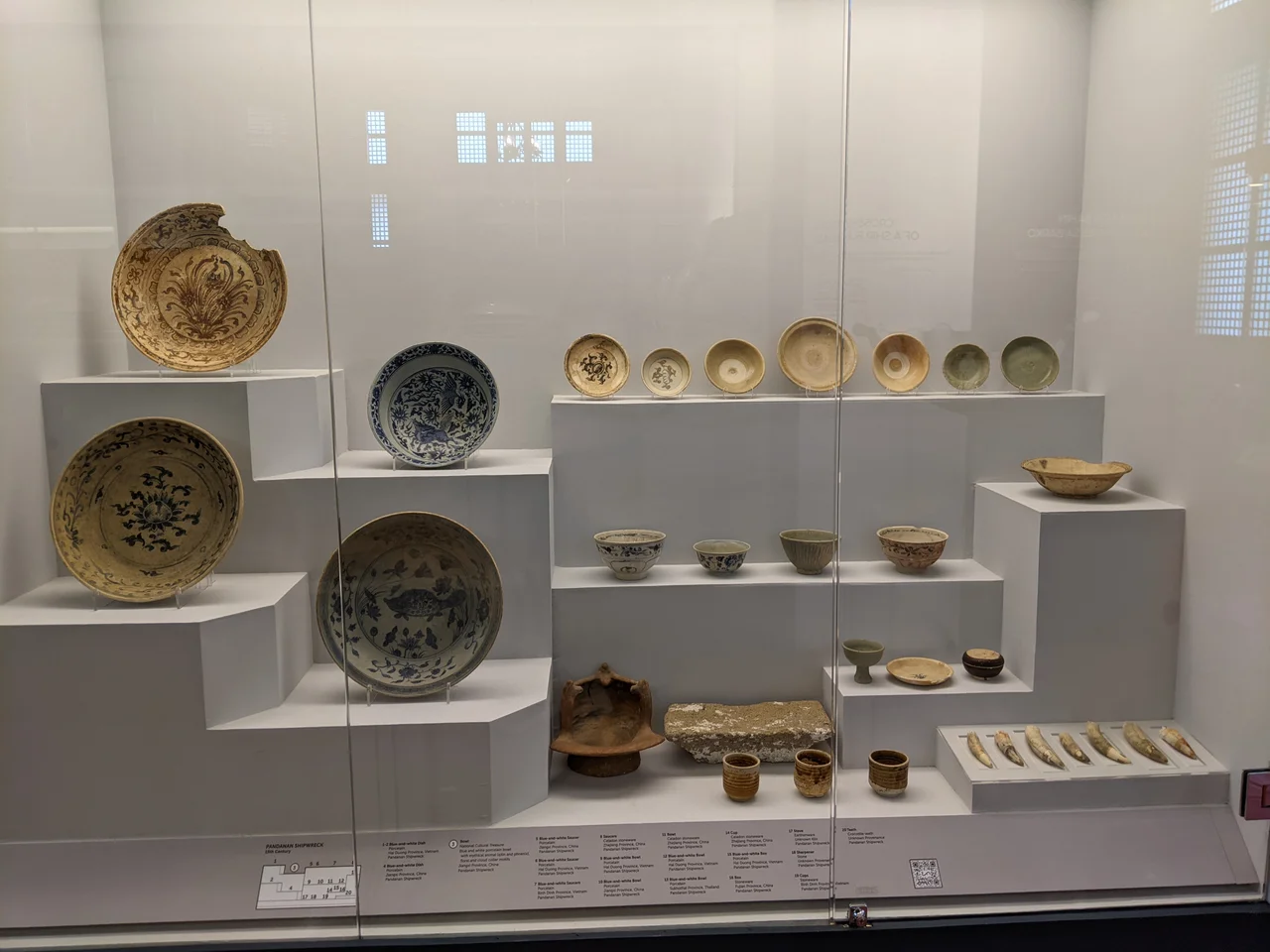

Pandanan Shipwreck
Eduardo Gordirilla was not looking for history. He was looking for a lost basket of giant oysters. A longtime diver at a pearl farm on Pandanan Island, off the southern coast of Palawan, Gordirilla was working the seabed when he noticed jars protruding from the sand beneath a coral reef cliff. He told his manager, Efren T. Anies, who called the National Museum of the Philippines on 9 June 1993. What Gordirilla had stumbled upon was one of the best-preserved pre-Spanish trading vessels ever found in Philippine waters -- a Southeast Asian cargo boat dating to approximately the mid-15th century, a period when the Chinese imperial court had banned all private overseas trade, making any ship that sailed these waters a smuggler by definition.
The Ship Under the Reef
The wreck lay just 250 meters off the northeast coast of Pandanan Island, concealed beneath sand and mud under a coral reef overhang. Surveyors worked from 1993 to 1994 mapping the site before the Underwater Archaeology Division of the National Museum began formal excavation in 1995. What they found was a vessel roughly 25 to 30 meters long and six to eight meters wide, with a flat bottom suited for riverine as well as coastal waters. Only a quarter of the hull remained intact -- tropical sea worms had consumed the exposed wood, and strong currents had scattered the rest. But the cargo told the story. Chinese coins dated to the reign of the Yongle Emperor (1403-1424), blue-and-white porcelain from the Jingdezhen kilns, celadon ware from the Longquan kilns, stonewares from Fujian and Guangdong -- the ship was a floating inventory of 15th-century Asian commerce.
A Cargo from Four Kingdoms
The diversity of the Pandanan ship's cargo reveals the complexity of maritime trade in the 15th-century South China Sea. Alongside the Chinese wares, archaeologists recovered blue-and-white porcelain from the Chu Dau kiln in northern Vietnam -- bowls, dishes, pots, jarlets, covered boxes, and water droppers. From central Vietnam's Go Sanh kiln in Binh Dinh Province came celadon saucers and dishes. Thailand contributed a large bowl with a fish design in iron pigment from the Sukhothai kiln and a black-brown glazed four-eared jar from the Noi River kiln. The metalwork told its own story: two small bronze cannons, five gongs, a lamp, a scale balance, a mirror, and approximately 60 iron cauldrons. Twenty-one grinding stones, likely used for honing sword and knife blades or processing food, suggested the ship carried practical goods alongside luxury wares. This was not a royal tribute vessel. It was a working merchant ship, loading cargo at multiple ports across Southeast Asia.
The Glass Bead Connection
Among the most revealing artifacts were glass beads found inside Vietnamese stoneware jars -- small spheres in black and red that seemed, at first, to be minor curiosities. Physical analysis of 204 beads from the Pandanan site, comparing their diameter, perforation size, shape, and manufacture to 20 glass beads from Sungai Mas on the northwest coast of Malaysia, revealed that 85 percent of the Sungai Mas beads were identical matches. The conclusion reshaped understanding of the ship's route. For beads from Sungai Mas to reach the South China Sea and the Philippines, they had to cross the Malaysian peninsula, either through the Malacca Strait by sea or overland. The Pandanan ship likely traveled southward from China or Vietnam, stopping at the port of Patani or Singora on the Thai-Malay peninsula to load the beads and other trade goods, then continued to northern Borneo, Labuan, and through the Balabac Strait toward southern Palawan, where it sank.
Diving into the Fifteenth Century
The excavation itself was a feat of endurance. All work was done during daylight for safety and visibility. Divers excavated for 30-minute intervals at depth before ascending through an hour of decompression stops, starting at 15 meters and rising in three-meter increments, switching from air to oxygen for the final two stops. A total of 301 earthenware vessels and fragments were recovered, including cooking pots still blackened with soot from the ship's galley, three types of portable stoves for onboard cooking, and pouring vessels with polished bottoms. The site dates to a period when written records about the Philippines and Southeast Asia are nearly nonexistent, making the Pandanan wreck one of the most important archaeological windows into 15th-century life and commerce in the region. What a pearl diver found while looking for a lost basket of oysters turned out to be a time capsule from an era when the seas between China, Vietnam, Thailand, Malaysia, and the Philippines were connected by trade routes that no empire fully controlled.
From the Air
Located at 8.16N, 117.05E near Pandanan Island off the southern coast of Palawan, Philippines. The island is a small landmass in the waters between Palawan and the northern tip of Borneo. The Balabac Strait, which the trading vessel was likely navigating when it sank, is visible as the water gap between southern Palawan and Sabah. Nearest major airport is Puerto Princesa (RPVP), approximately 350 km to the northeast. The area is remote with limited infrastructure. Coral reefs are visible in the shallow waters from lower altitudes.
Nearby Stories
- Cape Melville Lighthouse 16 km away
- HMS Pelorus (1808) 96 km away
- Tabon Caves 112 km away
- Japanese Cruiser Atago 123 km away
- Tango Maru 135 km away
- Second Thomas Shoal 146 km away
- Turtle Islands National Park 208 km away
- Iwahig Prison and Penal Farm 221 km away