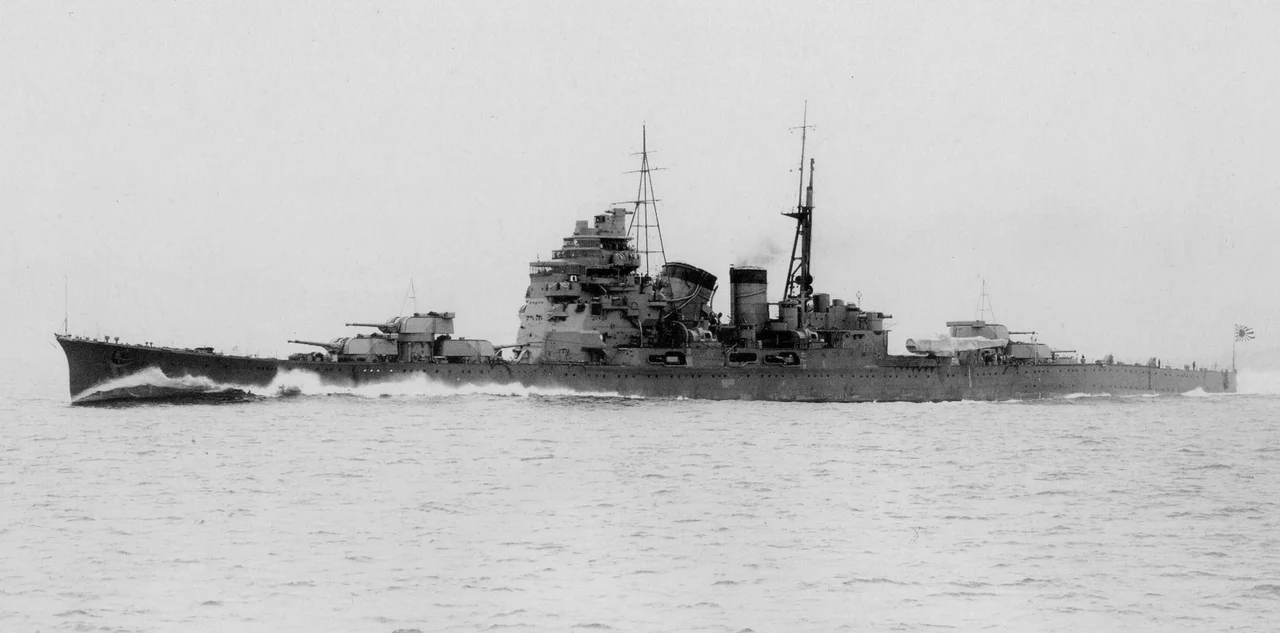

Japanese Cruiser Atago
The day before he was assassinated, Japanese Prime Minister Inukai Tsuyoshi toured the newly completed cruiser Atago. Two weeks later, Emperor Hirohito boarded the same ship for a three-day cruise through the Inland Sea, presiding over a naval review at Kobe. From her earliest days, Atago moved in the orbit of power. Named for Mount Atago outside Kyoto and completed two months ahead of her name-ship Takao, she was a heavy cruiser built to project Japanese strength across the Pacific. By October 1944, she would serve as flagship of Japan's last great surface fleet, leading it into the largest naval battle in history. She would not survive it.
Built for Speed, Cursed by Weight
The Takao-class cruisers were meant to fix the shortcomings of the Myoko class before them: thicker armor, dual-purpose guns that could engage aircraft, and torpedo launchers moved topside for safety. At 203.8 meters and 16,875 tons, capable of 35.25 knots, they were formidable. But the improvements came at a cost. The ships were dangerously top-heavy, a chronic problem that dogged the Japanese cruiser program. Atago and Takao were rebuilt between 1938 and 1939, their bridges reduced, main masts relocated, and hull bulges added to improve stability. The work bought them time. After rebuilding, the pair patrolled off China in 1940 and early 1941, preparing for a conflict that would consume every warship Japan could float.
Night Guns at Guadalcanal
Atago's war ranged from the opening strikes to the bitter end. She supported the evacuation of 11,700 troops from Guadalcanal and fought across the Solomons, but her most dramatic engagement came during the Second Naval Battle of Guadalcanal on November 15, 1942. In a chaotic night gun duel, Atago and Takao pounded the American battleship South Dakota with seventeen 20-centimeter rounds and one 12.7-centimeter shell. The battleship was damaged but not sunk. Earlier in the same battle, both Japanese cruisers had launched eight Type 93 Long Lance torpedoes apiece at the battleship Washington. All sixteen missed. It was a microcosm of the Pacific war: devastating firepower on both sides, close-range violence at sea, and the sheer unpredictability of night combat where searchlights and gun flashes were the only illumination.
A Floating Arsenal
By mid-1944, Atago had been through three modernizations. Radar sets were installed, and her anti-aircraft armament grew to sixty Type 96 guns, a testament to the increasing dominance of American airpower. She had survived carrier raids at Rabaul in November 1943, where near-misses from 500-pound bombs killed twenty-two crewmen, including her captain. She had sailed with Vice Admiral Ozawa's fleet in fruitless searches for American carriers, and she had emerged undamaged from the Battle of the Philippine Sea, the so-called Great Marianas Turkey Shoot that devastated Japanese naval aviation. Through it all, Atago remained operational, receiving each new refit and returning to the fight.
Flagship of the Center Force
From July to October 1944, Atago served as flagship of Vice Admiral Takeo Kurita's First Mobile Striking Force, the most powerful surface fleet Japan had left. Five battleships, ten heavy cruisers, two light cruisers, and nineteen destroyers were based at Lingga Roads near Singapore, gathering for one final gamble. On October 22, the force sortied for the Battle of Leyte Gulf. Atago led what the Allies called the Center Force as part of Sentai-4, alongside Chokai, Takao, and Maya. The next morning, two American submarines that had been shadowing the fleet attacked in the Palawan Passage, near the aptly named Dangerous Ground. Four torpedoes struck Atago, setting her ablaze. She capsized at 05:53, sinking in just eighteen minutes in about 1,800 meters of water.
The Admiral Swims
Of Atago's crew, 360 men died. Among the 529 survivors was Vice Admiral Kurita himself, pulled from the water and transferred to another ship so he could continue commanding the fleet into the battle ahead. Three hundred forty-seven crewmen were rescued by one destroyer, another 171 by a second. The loss of the flagship in the opening minutes of the engagement was a devastating blow, but Kurita pressed on, leading the Center Force through the Sibuyan Sea to its near-destruction of the American escort carriers off Samar the following day. Atago was struck from the navy list on December 20, 1944. She lies somewhere in the deep waters of the Palawan Passage, not far from where her sister Maya went down the same morning, two warships that sailed together from the shipyards in 1930 and met the same end fourteen years later, twenty minutes and a few miles apart.
From the Air
Coordinates: 9.50°N, 117.22°E, in the Palawan Passage of the South China Sea. The wreck lies approximately 1,800 meters deep, near sister ship Maya's resting place. From the air, the Palawan Passage appears as deep blue water between Palawan Island to the east and the Spratly Islands to the west. Nearest major airport is Puerto Princesa (RPVP) on Palawan, roughly 250 km east. The Dangerous Ground shoal area lies to the southwest.
Nearby Stories
- Sabina Shoal 20 km away
- Tabon Caves 23 km away
- Iwahig Prison and Penal Farm 99 km away
- Palawan 117 km away
- Pandanan Shipwreck 130 km away
- Mischief Reef 130 km away
- Dos Palmas Kidnappings 179 km away
- HMS Pelorus (1808) 187 km away