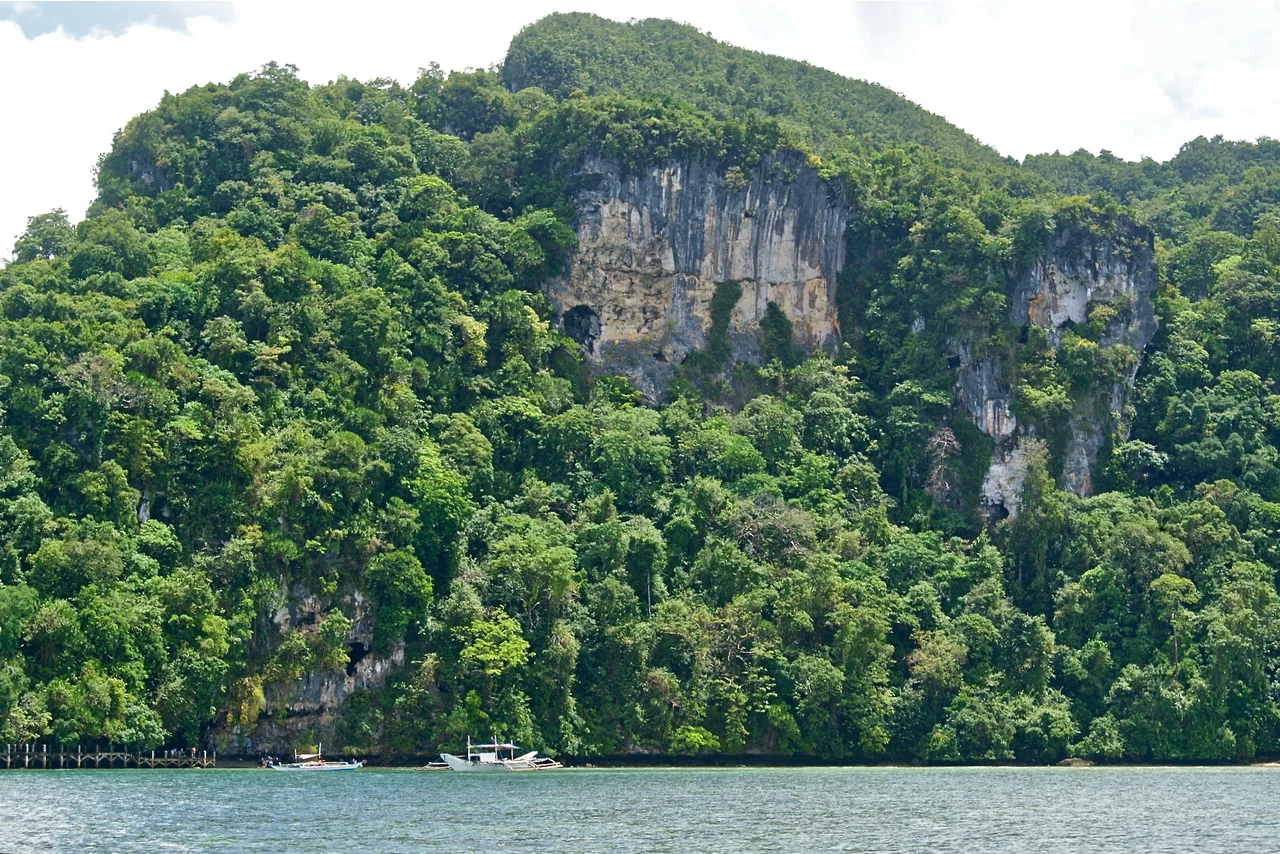

Tabon Caves
The caves are named for a bird. The Tabon scrubfowl, a ground-nesting megapode that once thrived on the limestone headland of Lipuun Point, gave its name to a place where humans have sheltered, worked, buried their dead, and marked their presence for at least 50,000 years. That makes the Tabon Caves in Quezon, Palawan, the oldest known site of human habitation in the Philippines, the place the country calls its cradle of civilization. Two hundred fifteen caves honeycomb the point, carved by millennia of rain and tide into limestone formations that date back 25 million years to the Lower Middle Miocene. Of those caves, twenty-nine have been explored. Seven are open to visitors. The rest keep their secrets in the dark.
The Man Who Opened the Caves
Between 1962 and 1966, American anthropologist Robert B. Fox led a team from the National Museum of the Philippines into the Tabon cave system and emerged with discoveries that rewrote the archipelago's prehistory. The most famous find was the Tabon Man, a fragment of a skullcap and jawbone representing one of the earliest known modern humans in the Philippines. Fox's team also uncovered thousands of stone tools, rock flakes, and hammers that suggest the caves served as workshops, places where early humans shaped the instruments of daily survival. Radioisotope dating techniques have since established a period of nearly continuous habitation stretching from 30,000 to 9,000 years ago. When Fox died, nearly all active research at the site stopped, a loss that still echoes through Philippine archaeology.
The Jars of the Dead
Among the most striking finds at Tabon are the jar burials. The caves yielded hundreds of burial jars, ceramic vessels in which the bones of the dead were placed after the flesh had decomposed or been removed. The most celebrated is the Manunggul Jar, a secondary burial vessel dating to around 890-710 BCE, with a lid sculpted to depict two figures paddling a boat, a soul being ferried to the afterlife. It is considered one of the finest examples of prehistoric art in Southeast Asia and is now held at the National Museum in Manila. The Sa Huynh trading culture, which had connections across maritime Southeast Asia, adorned their dead here with agate, carnelian, and glass beads traced to India and Iran, evidence that even in deep prehistory, Palawan was connected to trade networks spanning thousands of miles.
A Museum Under Guard
The Lipuun Point Reservation covers 138 hectares, an island connected to the Palawan mainland by mangrove forest. It was declared a Site Museum Reservation in April 1972 and named a priority site for tourism development in 1991. In 2006, the Tabon Cave Complex and all of Lipuun Point were added to the Philippines' tentative list for UNESCO World Heritage Site nomination. The National Museum declared it a National Cultural Treasure in February 2011. Visitors arrive by boat, dock at a small station, and walk into the complex under the watchful eyes of museum guards who ensure nothing is touched or taken. Every burial jar and set of remains has been secured. In February 2024, the National Museum opened the Tabon Caves Museum on-site, a facility meant to bring the caves' story to a wider audience without risking the fragile original sites.
What the Caves Still Hold
The paradox of Tabon is abundance and neglect existing side by side. Of 215 known caves, the vast majority remain unexplored. Excavated remains sit in storage, unexamined. Holy Trinity University in Puerto Princesa was selected in 2015 to establish a College of Tabonology, a discipline dedicated to studying ancient Palawan, but the field remains small. The caves hold bone fragments from the late Pleistocene to early Holocene, stone tools whose purposes are not fully understood, and burial practices that span millennia. New research and exploration have largely ceased. What has been found is extraordinary. What remains hidden may be more so. The caves wait, as they have for 25 million years, for someone to come looking.
From the Air
Coordinates: 9.28°N, 117.98°E, on Lipuun Point in southwestern Palawan, Philippines. The headland juts into the South China Sea and is visible from the air as a rocky promontory connected to mainland Palawan by mangrove forest. Nearest airport is Puerto Princesa (RPPS), approximately 150 km to the northeast. The coastline is rugged with limestone cliffs. From altitude, the contrast between the dark cave openings and white limestone is visible in clear conditions.
Nearby Stories
- Japanese Cruiser Atago 23 km away
- Japanese Cruiser Maya 25 km away
- Iwahig Prison and Penal Farm 35 km away
- Puerto Princesa 64 km away
- Pandanan Shipwreck 98 km away
- Dos Palmas Kidnappings 112 km away
- USS Billfish (SS-286) 132 km away
- Tubbataha Reef 153 km away