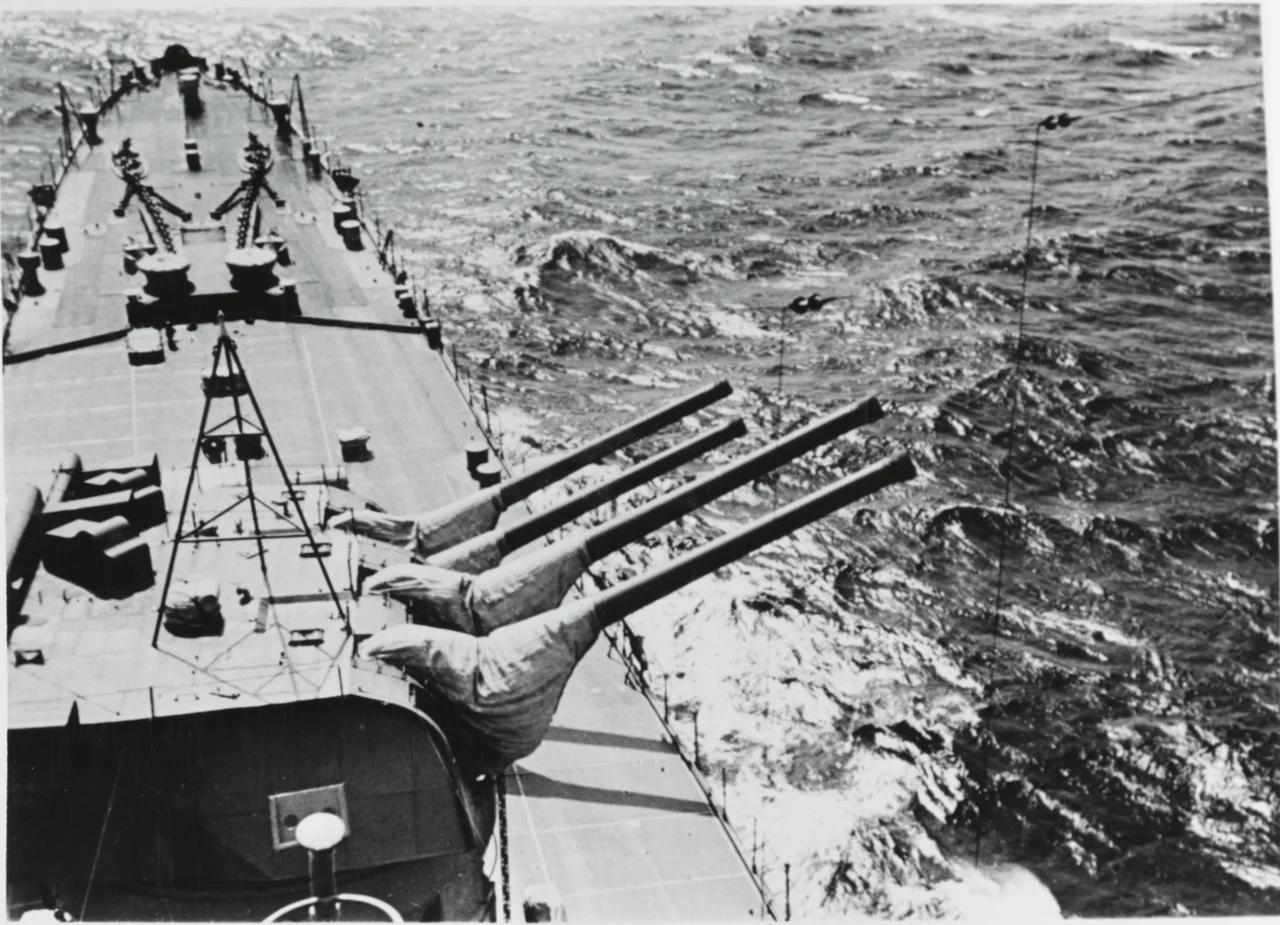
_in_action_during_the_Battle_of_the_Komandorski_Islands_on_26_March_1943_(80-G-73827).jpg)
Japanese Cruiser Maya
A monkey taught to salute officers. Sixty-one dive bombers failing to land a single direct hit. Four torpedoes ending a warship's life in under ten minutes. The story of the heavy cruiser Maya reads less like a naval record and more like a war novel, full of improbable escapes and sudden reversals. Named for a mountain outside Kobe, Maya was one of four Takao-class cruisers built for the Imperial Japanese Navy in the early 1930s, ships designed to be the backbone of a long-range strike force. At 203.8 meters long and capable of 35.25 knots, she was among the largest and most powerful cruisers afloat. But her career would be defined not by design specifications, but by the extraordinary events that played out across the Pacific from 1937 to 1944.
A Top-Heavy Thoroughbred
The Takao class represented Japan's ambition to build cruisers that could outfight anything they might encounter. Displacing 16,875 tons, they carried dual-purpose main guns effective against both ships and aircraft, with torpedo launchers relocated to the upper deck for greater safety. The design came with a price, though. Like their Myoko-class predecessors, the Takao-class ships were dangerously top-heavy, a flaw that plagued them throughout their service. While sister ships Takao and Atago underwent extensive rebuilding at Yokosuka Naval Arsenal between 1938 and 1939, receiving reduced bridges, relocated masts, and hull bulges for stability, Maya and Chokai received only minimal modifications. The two pairs diverged so significantly that they could almost be considered separate classes.
The Unsinkable Destroyer Escort
Maya spent the opening years of the war escorting troop convoys and supporting operations from China to the Aleutians. She became flagship of the IJN Fifth Fleet and assisted in the evacuation of Kiska after the Americans took Attu in August 1943. But it was at Rabaul on November 5, 1943, that her luck was first tested. SBD Dauntless dive bombers struck her aircraft deck above the No. 3 engine room, igniting a major fire that killed seventy crewmen. Maya limped back to Yokosuka, where she underwent a transformation. Engineers stripped her No. 3 turret and aircraft hangar and replaced them with a bristling forest of anti-aircraft weapons: thirteen triple-mount and nine single-mount Type 96 guns, six twin-mount 127-millimeter guns, and thirty-six Type 93 machine guns. She emerged as a dedicated anti-aircraft cruiser, a floating wall of flak.
The Monkey and the Scout Plane
After her refit, Maya embarked from Kure carrying two long-range scout planes, troops, and supplies. She also took aboard an unusual passenger: a monkey, donated by the Kure Zoo. During the voyage, the aircrew taught the animal to salute passing officers, a trick that amused the crew and annoyed the brass in equal measure. The monkey stayed aboard through the Battle of the Philippine Sea in June 1944, where Maya's scout plane spotted the massive American Task Force 58 at a distance of 300 miles. Maya formed a protective ring around the carriers with battleships and escorts, weathering attacks from over fifty torpedo bombers. She survived with only minor damage from near-misses. When the fleet retired through Okinawa to Yokosuka, the aircrew and their saluting monkey finally disembarked.
Ten Minutes in the Palawan Passage
On October 22, 1944, Maya sailed into the Battle of Leyte Gulf as part of Sentai-4, alongside sisters Atago, Takao, and Chokai. The following morning, a pair of American submarines attacked the fleet in the Palawan Passage. At 05:33, Atago was struck by four torpedoes and sank in eighteen minutes. Takao, hit twice, was crippled and forced to retire. Twenty minutes later, a submarine fired six torpedoes at Maya, mistaking the cruiser for a battlecruiser. Four struck her port side: the forward chain locker, opposite the No. 1 gun turret, the No. 7 boiler room, and the aft engine room. Secondary explosions tore through the ship. By 06:00 Maya was dead in the water, listing heavily. She sank five minutes later, taking 336 officers and men to the bottom, including her captain. Of the 769 survivors rescued, 143 were transferred to the battleship Musashi, which was sunk the very next day. From a final crew of 1,105, Maya lost 479 men.
Resting Upright in the Deep
For seventy-five years, Maya lay undiscovered in the deep waters of the South China Sea. Then, on April 19, 2019, researchers located her wreck in roughly 1,850 meters of water. What they found was remarkable: the ship sits upright on the seabed, her bow tip broken off and lying inverted nearby, but the rest of the hull in astonishingly good condition. All main gun turrets remain in place, and the massive bridge structure stands intact, a silent monument to the 479 men who never came home. Although sister ship Atago was sunk nearby the same morning, the distinctive bridge structure and gun layout confirmed the identity beyond doubt. In popular culture, Maya lives on in the 1988 Studio Ghibli film Grave of the Fireflies, where the father of the story's two children serves aboard the cruiser and is presumed killed.
From the Air
Coordinates: 9.45°N, 117.38°E, in the Palawan Passage of the South China Sea. The wreck lies in approximately 1,850 meters of water between Palawan Island (Philippines) to the east and the Spratly Islands to the west. From cruising altitude, the deep blue waters of the passage stretch in every direction. Nearest major airport is Puerto Princesa (RPVP) on Palawan, approximately 240 km to the east. The area sees frequent commercial shipping traffic.
Nearby Stories
- Sabina Shoal 14 km away
- Tabon Caves 27 km away
- Iwahig Prison and Penal Farm 98 km away
- Second Thomas Shoal 99 km away
- Pandanan Shipwreck 111 km away
- BRP Sierra Madre 153 km away
- HMS Pelorus (1808) 174 km away
- Tubbataha Reef 231 km away