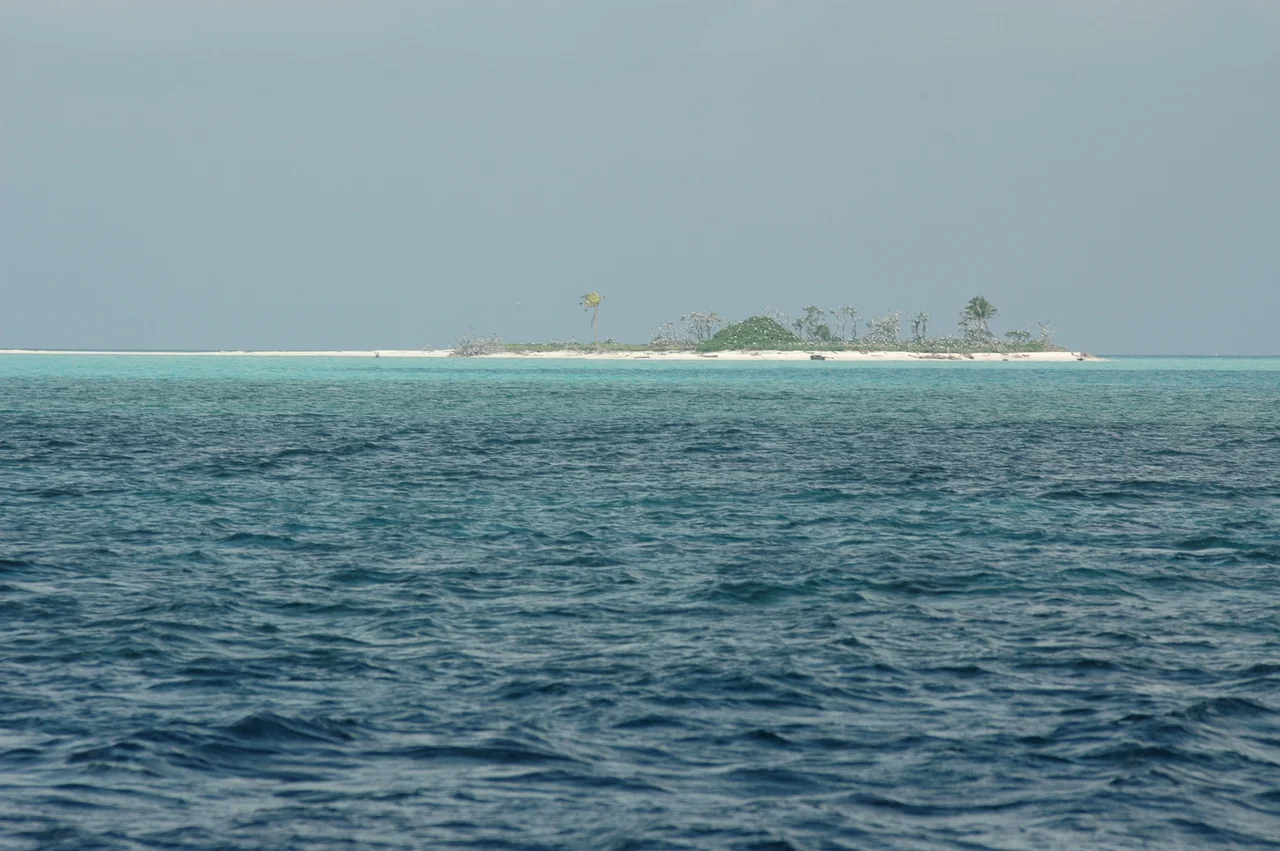

Tubbataha Reef
In the Sama-Bajau language, the word tubbataha combines tubba and taha to mean "a long reef exposed at low tide." It is an apt name for a place defined by what appears only when conditions allow. For most of the year, Tubbataha Reef exists in the minds of divers as an aspiration -- trips booked years in advance for a narrow window from mid-March to mid-June, when the seas calm and visibility reaches 30 meters or more. The rest of the time, this UNESCO World Heritage Site sits in the middle of the Sulu Sea, 150 kilometers from Puerto Princesa, guarded by armed rangers and visited mainly by the 600 fish species, 360 coral species, and 13 whale and dolphin species that call it home.
An Accidental Sanctuary
Tubbataha owes its extraordinary preservation to a simple fact: its two islets have no freshwater. Without drinkable water, no one could live there permanently, and for centuries the reef existed in a kind of benign neglect. The Sama-Bajau, a seafaring people with a nomadic tradition, visited periodically. Fishermen from the nearby islands of Cagayancillo sailed their bangka outrigger canoes to what they called Gusong, harvesting fish from waters so abundant that restraint seemed unnecessary. That changed in the 1980s, when motorized boats made the journey faster and easier. As fish stocks declined in closer waters, more fishermen turned to Tubbataha -- and many brought cyanide and dynamite. The reef that isolation had protected was being destroyed by the same technology that made it accessible.
Coral Walls and Open Water
Tubbataha's two atolls -- North and South -- plus the smaller Jessie Beazley Reef cover a total area of 97,030 hectares, making this one of the largest marine protected areas in Southeast Asia. The reef sits within the Coral Triangle, a region recognized as the global center of marine biodiversity, containing 75 percent of all described coral species and 40 percent of the world's reef fish. What draws experienced divers here are the coral walls: places where shallow reef abruptly drops into deep water, creating vertical habitats teeming with giant trevally, hammerhead sharks, barracudas, manta rays, napoleon wrasse, and moray eels. Whale sharks and tiger sharks have been sighted in the deeper waters. Hawksbill and green sea turtles nest on the reef's sand bars. CNN Travel has called Tubbataha one of the best dive sites in the world, and its ecosystem rivals the Great Barrier Reef in diversity if not in scale.
Rangers on a Concrete Islet
Protecting a reef in the middle of the sea is a logistical challenge that Tubbataha's managers have solved through determination and improvisation. In the early years of enforcement, rangers lived in a canvas tent on one of the islets. A wooden structure built in 1996 was undermined by shifting sand. Today, the marine park rangers occupy a styrofoam-reinforced concrete station on the Southeast Islet, standing watch 24 hours a day. President Gloria Macapagal Arroyo expanded the park's boundaries by 200 percent in 2006, and in 2017 the International Maritime Organization designated the reef a Particularly Sensitive Sea Area -- an official "area to be avoided" by international shipping. The designation came partly in response to a series of ship groundings, including the Greenpeace vessel Rainbow Warrior in 2005 and the USS Guardian in 2013, for which the United States paid 87 million pesos in damages and reimbursement.
The Thousand-Peso View
Tubbataha appears on the reverse side of the Philippine one-thousand-peso bill, a national recognition of its ecological importance. But seeing the reef in person requires commitment. All trips are vessel-based liveaboards departing from Puerto Princesa, a ten-hour boat ride each way. Dive boats are booked years in advance during peak periods around Easter and the Asian Golden Week holidays. Visitors stay on their vessels throughout; the sand bars are off-limits to humans, though tourists may set foot at the ranger station. The park entrance fee stands at 3,000 pesos. For the Sama-Bajau fishermen who named this place, tubbataha described what they saw at low tide. For modern visitors, it describes something else entirely: a reef so remote, so well-defended, and so astonishingly alive that reaching it feels less like travel and more like pilgrimage.
From the Air
Located at 8.95°N, 119.87°E in the middle of the Sulu Sea, approximately 150 km southeast of Puerto Princesa, Palawan. Best viewed from 15,000-25,000 feet. The two atolls (North and South) are visible as distinct ring-shaped coral formations in deep blue water, with lighter turquoise lagoons inside. No nearby airports -- nearest is Puerto Princesa International Airport (RPVP). The reef is an isolated feature with no surrounding landmass, making it a striking visual from altitude.
Nearby Stories
- Puerto Princesa 82 km away
- Iwahig Prison and Penal Farm 112 km away
- Dos Palmas Kidnappings 125 km away
- Cuyo, Palawan 209 km away
- USS Billfish (SS-286) 219 km away
- SuperFerry 9 224 km away
- Fort Cuyo 236 km away
- Philippine Air Lines Flight F26 296 km away