
Cuyo, Palawan
The cannons at Fort Cuyo face the sea, but they have not fired in anger for centuries. Today they boom only during town celebrations, a festive echo of a time when Moro raiders could appear on any horizon and the entire population would shelter behind walls of stone and mortar ten meters high. Cuyo is the oldest town in Palawan, a municipality scattered across the western Sulu Sea on islands that have been trading crossroads, colonial outposts, and contested ground for longer than anyone can document precisely. The town and its cultural environs are being considered for nomination to the UNESCO World Heritage tentative list.
Traders, Chiefs, and a Goddess in the Forest
Long before the Spanish arrived, Oriental traders discovered the Cuyo archipelago and established barter networks with the islanders. Malay chief Matuod arrived in large boats called sakayan and formed permanent settlements. The Islamic chieftain Datu Magbanua consolidated power across the islands, with allied datus governing territories from Taytay to Busuanga to Puerto Princesa. The Malays brought dances that blended with native traditions to create the pondo-pondo, still performed today. During Datu Magbanua's rule, three Chinese traders discovered gold deposits on Mount Aguado and introduced mining and metalwork, but the islanders grew suspicious and expelled them -- sending them on to found a settlement in what is now Iloilo.
Faith, Force, and a Forbidden Feast
In 1622, the Conde de San Agustin and five Spanish missionaries colonized the island. They quickly baptized some 500 inhabitants, but many Cuyunon continued honoring their indigenous deities. Diwata ang Kagueban, the goddess of the forest, was celebrated with feasts atop Mount Caimamis. Neguno, the ancient god of the sea, was credited with turning a greedy man into the first shark. Even after conversion, about two-thirds of the newly Christian Cuyunon still celebrated the forest goddess's feast, which infuriated the colonial authorities. The Spanish response was severe: forced conversion, burning of non-Catholic homes, and enslavement. They attempted to absorb the indigenous deity by renaming her Virgen Del Monte -- recasting a forest goddess as a Catholic virgin in a bid to erase what they could not suppress.
Raiders, Priests, and a Fort That Endured
In 1636, a fleet under Muslim Datu Tagul raided Cuyo, burned the town, attacked the church, and carried off prisoners including a priest, Fr. Francisco de Jesus Maria. The raiders continued to Agutaya and Culion, where they abducted another priest mid-Mass. A Spanish flotilla of six vessels caught the returning raiders on December 21; Datu Tagul was killed, 300 of his men captured, and 120 prisoners freed, but both priests had been killed. These raids led to the construction of Fort Cuyo, completed in 1680 -- a massive rectangular edifice with walls two meters thick, a belfry, and watchtowers. What makes the fort unique among Philippine fortifications is what it contains: the church, the convent, and a Perpetual Adoration chapel, all within its walls. In 1762, a British warship fired on the fort during their invasion of Manila. It was not damaged.
An Archipelago Preserved
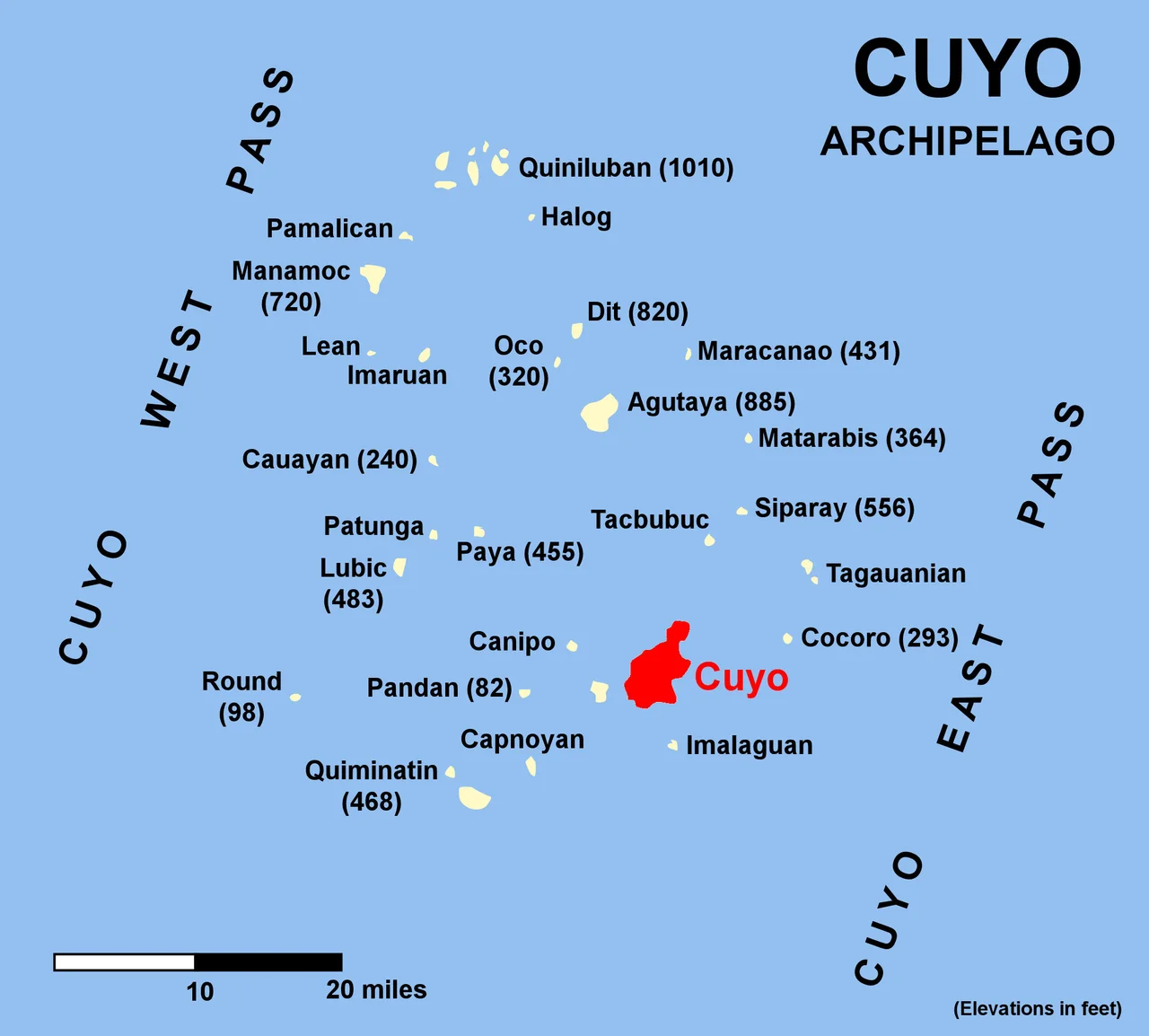
Cuyo Island itself is modest in size -- 13 kilometers long, 7.5 kilometers wide, covering 57 square kilometers -- but the municipality encompasses a constellation of smaller islands: Bisucay, Caponayan, Manamoc, Pamalican, and others scattered across the Sulu Sea. From the sea, the island's first visible landmark is a lighthouse by the pier. Ashore, the town preserves its Hispanic plaza-iglesia layout: the 1860 church, the convent, the fort, a schoolhouse, and a Rizal monument arranged around a central square. The streets are cemented but the pattern is colonial. With a population of 24,702 as of the 2024 census, Cuyo remains small enough that its 350 years of layered culture -- Malay, Chinese, Spanish, American, Filipino -- have not been bulldozed by development.
From the Air
Cuyo Island sits in the Sulu Sea at approximately 10.85N, 121.02E, part of the Cuyo Archipelago between Palawan and the Visayas. From altitude, the archipelago appears as a scattering of small green islands in open water. Cuyo Airport (RPLU) is located in the neighboring municipality of Magsaysay. Fort Cuyo and the town center are visible near the island's pier and lighthouse. The surrounding waters are shallow in places -- approach with awareness of the marine geography.
Nearby Stories
- San Jose de Buenavista 34 km away
- Maniguin Island Lighthouse 59 km away
- Guimaras Oil Spill 101 km away
- Coron, Palawan 111 km away
- Fort Santa Isabel 117 km away
- San Vicente, Palawan 146 km away
- Jalaur Dam 147 km away
- Japanese Cruiser Abukuma 206 km away