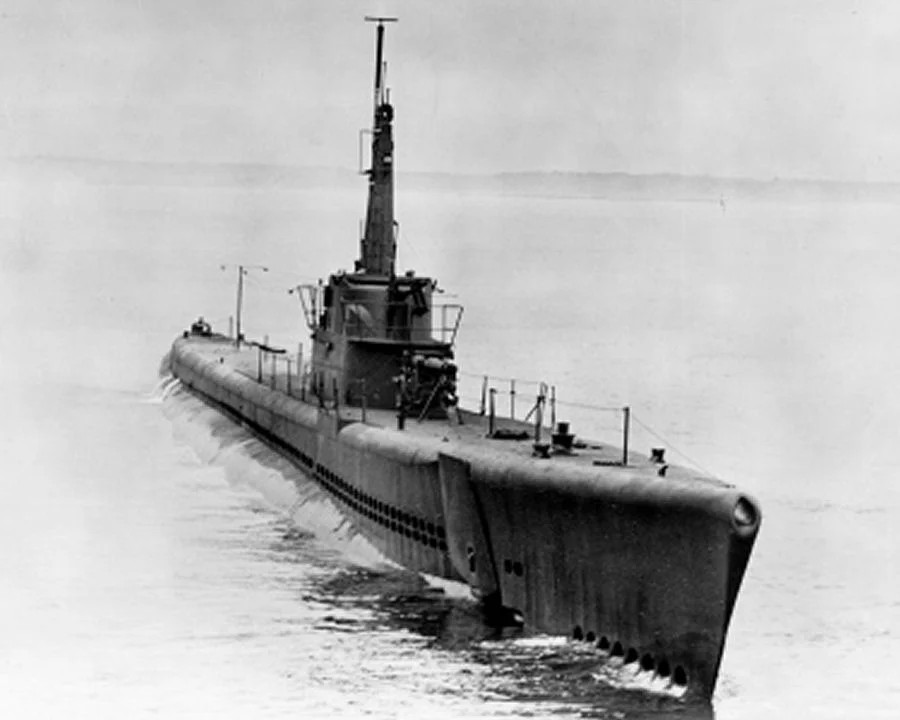

USS Billfish (SS-286)
On a November night in 1943, somewhere in the waters north of Australia, an Allied twin-engine bomber spotted a submarine on the surface and decided it was Japanese. The pilot responded to the submarine's recognition flare by strafing her with machine-gun fire. USS Billfish crash-dived to 100 feet, then deeper to 150 feet, her crew knowing that the bombs and bullets coming at them were American. It was one of several friendly fire incidents Billfish would endure during her eight war patrols -- a career that also included stalking Japanese submarines, torpedoing cargo ships off the Korean coast, and receiving the news of Japan's surrender while on lifeguard station off Kyushu. Billfish earned seven battle stars. She also earned something harder to quantify: the distinction of having survived everything the war could throw at her, including her own side.
The Dive Officer's Twelve Hours
Billfish was built at the Portsmouth Navy Yard in Kittery, Maine, launched on 12 November 1942, and commissioned on 20 April 1943 with Lieutenant Commander Frederic C. Lucas Jr. in command. Her early patrols from Darwin, Australia, were a baptism by frustration and near-disaster. On one patrol, after 12 continuous hours at his station as diving officer, Charlie Rush turned over control to a junior officer and assumed command of the boat. When the Japanese detected Billfish and followed her oil slick, Rush reversed course so precisely that the submarine was able to proceed back down her own previous track, using the floating oil slick as cover -- turning the enemy's tracking advantage into concealment. Rush would later receive the Navy Cross. The submarine also stalked a Japanese submarine for six hours, fired four torpedoes, watched three miss due to a last-minute course change, and had to jar the fourth loose from its tube with a heavy blast of compressed air. The target escaped.
Hunting Convoys
Billfish's patrols took her from the waters around the Mariana and Caroline Islands to the Luzon Strait, the Volcano Islands, and the Ryukyu chain. The pattern was the same everywhere: long stretches of boredom punctuated by minutes of explosive action. On her fifth patrol, operating as part of a wolfpack in the Luzon Strait, she launched four torpedoes at a cargo ship that spotted the wakes and evaded. On her sixth patrol near the Ryukyu Islands, she tracked a five-ship convoy for an entire day before firing seven torpedoes in rapid succession -- three from the bow tubes, then swinging around to launch four from the stern. Her patrol report claimed hits on multiple ships, but postwar analysis of Japanese records failed to confirm any sinkings. The submarine war in the Pacific was full of such discrepancies: explosions heard through the hull, escorts forcing you deep before you could confirm the kill.
Blood in the Yellow Sea
Billfish's seventh patrol, in the spring of 1945, brought her to the East China Sea and Tsushima Strait for lifeguard duty supporting B-29 raids on Honshu. The assignment also meant hunting whatever Japanese shipping remained. On 26 May, she sank the 991-ton cargo ship Kotobuki Maru No. 7. On 4 June, two torpedoes sent the 2,220-ton Taiu Maru to the bottom in the Yellow Sea, barely a nautical mile off the Korean coast. Then Billfish surfaced and attacked three coastal steamers with her deck guns. During the action against the third vessel -- a schooner -- rifle fire from the enemy crew killed Quartermaster 1st Class Robert V. Oliver and wounded another crewman. It was a reminder that even in the war's final months, with Japanese shipping reduced to coastal freighters and fishing boats, the killing went both ways.
The Last Patrol
Billfish departed Midway Atoll on 12 July 1945 for her eighth and final war patrol in Japan's home waters. Japanese shipping had become, in the words of her patrol report, a rare commodity. On 5 August, near the coast of Manchuria, she sank the 1,091-ton Kori Maru with three torpedoes out of a salvo of four. Two days later, she sent a smaller cargo ship to the bottom with a single torpedo, then escaped the escort through what the record calls skillful maneuvering in water barely deep enough for submerged operation. That night, running on the surface at high speed, she collided with and sank a small fishing junk. On 15 August, while on lifeguard station off Kyushu waiting to rescue downed aircrews, Billfish received word of Japan's surrender. She proceeded to Pearl Harbor, arriving on 27 August 1945. Her war was over. She was decommissioned on 1 November 1946, served as a Naval Reserve training vessel in Boston until 1968, and was sold for scrapping in 1971.
From the Air
Billfish's operational area during her patrols near northern Borneo is roughly 7.97N, 117.30E, in the waters between Sabah and the southern Philippines. However, her wartime patrols ranged across the entire western Pacific -- from Darwin, Australia, to the Yellow Sea off Korea to Japan's home waters. The Balabac Strait and Palawan Passage, visible from altitude as the water gap between Palawan and Borneo, were transit corridors for submarine operations. Nearest airports to the listed coordinates are Sandakan (WBKS) and Kota Kinabalu (WBKK).
Nearby Stories
- Banggi Island 55 km away
- Tabon Caves 116 km away
- Japanese Cruiser Maya 133 km away
- HMS Pelorus (1808) 135 km away
- Sabina Shoal 162 km away
- Tango Maru 171 km away
- Turtle Islands National Park 179 km away
- Iwahig Prison and Penal Farm 217 km away