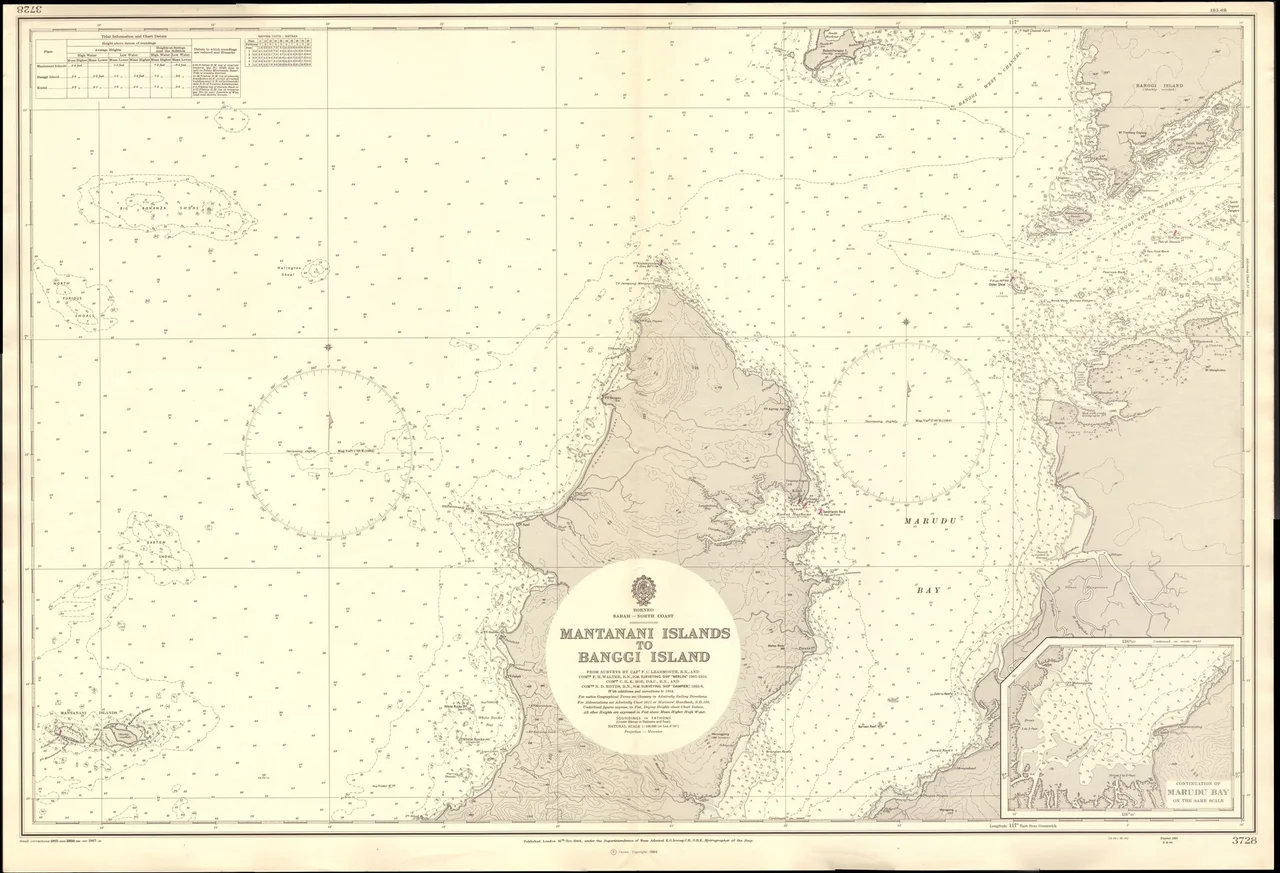

Banggi Island
The name gives visitors pause. In the Bonggi Dusun language, banggi derives from bangkai -- corpse. Early visitors to this island, the largest fully within Malaysia at 440.7 square kilometers, reportedly found human bodies strung in the trees, because the earliest inhabitants did not practice burial of the dead. That grim etymology belies a place of extraordinary natural beauty and cultural complexity: an island where animist traditions persist alongside Islam and Christianity, where ten species of mangrove trees shelter dugongs and rare dolphins, and where the Bonggi Dusun people live not in villages but in scattered family settlements across a landscape that was, until 9,000 years ago, part of the Borneo mainland.
Three Centuries of Flags
Banggi has been coveted by nearly every power to operate in Southeast Asia. The Sultanate of Brunei controlled it before ceding northern Borneo, including Banggi and neighboring Palawan, to the Sultanate of Sulu around 1704 as reward for military support during the Brunei Civil War. In 1759, the East India Company dispatched Alexander Dalrymple to establish trade with Sulu, and by 1762 the EIC had secured cession of nearby Balambangan. Dalrymple established a factory at Banggi to process spices obtained from Bugis traders working the Moluccas, though the plan never materialized. The Americans considered building a naval depot here. The Kingdom of Italy attempted to acquire the island in 1870 for a penal colony. Germans established a tobacco estate at Limbuak Darat in 1884. Ultimately it was the British who prevailed, establishing the protectorate of North Borneo through the North Borneo Chartered Company in 1881. By 1887, the only government building on the island was a police quarters at the town the British named Mitford -- known to the Bonggi Dusun as Karakit.
The Bonggi Dusun
What makes Banggi culturally distinct is the Bonggi Dusun, the indigenous group that forms the island's largest ethnic community. Unlike other indigenous groups in Sabah, the Bonggi have traditionally lived not in centralized villages but in scattered family settlements across the island. Their language, Bonggi, contains many English loanwords despite minimal historical contact with English speakers -- a linguistic puzzle that researchers continue to study. While Sunni Islam is now the dominant religion on Banggi, many Bonggi Dusun still practice animism, maintaining reverence for spirits and the natural world. Their resistance to religions perceived as conflicting with traditional customs is a quiet, persistent act of cultural preservation. Christians on the island, primarily Seventh-day Adventists, face their own challenges: cases of indigenous Banggi Christians being erroneously registered as Muslims by federal agencies are a recurring bureaucratic injustice.
A Biological Borderland
Banggi sits at a biogeographical boundary. The 120-meter bathymetric line north of the island divides Bornean fauna from Palawan fauna of the Philippine Islands -- a line that reflects ancient land connections and separations stretching back tens of thousands of years. The island hosts 39 species of mammals, 20 of which were first documented in 1995. At Banggi Peak's Kalangkaman Site, part of the Banggi Forest Reserve, mosses and epiphytes coat the trees at 350 meters elevation. The summit meadows hold pitcher plants, orchids, and dense fern cover. The southern tip of the island, called Wak-Wak, preserves both primary lowland forest and mangrove, while the Karakit Forest Reserve at the southernmost point hosts a large expanse of mangrove. Since 2016, the island has been part of the Tun Mustapha Marine Park, one of Malaysia's largest marine protected areas.
Island Life, Modern Pressures
Reaching Banggi requires a ferry from Kudat, a journey of one and a half to two hours that departs twice daily. A district office in Karakit now administers the island along with neighboring Balambangan, Manawali Cape Island, and Tigabu Island. Schools, a health clinic, a police station, a Malaysian Army camp, and a government rest house serve the community. In 2024, one of the island's primary schools was selected for the British Council's global English programs alongside schools from Palestine, Greece, and Cameroon. Energy is a persistent challenge: as of 2023, the island runs on the SSH Pulau Banggi solar hybrid off-grid station, though the BIMP-EAGA Council has estimated Banggi could produce over 1.5 gigawatt-hours of annual renewable electricity by converting palm oil mill waste into biogas. For now, the island remains a place where modernity arrives slowly, in ferries and solar panels, while the forest and the sea maintain their older rhythms.
From the Air
Located at 7.25N, 117.17E, Banggi Island is the large island visible northeast of the Tip of Borneo, separated from mainland Sabah by the South Banggi Channel. At 440.7 square kilometers, it is clearly visible from high altitude as the dominant landmass north of Kudat. Smaller Balambangan Island lies immediately to its west. The nearest Philippine island is Mangsee Islands to the north. Nearest airport is Kudat (WBKT) on the mainland. The Tun Mustapha Marine Park surrounds the island. Tropical rainforest climate with heavy rain November through March.
Nearby Stories
- Cape Melville Lighthouse 39 km away
- Jambongan Island 43 km away
- Kinabalu Park 98 km away
- Turtle Islands National Park 103 km away
- Mount Kinabalu 137 km away
- HMS Pelorus (1808) 149 km away
- Sandakan Camp 159 km away
- Tabon Caves 193 km away