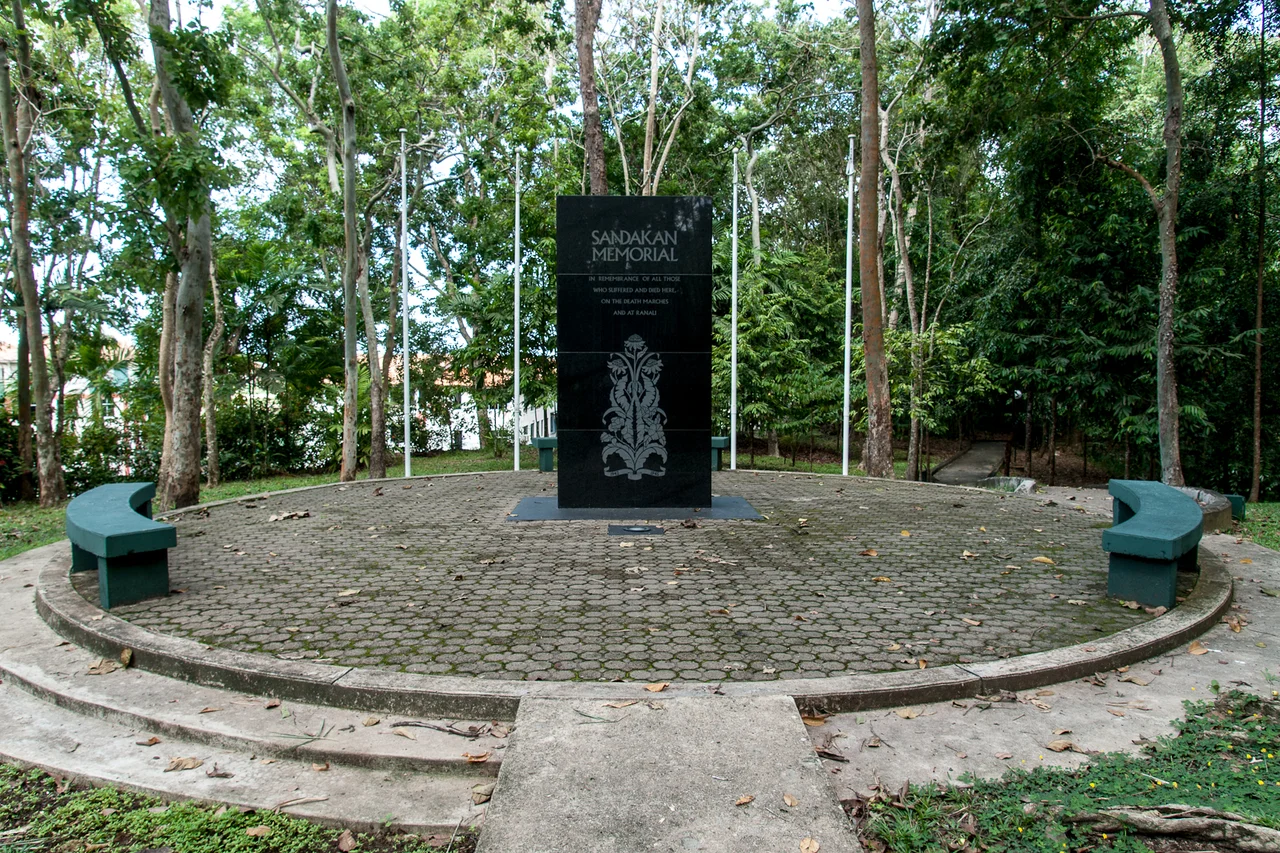

Sandakan Camp
Before the war, the site was an experimental farm run by the North Borneo Chartered Company, a place where fruit trees grew and cattle grazed. By July 1942, it held 1,500 Australian prisoners of war, most of them captured after the fall of Singapore. The Japanese needed an airfield in Sandakan, and they needed labor to build it. What happened on this patch of ground over the next three years -- the forced construction, the starvation, the cages, the clandestine radio, and finally the death marches -- constitutes one of the worst atrocities committed against Allied prisoners in the Pacific War. Of the roughly 2,500 men imprisoned here, only six Australians survived.
Building an Airfield on Empty Stomachs
The camp grew quickly. After the initial 1,500 Australians arrived in 1942, another 770 British and 500 Australian soldiers were added in 1943, bringing the prisoner population to approximately 2,500. The men were forced to construct a military airfield under brutal conditions, with inadequate food, rampant disease, and systematic cruelty. The camp produced its own electricity using a wood-fired steam engine coupled to an alternator, originally part of the agricultural research station's infrastructure. That power system became the unlikely backbone of an act of defiance: from 1942 until its discovery in July 1943, prisoners secretly raised the voltage in the evening hours to power a clandestine radio transmitter, feeding intelligence to Allied forces outside.
The Cage and the Commander
Camp commandant Susumi Hoshijima, a military engineer promoted from lieutenant to captain during the war, presided over a regime of deliberate cruelty. When new prisoners arrived in April 1943, he made his authority clear in terms that left no room for misunderstanding. The camp was ringed with barbed wire, and in front of the guards' office stood a wooden cage roughly 1.8 by 1.5 by 1.2 meters -- about the size of a large dog crate. Prisoners caught stealing food from the kitchen were locked inside. As conditions deteriorated, larger cages were built: a second measuring 2.7 by 2.1 by 1.5 meters in June 1943, and a third at 4.5 by 2.7 by 2.7 meters in October 1944. The escalating dimensions tell their own story -- more prisoners were being punished, for the simple act of trying not to starve.
The Marches Begin
By October 1944, the airfield had become a liability. Allied bombing raids hammered it relentlessly, and by January 1945 the runway was beyond repair. Work stopped on 10 January. The prisoners' labor was no longer needed, but the Japanese had no intention of freeing them. That same month, approximately 455 prisoners were forced to march westward through the jungle toward Ranau, roughly 260 kilometers away. The men were already weakened by years of malnutrition and disease. Stragglers were shot. In May 1945, the Japanese decided to close the camp entirely. Captain Takakuwa Takuo took command on 17 May. Twelve days later, he ordered the remaining 536 prisoners to march to Ranau, then set the camp on fire, destroying almost all records of what had happened there.
The Great Tree and What Remains
The dominant structure of the camp was not a building but a tree. A towering specimen of Koompassia excelsa -- known locally as the Mengaris tree -- rose above the compound, visible to every prisoner and guard alike. It became an involuntary witness to three years of suffering. The tree did not survive the postwar years, but today the site has been partially transformed into Sandakan Memorial Park, dedicated to all who suffered and died here and on the marches to Ranau. A concrete water reservoir and baseplate from the Japanese kitchen facility still remain, physical remnants of a place where thousands of men were worked, starved, and ultimately marched to their deaths. The park stands as a permanent reminder that some ground carries a weight that ordinary use cannot erase.
From the Air
Located at 5.889N, 118.047E, approximately 1.5 km southwest of present-day Sandakan Airport (WBKS). The former camp site is now partially occupied by Sandakan Memorial Park. From the air, the airport and the memorial park are adjacent landmarks. Best viewed at 1,500-3,000 feet on approach to Sandakan from the south or west. The Sandakan Death March route ran roughly westward through the jungle toward Ranau, a distance of approximately 260 km.
Nearby Stories
- Gomantong Caves 18 km away
- Tabin Wildlife Reserve 44 km away
- Jambongan Island 59 km away
- North Borneo 63 km away
- Nunuk Ragang 66 km away
- USS S-36 105 km away
- Banggi Island 150 km away
- Tubbataha Reef 347 km away