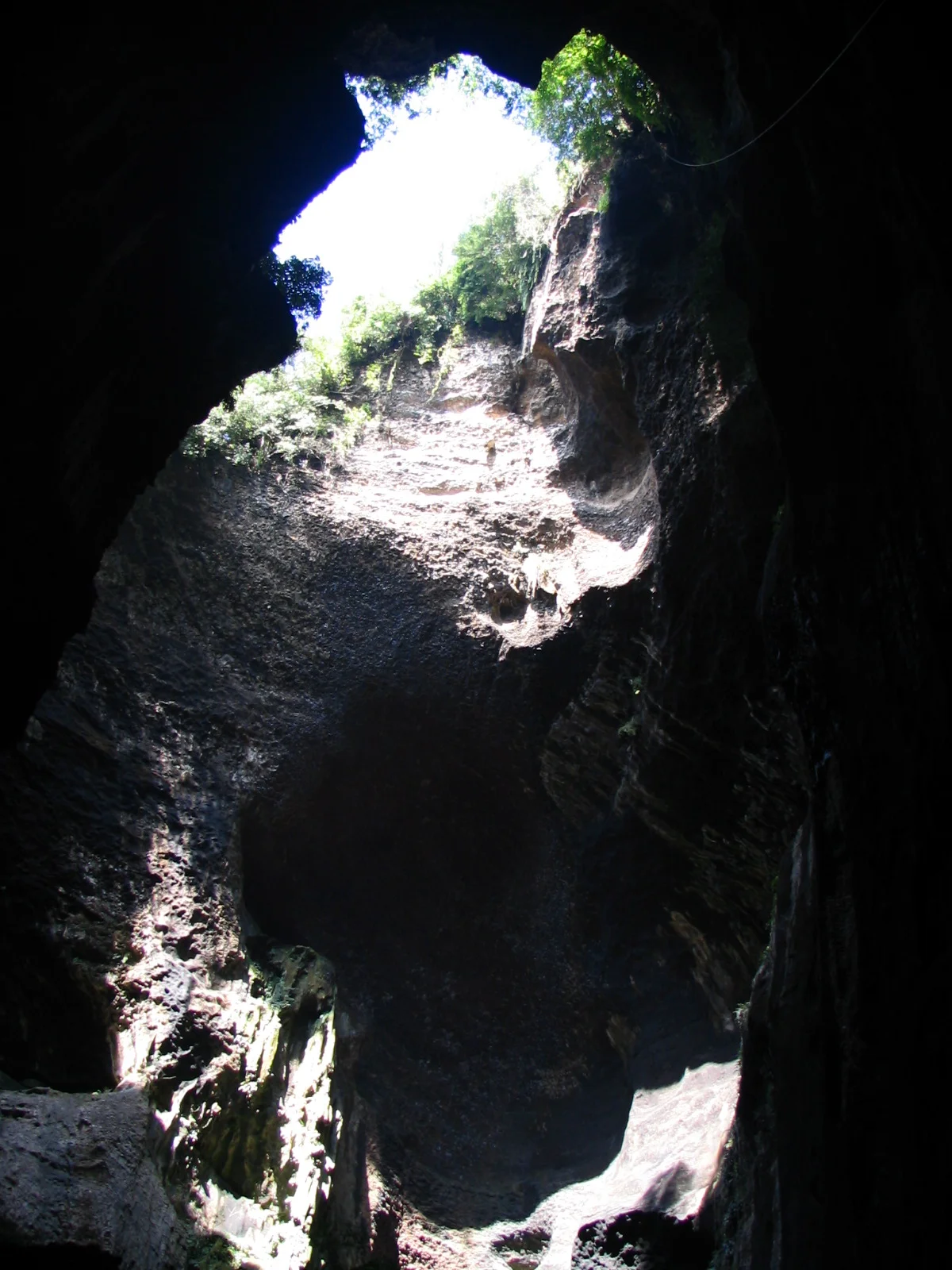

Gomantong Caves
Every evening, just before dark, the mouth of Gomantong Hill exhales. A quarter-million wrinkle-lipped free-tailed bats spiral upward from the limestone interior in a churning column, while bat hawks circle the periphery, picking off stragglers with surgical precision. Below, on the cave floor, cockroaches carpet the guano in such density that the ground itself appears to move. This is Gomantong -- the largest limestone outcrop in the Lower Kinabatangan floodplain of Sabah, Malaysian Borneo, and one of the most alive places on Earth, in every sense of the word.
Saliva and Gold
The caves have drawn human attention for at least 1,500 years, and the currency has always been the same: bird spit. Since at least AD 500, traders have harvested the nests of swiftlets who build their homes from threads of hardened saliva, cemented to the cave ceilings in the thousands. These nests, dissolved into bird's nest soup, are among the most expensive animal products in the world. The white nests from Simud Putih -- the upper White Cave -- command the highest prices, their pure saliva composition making them a prized delicacy across East Asia. The black nests from Simud Hitam below, woven with feathers as well as saliva, fetch less but remain valuable. Twice each year, from February to April and again from July to September, licensed harvesters scale the cave walls using only rattan ladders, ropes, and bamboo poles to reach ceilings that soar overhead. The first harvest is carefully timed before the swiftlets lay their eggs, prompting the birds to build replacement nests. The second collection comes only after the young have fledged and flown.
The Black Cave and the White
Gomantong's cave system divides into two distinct chambers, stacked one above the other. Simud Hitam -- the Black Cave -- is the more accessible of the two, reached by a wooden boardwalk that circuits the interior just minutes from the entrance building. Its name refers not to the darkness but to the black-nest swiftlets that colonize its vaulted ceilings. Visitors walking the boardwalk share the space with centipedes, cockroaches, and the heavy ammonia scent of guano that has accumulated for millennia. Above and beyond, reached only by a steep thirty-minute climb requiring proper caving equipment, lies Simud Putih -- the White Cave. Larger and more technically demanding, it harbors the white-nest swiftlets whose pure saliva nests are the real treasure. The main entrance to Simud Putih sits above the great lighthole at the rear of the Black Cave, where daylight pours down through the rock like a natural skylight connecting the two worlds.
A Hill That Breathes
Gomantong Hill is not merely a geological formation; it functions as a living system. The Gomantong Forest Reserve that surrounds it protects orangutans in the canopy and harbors the only known population of Plectostoma mirabile, an endangered land snail found nowhere else. Outside the cave entrance, crested serpent eagles soar on thermals rising from the limestone, kingfishers flash blue along the river corridors, and Asian fairy-bluebirds move through the understory. The bat colony -- counted at between 275,000 and 276,000 individuals in a 2012 census, correcting years of wild exaggeration -- drives a nightly cycle that feeds predators from bat hawks to snakes. First mapped by P. Orolfo in 1930, the caves were laser-scanned in 2012 and 2014, revealing passage networks that earlier surveys had missed entirely.
Tradition Under Protection
Nest harvesting at Gomantong is not a free-for-all. The Wildlife Conservation Enactment of 1997 brought the practice under strict legal control, with heavy fines for unlicensed collectors. Government-issued permits go to specific communities with historical ties to the caves, and the two-season harvesting calendar is designed to ensure swiftlet populations remain stable. The first collection removes nests before eggs are laid, triggering rebuilding behavior; the second waits until fledglings have departed. It is a system that acknowledges a truth the harvesters have understood for centuries: the caves are valuable only so long as the birds keep returning. Modern conservation science has arrived at the same conclusion through different methods, but the outcome is identical -- protect the cycle, and the cycle sustains you.
From the Air
Located at 5.52N, 118.07E in the Sandakan Division of Sabah, Malaysian Borneo. The limestone hill is the largest outcrop in the Lower Kinabatangan area and stands out from surrounding rainforest canopy. Nearest major airport is Sandakan Airport (WBKS). Best viewed at lower altitudes in clear conditions when the forest reserve and river systems are visible. The Kinabatangan River floodplain stretching to the east is a useful navigation reference.
Nearby Stories
- Operation Agas 6.5 km away
- Tabin Wildlife Reserve 19 km away
- Menara (tree) 36 km away
- North Borneo 47 km away
- USS S-36 65 km away
- Nunuk Ragang 66 km away
- Quailey's Hill Memorial 73 km away
- Sulu 280 km away