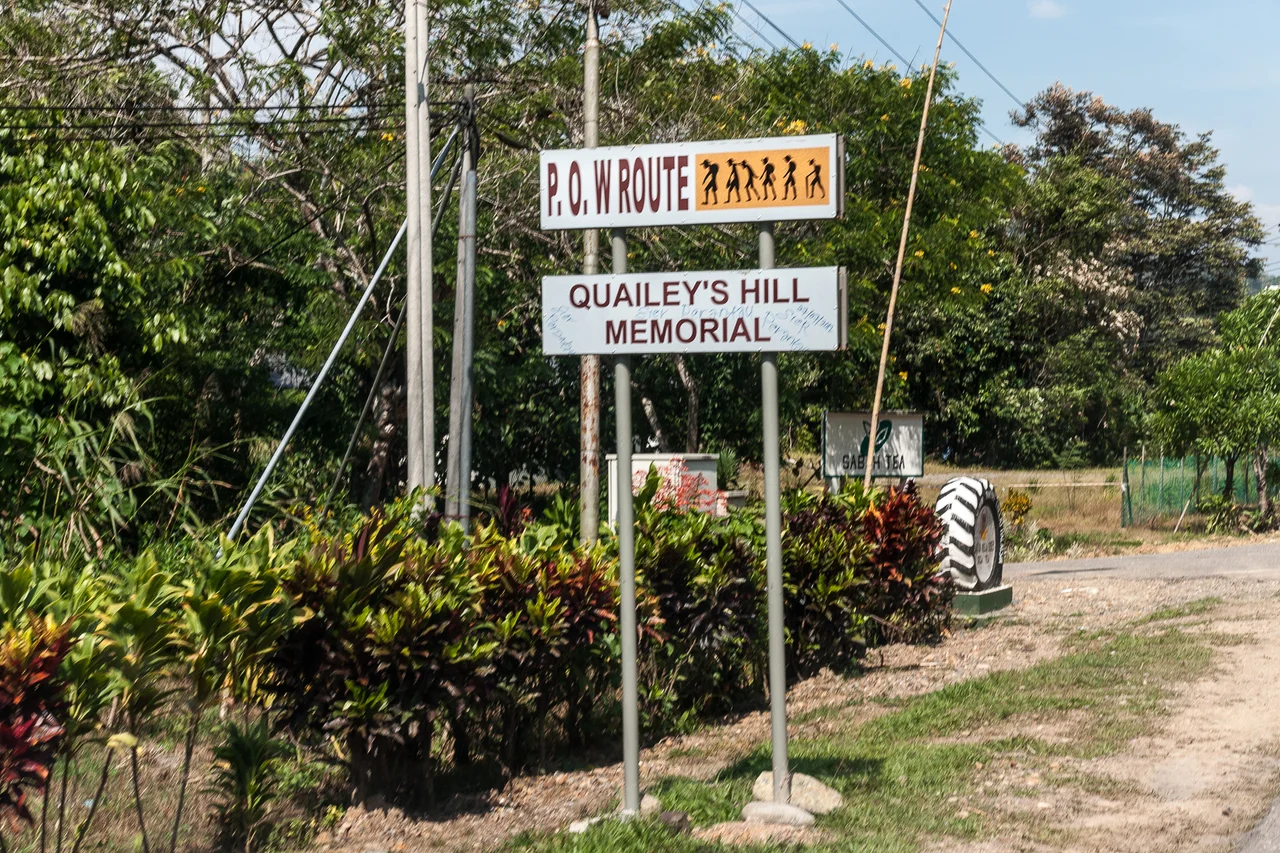

Quailey's Hill Memorial
Allan Quailey Clarence was twenty-four years old when he stopped walking. It was 16 February 1945, and he was on the first of three forced marches from the Sandakan POW camp to Ranau, through the jungle interior of North Borneo. His fellow prisoners in Group 3 could see that he would not survive. On a hill along the route, Quailey refused to go on. He knew what would happen. The Japanese guards killed anyone who could not keep up. He was killed there, on that hill, and for sixty years no one knew exactly where. Today, a granite memorial on the grounds of the Sabah Tea Plantation marks the spot where Allan Quailey died, on a slope now covered in tea bushes and bordered by a white fence.
From Lismore to Sandakan
Allan Quailey Clarence was born on 8 November 1920 in Lismore, New South Wales. On 5 August 1941, he volunteered for the Australian Imperial Force and was assigned to the 2/30th Australian Infantry Battalion. With the 8th Division, he sailed to Malaya -- and into catastrophe. When Singapore fell on 15 February 1942, Quailey was among the approximately 15,000 Australians captured by the Japanese. He was taken to Changi Prison. In July 1942, he was one of 1,500 Australians transferred aboard the SS Yubi Maru to Sandakan, on the northeast coast of North Borneo. For nearly three years, the prisoners endured forced labor, starvation, and disease at the Sandakan POW camp. Of the 2,500 Australian and British prisoners held there, only six Australians would survive the war. Every British prisoner died. On 31 January 1945, Quailey was sent out with Group 3 on the first of the three death marches.
The Hill He Named
The death marches from Sandakan to Ranau covered roughly 260 kilometers of jungle. Prisoners who could not maintain the pace were executed. Quailey, weakened by nearly three years of captivity, made it sixteen days before his body gave out on a hill deep in the interior. His friends watched him stop and understood what it meant. After the war, his remains were collected with other bodies and interred at the Labuan War Cemetery as an "unknown soldier," his grave marked with the inscription "Known unto God." It was not until 1999 that his identity was recovered and a personal gravestone replaced the anonymous marker. The hill where he died remained unmarked and forgotten, lost in the landscape of plantations and secondary forest that had grown over the wartime route.
Finding the Spot
In 2005, Australian historian Lynette Silver set out to trace the original route of the Sandakan death marches. Working with Malaysian trekking expert Tham Yau Kong, she discovered that portions of the old trail passed through land now managed by Sabah Tea, a commercial tea plantation in the Ranau district. Using wartime documents, Silver and Tham identified the precise location where Quailey had been killed in February 1945. They proposed renaming the site Quailey's Hill. The tea company's management agreed and offered to install a memorial. On 14 July 2007, the granite monument was inaugurated in a ceremony attended by Masidi Manjun, Sabah's Minister of Tourism, Culture and Environment; Australian Senator Anne McEwen; Lynette Silver; and Goh Mung Chwee, Managing Director of Sabah Tea. The memorial sits within a white-fenced area of about 100 square meters, open to the public. It is one of the stations on the POW Route, a marked trail that follows the path of the death marches from Sandakan to the camp at Ranau.
A Name Restored
What makes Quailey's Hill unusual among war memorials is its specificity. This is not a monument to a battle, a campaign, or even a group of fallen soldiers. It is a marker for one man on one hill on one day. The granite slab tells his story in English: where he was born, how he came to Borneo, and why he died here. The memorial transforms an anonymous stretch of tea plantation into a place with a history, a name, and a debt. Quailey's Hill is part of a broader network of remembrance across Sabah. The Kundasang War Memorial commemorates all the victims of the Sandakan marches. The Labuan War Cemetery holds the physical remains. Each station on the POW Route carries a sign board linking one location to the next, tracing the path of suffering across the landscape. But Quailey's Hill is the most intimate of these sites -- a single life, a single refusal, a single consequence, fixed to a coordinate on a Bornean hillside.
From the Air
Located at approximately 5.945°N, 116.781°E within the Sabah Tea Plantation in Ranau District. The tea plantation's orderly rows of tea bushes contrast with the surrounding forest and are identifiable from moderate altitude. Kota Kinabalu International Airport (WBKK) is approximately 100 km to the west. Mount Kinabalu (4,095 m) is visible to the northwest. The area is often clouded in the afternoon. The memorial is part of the POW Route tracing the Sandakan death marches.
Nearby Stories
- Mari Mari Cultural Village 20 km away
- Cho Huan Lai Memorial 38 km away
- Mount Trusmadi 43 km away
- Operation Agas 55 km away
- Agop Batu Tulug Caves 62 km away
- Jambongan Island 83 km away
- Tango Maru 216 km away
- Tabon Caves 353 km away