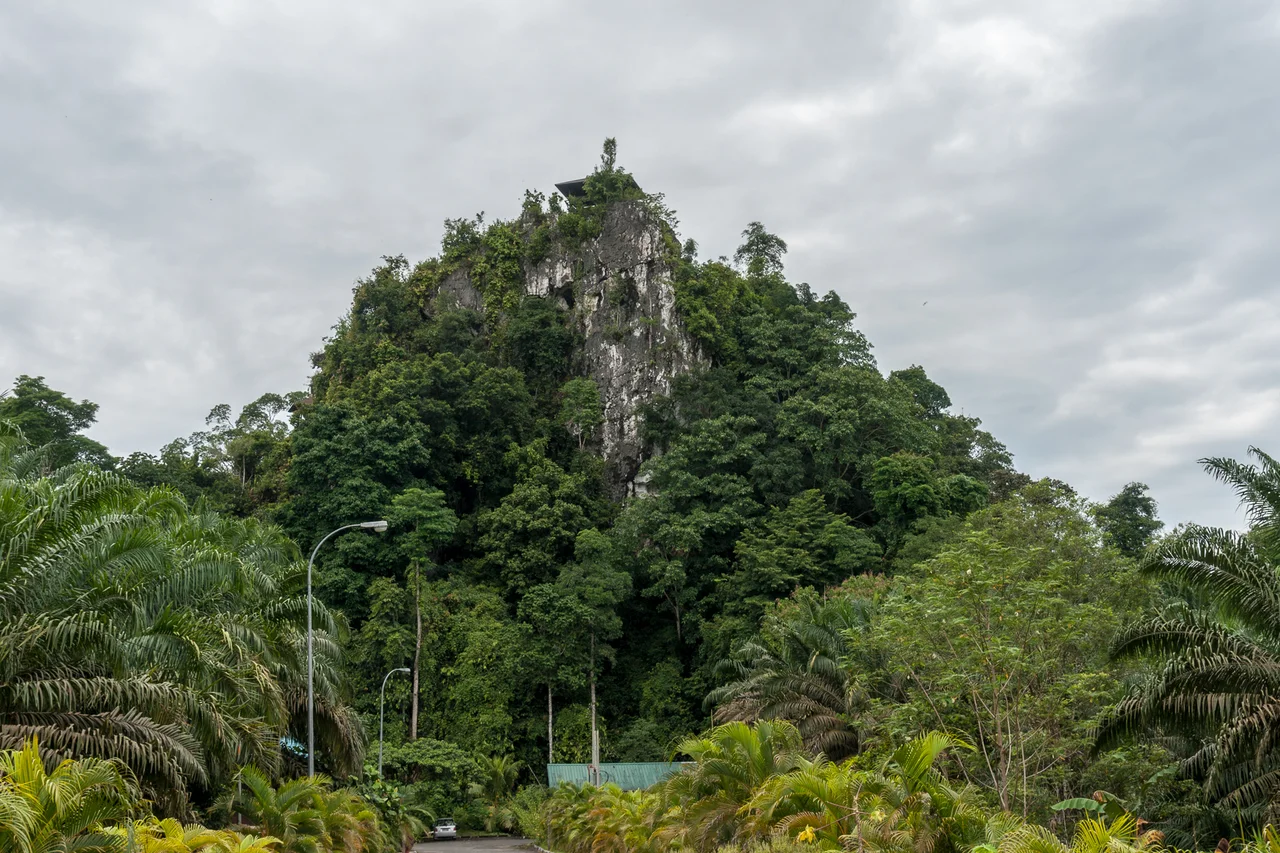

Agop Batu Tulug Caves
The name tells you what the place is, if you speak three languages. Agop means 'cave' in the Sungai language. Batu means 'rock' in Malay. Tulug, from Cebuano, means 'to go to sleep' - the sleep of the dead. In three words drawn from three peoples of Borneo, the Agop Batu Tulug Caves describe themselves: the rock caves where the dead rest. And rest they have, for somewhere between 500 and 900 years, in carved wooden coffins tucked into the mouths of limestone cliffs in the Kinabatangan district of Sabah.
Three Caves, 125 Coffins
The caves are divided into three main chambers. Agop Sawat, the upper cave, and Agop Lintanga, the middle cave, contain the majority of the coffins - more than 125 ancient log coffins distributed across their limestone shelves. Agop Suriba, the lower cave, completes the vertical arrangement. The coffins were carved from single logs, shaped into forms that carried meaning: crocodiles, associated with death and the power of darkness in Kinabatangan belief; bugang birds, dogs, roosters, and deer, which were friends of the heroes in local legend. Each carved figure connected the dead to the mythology of the Orang Sungai, the river people of the Kinabatangan Valley. But an alternative theory persists - Chinese artifacts found among the remains suggest that some coffins may belong to Chinese settlers who once lived in the area.
A Funeral Tradition Across Seas
The practice of log-coffin burial in cliff caves was not unique to Borneo. Similar wooden coffins have been found in mainland China and Indochina, leading researchers to conclude that traders from the Asian mainland brought this funeral culture to northern Borneo, possibly centuries before European contact. The practice took root in the Kinabatangan Valley, where researchers estimate that approximately 2,000 such wooden coffins are distributed across multiple sites, including locations in Ulu Segama, Lahad Datu, and Tawau. The caves were not random choices. Limestone cliffs offered natural protection from the elements, and the elevation kept the dead above the floodplain of the Kinabatangan River - Borneo's second-longest waterway, prone to seasonal flooding that would have destroyed ground-level burials.
Discovery in 1984
The caves entered the academic record in 1984, when an expedition led by P. Brietag, the manager of a tobacco estate in Batu Putih, brought researchers to the site. Barbara Harrisson of the Sarawak State Museum and staff from the Sabah Museum documented the coffins and their carvings, establishing the site as one of the most significant archaeological discoveries in Malaysian Borneo. Since 6 July 1996, the caves have been administered by the Sabah Museum, which maintains the access stairs, office buildings, and overnight cabins that allow researchers and visitors to reach the cliff-face openings. The management arrangement reflects the site's dual identity: a scientific resource requiring careful preservation and a cultural heritage site belonging to the communities whose ancestors carved the coffins.
Reading the Carvings
What survives in the caves is a library carved in wood. The animal motifs on the coffins encoded a belief system that mapped the relationships between the living, the dead, and the natural world. The crocodile was not mere decoration - it represented the passage between life and death, a creature of both water and land, both worlds. The bugang bird, sacred to the Orang Sungai, signified heroism and protection. Each coffin was not just a container but a statement about who the deceased was and what powers would accompany them into sleep. The carvings are weathering. Wood does not last as long as stone, and 500 to 900 years in a tropical climate has softened some details past recognition. What remains is enough to confirm that the people who carved these coffins understood their dead as travelers, not simply the departed.
From the Air
Located at 5.42N, 117.94E in the Kinabatangan district of Sabah, in the steep limestone cliffs near Batu Putih. The caves sit along the lower Kinabatangan River corridor - Borneo's second-longest river, visible as a brown serpentine ribbon through dense jungle from altitude. The limestone karst formations that house the caves appear as pale outcrops against the green forest canopy. Nearest airport is Sandakan (WBKS), approximately 120 km to the northeast. The site is part of the broader Kinabatangan wildlife corridor, one of Borneo's most important ecological zones.
Nearby Stories
- USS S-36 17 km away
- Menara (tree) 18 km away
- Tabin Wildlife Reserve 22 km away
- Operation Agas 25 km away
- North Borneo 48 km away
- Nunuk Ragang 64 km away
- Maliau Basin 65 km away
- Japanese Destroyer Tanikaze 244 km away