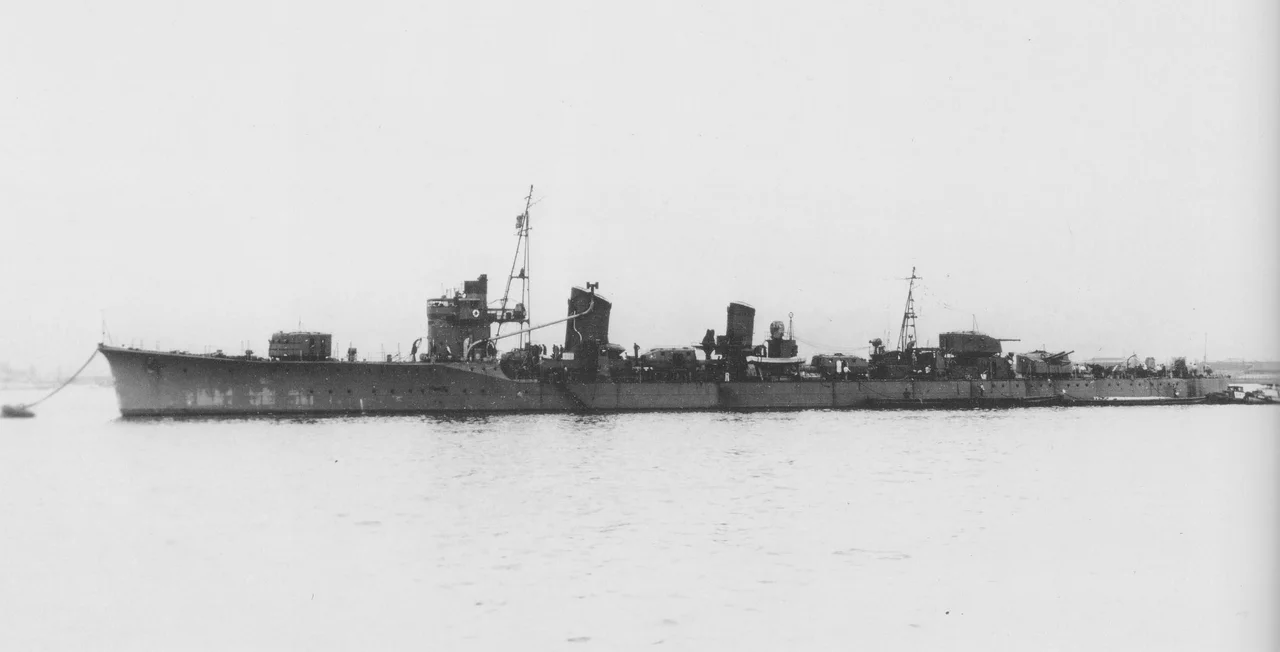

Japanese Destroyer Tanikaze
Sixty-one dive bombers against one destroyer. That was the math at Midway on June 6, 1942, when American pilots, unable to find the carrier Hiryu they had been sent to finish off, turned their attention to the Japanese destroyer Tanikaze instead. They needed to jettison their bombs before landing, and the small warship below made a convenient target. Through aggressive zigzagging commanded by Katsumi Motoi, Tanikaze dodged every single bomb. Not one of the sixty-one aircraft scored a direct hit. It was the kind of improbable survival that defined this Kagero-class destroyer's war, a career that stretched from the attack on Pearl Harbor to a torpedo in the Sulu Sea, touching nearly every major battle of the Pacific campaign along the way.
From Hitokappu Bay to Pearl Harbor
Tanikaze was one of nineteen Kagero-class destroyers built for the Imperial Japanese Navy in the late 1930s. At 118.5 meters long with a crew of 240, she was fast at 35 knots and lethal, armed with six 127-millimeter guns and eight 610-millimeter torpedo tubes loaded with the oxygen-fueled Type 93 Long Lance, the most devastating torpedo of the war. In November 1941, Tanikaze steamed from Saeki to Hitokappu Bay, joining the Kido Butai, Japan's massed carrier force, for the strike on Pearl Harbor. She escorted six fleet carriers across the Pacific for eleven days at 18 knots. On December 7, as two waves of aircraft devastated the American fleet, Tanikaze stood guard over the carriers. No attack came against the Kido Butai that day. After Pearl Harbor, she escorted carriers to Wake Island, Rabaul, Kavieng, and Port Darwin, where Japanese aircraft sank eight troopships and a destroyer. On March 7, 1942, Tanikaze fired her own guns for the first time, bombarding Christmas Island into surrender.
The Impossible Dodge at Midway
Midway was the turning point of the Pacific War, and Tanikaze was at its center. Sent to check on the burning carrier Hiryu, the destroyer arrived too late; Hiryu had already slipped beneath the waves. But the American dive bombers searching for the carrier found Tanikaze instead. What followed was one of the most remarkable episodes of ship handling in the war. Commander Motoi threw his destroyer into violent evasive maneuvers as sixty-one SBD Dauntless aircraft attacked simultaneously. Bombs fell around the ship, raising enormous water columns. Shrapnel from a near-miss slashed across the No. 3 aft gun turret, triggering an explosion that killed all six crew inside. Tanikaze's anti-aircraft gunners shot down one dive bomber, which plunged into the destroyer's wake. Shortly after, five B-17 Flying Fortress bombers attacked from 11,000 feet. They scored no hits either. One B-17 accidentally dropped its auxiliary fuel tanks along with its bombs and was lost with all crew.
Three Torpedoes for Helena
After Midway, Tanikaze plunged into the grinding Guadalcanal campaign, running troops and supplies through waters contested by both navies. On January 15, 1943, Commander Motoi was killed by shrapnel during an air attack, a loss felt deeply by a crew who had watched him outmaneuver sixty-one bombers. But Tanikaze's most decisive moment came at the Battle of Kula Gulf on July 6, 1943. When the American light cruiser Helena ran out of flashless powder, her gun flashes lit up the darkness, drawing the attention of Tanikaze and the destroyer Suzukaze. Together they launched sixteen Type 93 torpedoes. One struck Helena's forward magazines, blowing off 150 feet of bow. Two more hit amidships, destroying the engine room and breaking the keel. The cruiser lost all power, broke in two, then into three pieces. One hundred sixty-eight men died with her. Tanikaze took a six-inch shell hit in return, but the round failed to explode and caused only cosmetic damage.
The Long Escort
Through 1943 and into 1944, Tanikaze served as a tireless escort, shepherding carriers, battleships, and troop transports across the shrinking perimeter of Japanese control. She rescued sailors blown overboard when the carrier Junyo was torpedoed. She had her X turret removed and replaced with additional anti-aircraft cannons, reflecting the growing aerial threat. At the Battle of Santa Cruz, she escorted the fleet that sank the carrier Hornet. She ran supplies to Guadalcanal through PT boat-infested waters. She made troop transport runs to Munda, New Georgia, Kolombangara, and Lae. Through it all, the dud shell from Kula Gulf remained unrepaired for months, a cosmetic blemish on a ship that kept fighting. On June 9, 1944, Tanikaze's luck finally ran out when a submarine's torpedo found her in the Sulu Sea. The destroyer that had dodged sixty-one bombers, survived B-17 attacks, and shrugged off a six-inch shell could not outrun a torpedo in the dark.
From the Air
Coordinates: 5.70°N, 120.68°E, in the Sulu Sea between the Philippines' Palawan and Sulu archipelago. The wreck lies in deep water in a region historically significant for World War II naval engagements. Nearest airports include Zamboanga (RPMZ) approximately 120 km to the east and Puerto Princesa (RPPS) roughly 350 km to the northwest. The Sulu Sea appears as deep blue water from altitude, dotted with small islands of the Sulu archipelago to the south.
Nearby Stories
- Sulu 27 km away
- Tawi-Tawi 32 km away
- Sheikh Karimul Makhdum Mosque 100 km away
- Basilan 105 km away
- Isabela, Basilan 133 km away
- 2013 Lahad Datu Standoff 180 km away
- Turtle Islands National Park 242 km away
- Balut Island 454 km away