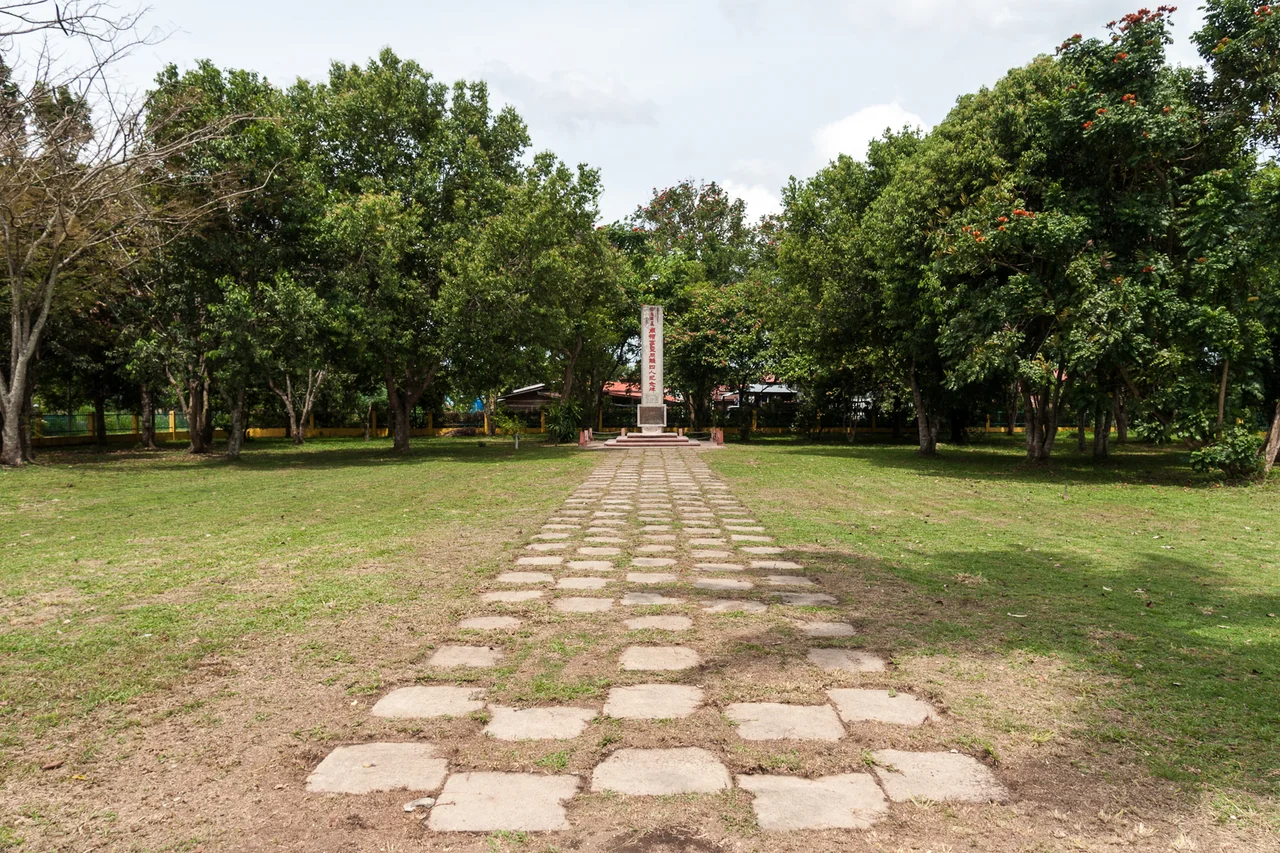

Cho Huan Lai Memorial
The names are listed on a bronze plaque: Cho Huan Lai, Consul General of the Republic of China. Cyril Drummond Le Gros Clark, Chief Secretary of the Rajah of Sarawak. Valentine A. Stokes, medical practitioner from Sandakan. Henry William Webber, engineer from Manila. Donald Macdonald, planter from Kuching. Five men from different nations and walks of life, bound together by imprisonment and killed together on 6 July 1945, just weeks before the war that condemned them would end. Their memorial stands near the former airfield in Keningau, Sabah, where they were executed.
A Consul in the Crosshairs
Cho Huan Lai had served as the Chinese Consul General for the Republic of China in North Borneo since 1940. When Japanese forces invaded Sandakan on 19 January 1942, the Chinese Consulate was among their first targets. In the minutes before soldiers reached the building, Cho managed to destroy consulate documents and coded materials. His diplomatic immunity initially afforded him some protection. He and several European civilians were sent to an internment camp on Berhala Island, then transferred with his family to the Batu Lintang camp in Kuching. Even in captivity, Cho used his connections to maintain contact with the outside world. When the Japanese discovered this in May 1944, Cho and his fellow inmates were arrested, tried by a military court, and sentenced to imprisonment.
A Journey Through Prisons
The prisoners began their sentence in Kuching, then were moved to Batu Tiga prison in Jesselton, the colonial capital now known as Kota Kinabalu. When Allied forces launched their campaign to retake Borneo, the Japanese shifted the prisoners again. An air raid on the Jesselton prison in late 1944 killed some inmates and wounded Cho himself. In January 1945, they were moved to Beaufort, and then in April to Keningau, deeper into the interior and further from the advancing Allied armies. After further bombing raids threatened other prison facilities, the group was taken to Bulu Silau, roughly two miles from Keningau, where they came under the authority of Lieutenant Colonel Abe Keichi and Lieutenant Akutagawa Mitsuya, the local kenpeitai commander.
Execution at the Airfield
By 5 July 1945, the five men had served their full sentences. The Japanese planned to release them. What happened instead, on 6 July, was their execution near the Keningau airfield. The circumstances surrounding the decision to kill prisoners who had completed their terms remain one of the dark chapters of the Japanese occupation of Borneo, a place where the ordinary brutalities of war crossed into calculated cruelty. The remains of Cho and his colleagues were later recovered and reburied at the old Anglican Cemetery in Jesselton, giving them at last a resting place of dignity after years of captivity and a death that defied even the grim logic of wartime.
Memory Carved in Red Characters
The memorial stands about four metres tall, a rectangular stele on a three-tiered square pedestal. Its most striking feature is the large red ancient Chinese characters inscribed on the front face, while a bronze plaque at the base provides the details in English. The monument was built near the site of the execution, and in 2017, the Taiwanese Deputy Representative Michael S.Y. Yiin visited for the 72nd anniversary alongside Malaysia's member of parliament for Keningau, Joseph Pairin Kitingan. The diplomatic visit underscored something the memorial has always represented: that the crimes committed here crossed national borders, and the obligation to remember them does too.
From the Air
The Cho Huan Lai Memorial is located in Keningau (5.35°N, 116.17°E), an interior town in Sabah accessible via Keningau Airport (formerly an airfield where the executions took place). The town sits in a valley surrounded by the Crocker Range to the west. Nearest major airport: Kota Kinabalu International Airport (WBKK), approximately 135 km northwest. Best viewed at lower altitudes; the Keningau valley is a clear landmark in the interior highlands.
Nearby Stories
- Nunuk Ragang 18 km away
- De Fontaine Memorial 25 km away
- North Borneo 34 km away
- Maliau Basin 36 km away
- Labuan War Cemetery 45 km away
- The Forests That Burn Underground 56 km away
- Mosquito Island's Older Residents 120 km away
- Tango Maru 235 km away