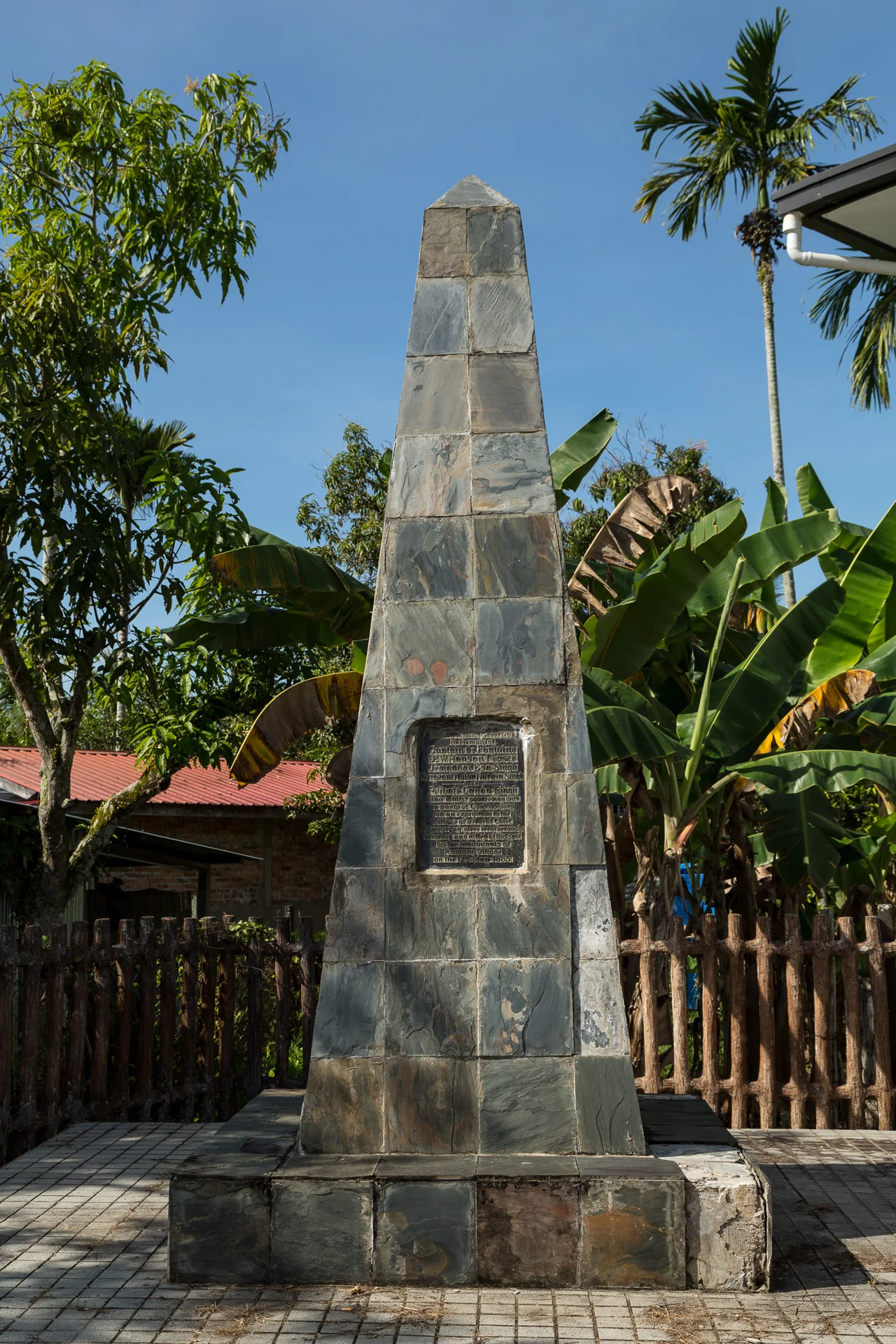

De Fontaine Memorial
The tree is gone now. It was called the "Government Tree," and under its branches on 12 May 1885, two Bajau men walked up to a group of British officials and Indian constables, struck up a friendly conversation, and then opened fire. When the violence ended, Dr. Donald Manson Fraser lay dead from a point-blank gunshot, three Indian constables had been killed by spearmen, and Captain A.M. de Fontaine -- chief commissioner of the British North Borneo Constabulary -- had taken a spear wound that would kill him five days later. A 2.5-metre obelisk on a stepped square base now stands where the tree once grew, in the village of Kawang, Sabah.
The Puroh Expedition
De Fontaine had come to North Borneo from the Singapore police force. In May 1885, he organized what was called the Puroh Expedition, tasked with finding a Murut chief named Kandurong, known as both a cattle thief and a headhunter. De Fontaine assembled a party that included G.L. Davies, the Resident of the West Coast; Dr. Fraser; R.M. Little, a Resident Assistant; and J.E.G. Wheatley, along with a detachment of police. They arrived at Kawang village on 10 May. The expedition needed to push into the mountainous Crocker Range, but they were short of baggage carriers. The Dusun people who normally served as porters were unavailable, so the British turned to the Bajau headmen of Kawang and demanded 30 men to carry loads into the mountains.
A Demand Too Far
The Bajau headmen resisted. "The carrying of heavy loads is hard for them," they told the British, a refusal that was as much about dignity as physical burden. The British Resident threatened to fine the village if the headmen did not comply. Tensions sharpened when a porter from a neighboring district discovered a stolen water buffalo in the Bajau village, forcing the headmen to surrender the animal to British authorities. On 12 May, the situation worsened further as more porters were demanded from Papar. The Kawang inhabitants felt cornered -- their autonomy overridden, their village threatened with punishment, their livestock seized. The colonial authorities, waiting under the shade of a tree with their Indian constabulary and policemen, did not recognize how close the situation was to breaking.
Seven Seconds Under the Tree
Two Bajau men approached the group carrying guns and began what appeared to be casual conversation. Then, without warning, one of them shot Dr. Fraser at point-blank range. Seven more Bajau fighters charged from concealment with spears, killing three Indian constables and wounding eight policemen in a burst of chaotic violence. R.M. Little drew his revolver and shot three attackers. One of the Indian constables seized a Bajau gun and killed another three, wounding two more. Facing unexpected resistance and mounting losses, the surviving Bajau retreated across open ground and vanished into the jungle. De Fontaine, severely wounded by a spear, was carried from the scene. He died on 17 May 1885 and was buried the following day in the European cemetery at Sandakan. In all, five members of the constabulary died in what became known as the Kawang Incident.
The Obelisk and What It Remembers
The tree where the ambush occurred became known as the Government Tree, a local landmark that served as an informal memorial for years. When the tree eventually fell, the Resident of the time proposed erecting a permanent marker: a small stone pillar, fenced in, to stand as a perpetual memorial. The monument that stands today is an approximately 2.5-metre obelisk on a simple stepped square base, bearing an inscription that contains a slight error in the spelling of Dr. Fraser's name. The North Borneo Chartered Company built it to honor its fallen officers, but the story the obelisk tells is incomplete. It memorializes the British dead without fully accounting for why the Bajau fought back -- the accumulated pressure of colonial demands, the threat of fines, the seizure of livestock, the erosion of village authority. The memorial stands at the intersection of colonial duty and local resistance, marking a moment when both sides paid in blood for the frictions of empire.
From the Air
Coordinates: 5.77N, 116.02E. The De Fontaine Memorial is located in Kawang village, approximately 30 km south of Kota Kinabalu on Sabah's west coast. The nearest major airport is Kota Kinabalu International Airport (ICAO: WBKK). The village sits near the Kawang River at the foot of the Crocker Range. The memorial obelisk is a small ground-level structure not visible from altitude, but the village and river valley are identifiable landmarks.
Nearby Stories
- Kota Kinabalu City Mosque 9.5 km away
- Cho Huan Lai Memorial 11 km away
- Nunuk Ragang 15 km away
- North Borneo 38 km away
- The Chimney of Labuan 47 km away
- Labuan War Cemetery 65 km away
- Jambongan Island 110 km away
- Tango Maru 198 km away